The Week Observed: October 10, 2025
Must Read
Crime is down in supposedly “crime-ridden” cities. The Trump administration is using false claims of a surge in crime and violence as a pretext for sending armed troops to major American cities. While these builds on a widely shared--but again, patently false--right wing trope that cities are dangerous and crime-ridden places, actual data show that these cities are safe, and getting safer.
Philip Bump presents the latest data, covering the first half of 2025, showing how crime has fared in five cities singled out by the Trump Administration for military intervention. In every one of these cities, violent crime is down compared to a year ago.
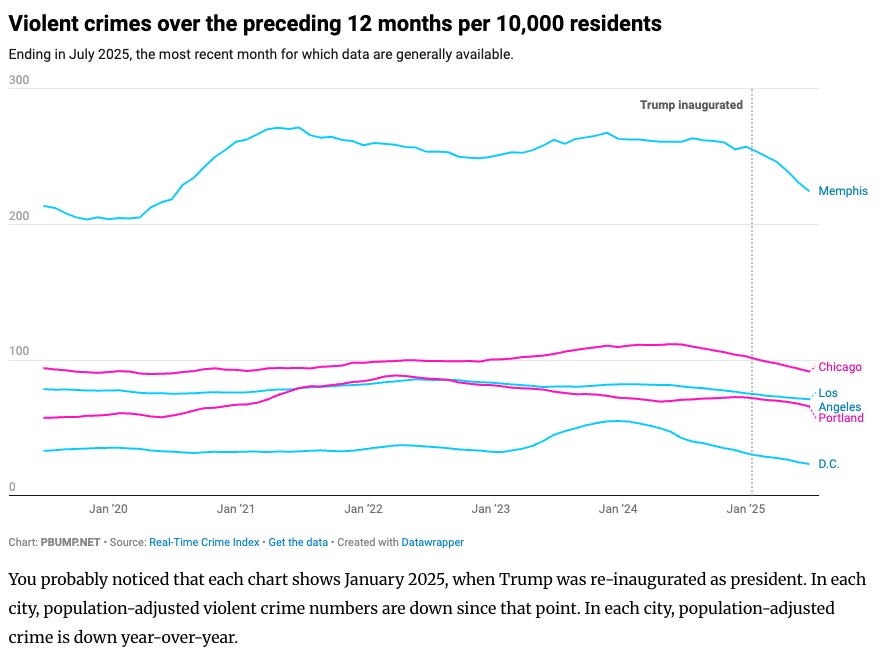
The irony, of course, is that these statistics omit the increase in crime--in the form of repeated and violent abductions of persons off the streets of all of these cities that are being perpetrated by masked, and unidentified persons purporting to by law enforcement agents. The real and growing crime problem in US cities has more to do with the lawless assault, largely on people of color by these masked thugs, than anything that was previously happening in these blue cities.
Jarrett Walker on weather, walkability and elite projection. A common criticism of efforts to promote walking and biking is that not everyone will find it easy or convenient to walk or cycle on every single occasion. It’s too cold, too wet, too hot, too hilly for people to chose active transportation modes. As Jarrett Walker points out, this critique ignores the practical reality that many people do walk and bike despite these obstacles, often because they have no choice.
Deciding transportation policy for the comfort and preferences of those with abundant choices is a kind of “elite projection” that overlooks the need and opportunity to make transportation widely available.
The functionality of a city, and of its transport system, arises from the sum of everyone’s choices about how to travel, not just the preferences of elites. When elites make pronouncements about what “people” will tolerate, while really speaking only of themselves, they mislead us about how cities actually succeed. They also demean the contributions of the vast majority of people who are in fact tolerating extreme weather to do whatever will give their lives meaning and value.
Walker argues that the bias of elite projection, which often plays a decisive role in shaping policy, prioritizes the views of those
...This excerpt is provided for preview purposes. Full article content is available on the original publication.