How Google Manages Trillions of Authorizations with Zanzibar
WorkOS Pipes: Ship Third-Party Integrations Without Rebuilding OAuth (Sponsored)

Connecting user accounts to third-party APIs always comes with the same plumbing: OAuth flows, token storage, refresh logic, and provider-specific quirks.
WorkOS Pipes removes that overhead. Users connect services like GitHub, Slack, Google, Salesforce, and other supported providers through a drop-in widget. Your backend requests a valid access token from the Pipes API when needed, while Pipes handles credential storage and token refresh.
Sometime before 2019, Google built a system that manages permissions for billions of users while maintaining both correctness and speed.
When you share a Google Doc with a colleague or make a YouTube video private, a complex system works behind the scenes to ensure that only the right people can access the content. That system is Zanzibar, Google’s global authorization infrastructure that handles over 10 million permission checks every second across services like Drive, YouTube, Photos, Calendar, and Maps.
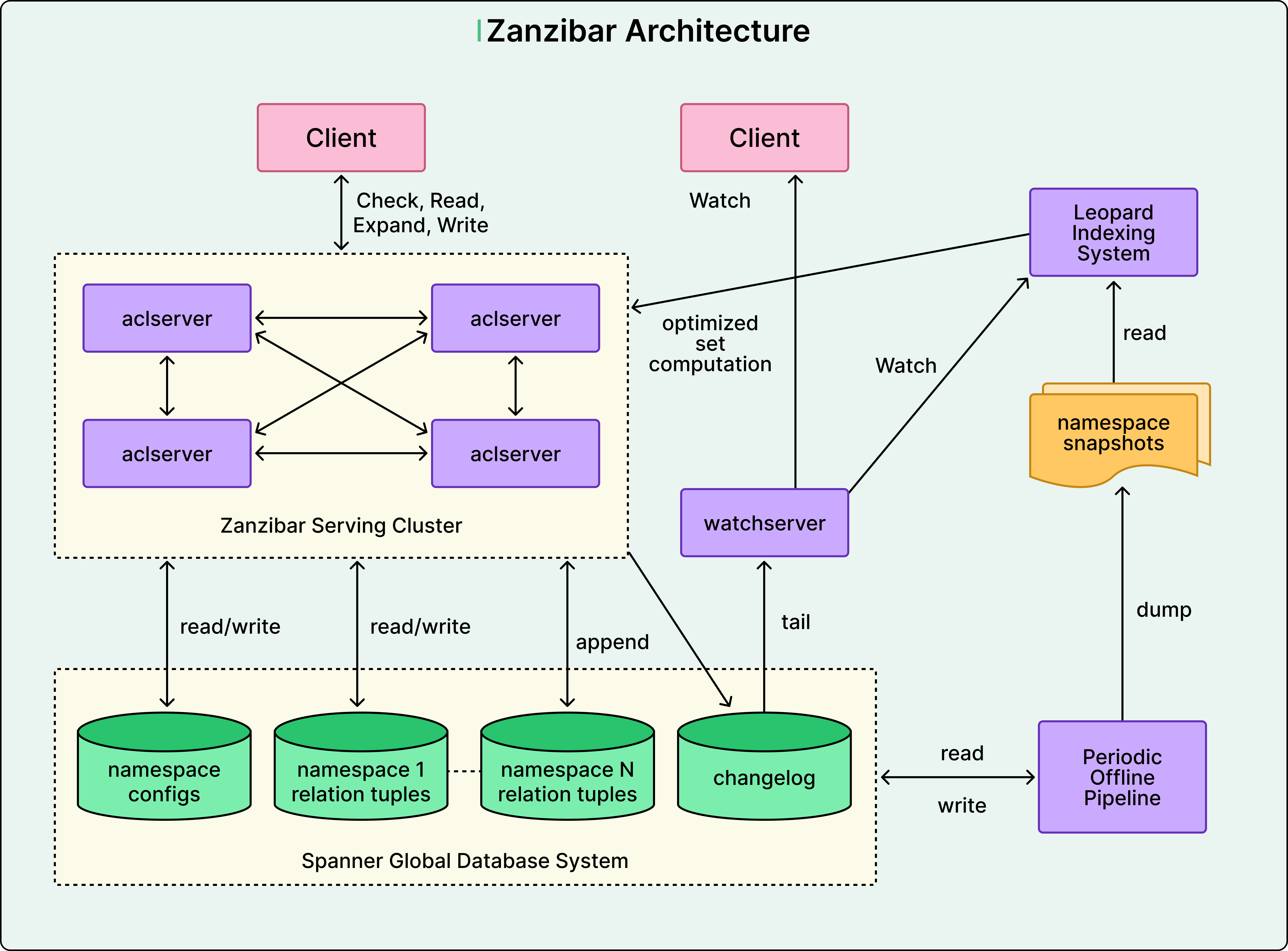
In this article, we will look at the high-level architecture of Zanzibar and understand the valuable lessons it provides for building large-scale systems, particularly around the challenges of distributed authorization.
See the diagram below that shows the high-level architecture of Zanzibar.
Disclaimer: This post is based on publicly shared details from the Google Engineering Team. Please comment if you notice any inaccuracies.
The Core Problem: Authorization at Scale
Authorization answers a simple question: Can this particular user access this particular resource? For a small application with a few users, checking permissions is straightforward. We might store a list of allowed users for each document and check if the requesting user is on that list.
The challenge multiplies at Google’s scale. For reference, Zanzibar stores over two trillion permission records and serves them from dozens of data centers worldwide. A typical user action might trigger tens or hundreds of permission checks. When searching for an artifact in Google Drive, the system must verify your access to every result before displaying it. Any delay in these checks directly impacts user experience.
Beyond scale, authorization systems also face a critical correctness problem that Google calls the “new enemy” problem. Consider the scenario where we remove someone from a document’s access list, then add new content to that document. If the system uses stale permission data, the person who was just removed might still see the new content. This happens when the system doesn’t properly track the order in which you made
...This excerpt is provided for preview purposes. Full article content is available on the original publication.