We Already Have a Social Contract for Universities
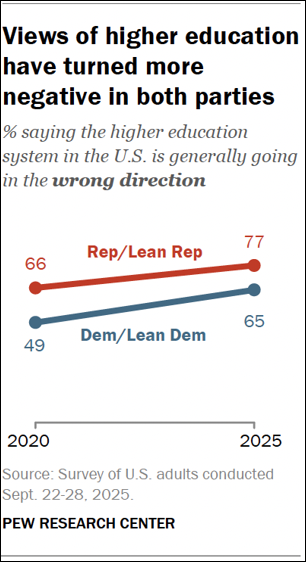
The bad news for U.S. universities keeps on coming. Last week, Pew Research released the results of a September 2025 poll showing that increasingly large majorities of Republicans and Democrats believe that the country’s higher education system is moving in the wrong direction.
In this broader context of public dissatisfaction with universities, the Trump Administration has offered nine universities an opportunity to sign on to a new “Compact for Academic Excellence in Higher Education” — with a deadline of today to agree to its terms, in order to continue to receive federal funding. So far, six of the nine universities have rejected the offer.
As there is plenty of discussion of the proposed Compact, much of it apparently unburdened by knowledge of what it actually says, I have enlisted my trusty research assistant ChatGPT to produce the summary table below, distilling the ten requirements of the Compact.

The Massachusetts Instituteof Technology (MIT) was the first institution to reject the Compact. MIT’s president, Sally Kornbluth, explained the decision in a letter to the Secretary of Education, Linda McMahon, noting that MIT already operates under a mission that shares many values in common with the proposed Compact.
At the same time, she noted that the Compact imposes unacceptable limits on academic freedom:
These values and other MIT practices meet or exceed many standards outlined in the document you sent. We freely choose these values because they’re right, and we live by them because they support our mission – work of immense value to the prosperity, competitiveness, health and security of the United States. And of course, MIT abides by the law.
The document also includes principles with which we disagree, including those that would restrict freedom of expression and our independence as an institution. And fundamentally, the premise of the document is inconsistent with our core belief that scientific funding should be based on scientific merit alone.
In our view, America’s leadership in science and innovation depends on independent thinking and open competition for excellence. In that free marketplace of ideas, the people of MIT gladly compete with the very best, without preferences. Therefore, with respect, we cannot support the proposed approach to addressing the issues facing higher education.
I agree with this stance — the proposed Compact includes some proposals
...This excerpt is provided for preview purposes. Full article content is available on the original publication.