How The New Yorker Became Irrelevant
Deep Dives
Explore related topics with these Wikipedia articles, rewritten for enjoyable reading:
-
Algonquin Round Table
15 min read
Linked in the article (10 min read)
-
Joseph Mitchell (writer)
11 min read
Mitchell is central to the article's thesis about The New Yorker's golden age. His profile writing, particularly on Joe Gould, represents the 'lowlife ascendant' style that the author argues made the magazine great. Readers would benefit from understanding Mitchell's full body of work and his complicated legacy.
-
Hiroshima (book)
14 min read
The article cites Hersey's 1946 piece as a pivotal moment when The New Yorker devoted an entire issue to serious journalism. This groundbreaking work of literary journalism changed how magazines approached serious topics and represents the transformation the author admires.
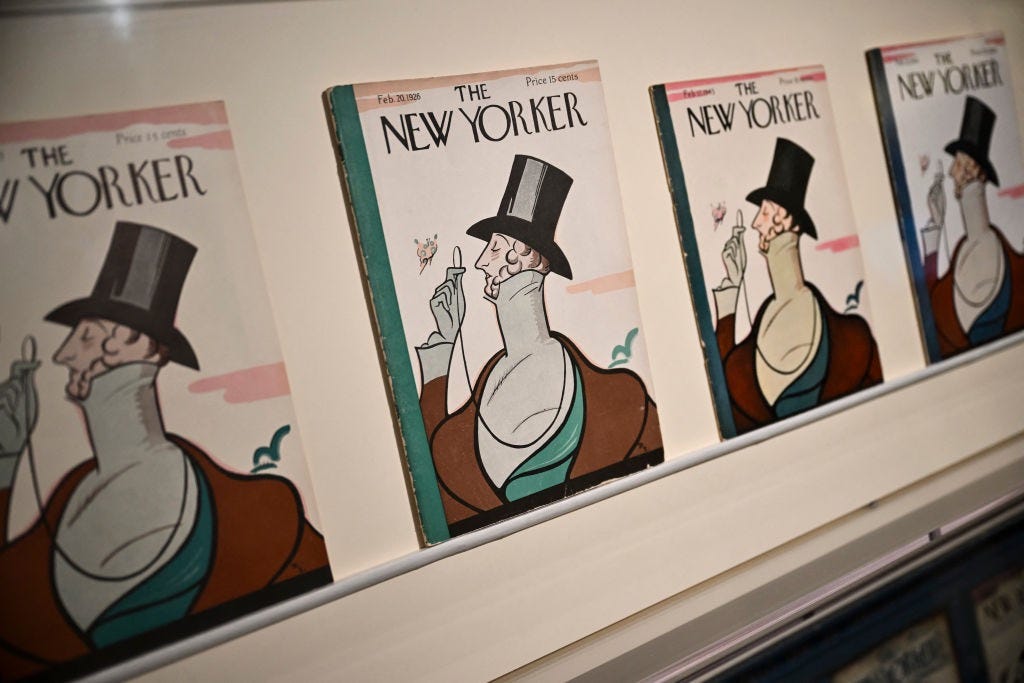
As that bon vivant Eustace Tilley might have put it, The New Yorker was recently spotted in an unlikely locale—on Substack. In a jaunty little note, the storied magazine declared, “Yep, we’re on Substack toö. Your favorite hundred year-old magazine is crashing the party.” And the reaction on the platform was… a bit different from what might have been expected. “Oh FUCK OFF please,” wrote one user in a comment that was liked over 100 times. “Who actually reads and enjoys this?” wrote another. “More and more the NYer feels like an artifact, no longer relevant to our time,” wrote The Literarian Gazette. “They’re not even sure what they do anymore,” wrote the essayist Jacob Savage.
The problem, really, was about register—and seemed to be entirely lost on The New Yorker. It was exactly as if your mother, who had abandoned you as a child to run off with the general manager of a golf club, had now returned to the neighborhood and wanted to be your best friend. The New Yorker—it’s absolutely true—is just about everybody’s favorite hundred-year-old magazine. It has a reputation for combining fun and sophistication that is unparalleled, and the magazine inspires a certain loyalty that is unimaginable in virtually any other publication. Ben Yagoda, in his magisterial history About Town: The New Yorker and the World It Made, opens with the anecdote of a nurse speaking to a dying soldier at the end of World War II and discovering that what he really wanted to talk about, most of all, was The New Yorker. That example, if extreme, is representative. In over seven hundred responses Yagoda received from a survey, the overwhelming sensibility was that The New Yorker was part of the deep structure of everybody’s intellectual life—respondents decorated their houses in New Yorker covers, spent decades trying to win the caption contest, described themselves as being “nourished” by The New Yorker or having their sense of humor “created” by The New Yorker.
And at 100, The New Yorker is barely showing its age. It is venerable, storied, indestructible, but has the same saucy tone of your very brightest child about to put on a living room extravaganza. Which is exactly the problem.
The New Yorker didn’t have quite the effortless path to success that everybody sort of assumes it did. It was founded,
...This excerpt is provided for preview purposes. Full article content is available on the original publication.