The Science of History: An Introduction to Our Cliodynamics Replication Project
History, for most of its existence as a discipline, has resisted the kind of systematic quantification that transformed fields like physics, chemistry, and biology into predictive sciences. Historians have long argued, with considerable justification, that human societies are too complex, too contingent, too shaped by individual decisions and unpredictable events to submit to mathematical analysis. Every empire, every revolution, every social transformation is unique, the argument goes, and any attempt to find patterns across such diverse phenomena risks flattening the rich particularity that makes history worth studying in the first place. This view has dominated the academy for centuries, and it has produced remarkable scholarship that illuminates the past in extraordinary detail. But what if it is wrong, or at least incomplete? What if beneath the surface chaos of historical events there exist deep structural patterns, recurring dynamics that shape how societies rise and fall, how populations grow and contract, how elites emerge and compete, how states strengthen and weaken? This question has motivated a small but growing number of researchers to attempt something that many historians consider impossible: the creation of a genuine science of history, one that can identify these patterns, model their dynamics mathematically, and even make predictions about the future.
We are embarking on a project to explore this possibility by replicating and extending the work of Peter Turchin, a scientist who has spent the past three decades developing exactly such a science. Turchin calls his field cliodynamics, a name derived from Clio, the muse of history in Greek mythology, combined with dynamics, the branch of mathematics that studies how systems change over time. The name itself captures the ambition of the enterprise: to bring the same rigor that has transformed our understanding of physical and biological systems to the study of human societies. This essay serves as an introduction to both Turchin's work and our project. We will explain what cliodynamics is and why it matters, describe the mathematical framework known as Structural-Demographic Theory that lies at its heart, discuss how we plan to replicate and extend this work, and document the unusual process by which this project is being built. That process involves a collaboration between human and artificial intelligence that is itself an experiment in a new way of developing software and conducting research.
To understand cliodynamics, it helps to understand the person who created it. Peter Turchin's path to the science of history was unconventional. He began his career not as a historian but as an ecologist, studying the population dynamics of insects. This might seem an unlikely background for someone who would go on to analyze the rise and fall of empires, but it turns out to be ideally suited. Population ecology is fundamentally about understanding how populations grow, fluctuate, and decline based on environmental conditions and interactions with other species. The mathematical tools developed to model these dynamics, particularly differential equations describing growth rates and feedback loops, are directly applicable to human populations as well. Turchin recognized this connection and began exploring whether the same techniques could illuminate human history.
The transition from ecology to history required a different kind of evidence. Ecologists can run experiments, manipulating populations and observing the results. Historians cannot. They must work with the evidence that survives from the past, evidence that is incomplete, biased, and often contradictory. This constraint has led many to conclude that history simply cannot be scientific in the way that ecology or physics can be. Turchin's response was to turn this limitation into a methodology. Rather than treating historical evidence as a collection of facts to be interpreted, he approached it as data to be analyzed. This meant quantifying variables wherever possible: population sizes, economic indicators, measures of inequality and conflict. It meant looking for patterns across many societies rather than focusing on the unique features of individual cases. And it meant developing theories that could be tested against this data, theories that would make specific predictions that could be confirmed or refuted by evidence.
The idea that history might be subject to scientific analysis is not new. The nineteenth century saw numerous attempts to discover laws of historical development, from Auguste Comte's positivism to Karl Marx's historical materialism to Oswald Spengler's cyclical theory of civilizations. These efforts were ambitious but ultimately premature. They lacked the data, the mathematical tools, and the computational power necessary to test their theories rigorously against the historical record. What has changed in recent decades is the availability of all three. We now have access to vast digital archives of historical information, sophisticated statistical and mathematical techniques for analyzing complex systems, and computers powerful enough to simulate the dynamics of entire societies over centuries. Turchin's contribution has been to bring these resources together in a coherent research program that generates specific, testable predictions about how societies function and change.
Turchin's academic career reflects this interdisciplinary ambition. He holds positions at the University of Connecticut, where he is an emeritus professor spanning the departments of Ecology and Evolutionary Biology, Anthropology, and Mathematics. He is also a project leader at the Complexity Science Hub in Vienna, a research associate at the School of Anthropology at the University of Oxford, and the founding director of the Seshat Global History Databank, a massive collaborative project to compile and organize historical data from societies around the world. This combination of institutional homes speaks to the challenge of pursuing research that does not fit neatly into any existing discipline. Cliodynamics requires expertise in history, mathematics, sociology, economics, and computer science. Few individuals possess all of these skills, and academic structures make it difficult to collaborate across disciplinary boundaries. Turchin has spent decades building the intellectual infrastructure necessary to pursue this kind of research.
His publication record tells the story of a developing research program. His 2003 book Historical Dynamics: Why States Rise and Fall laid out the foundational methodology, introducing the mathematical models that would become central to cliodynamics. His 2006 book War and Peace and War: The Rise and Fall of Empires explored the role of collective solidarity in the formation and dissolution of large political entities. The 2009 book Secular Cycles, co-authored with Sergey Nefedov, presented detailed case studies of boom-bust patterns in pre-industrial societies. His 2016 book Ages of Discord applied these tools to the United States, diagnosing the structural pressures driving contemporary political instability. And his 2023 book End Times: Elites, Counter-Elites, and the Path of Political Disintegration brought these ideas to a broader audience, just as many of his predictions appeared to be coming true.

Before we can understand Turchin's specific theories, we need to grasp the fundamental insight that makes cliodynamics possible: the recognition that societies are systems. This may sound obvious, but its implications are profound. A system, in the technical sense used by scientists, is a collection of interacting components whose behavior cannot be understood by studying the components in isolation. The key word is interacting. In a system, changes in one component affect other components, which in turn affect still other components, creating chains of causation that can loop back on themselves in complex ways. Consider a simple example: a population of rabbits living in a meadow. The number of rabbits at any given time depends on how much food is available, but the amount of food available depends on how many rabbits are eating it. More rabbits means less food per rabbit, which eventually means fewer rabbits, which means more food, which means more rabbits again. This feedback loop creates dynamics that cannot be predicted by studying rabbits or grass separately. You have to model the system as a whole.
This systems perspective represents a profound shift from how history has traditionally been practiced. Conventional historical scholarship tends to focus on narrative: the sequence of events that led from one situation to another, the decisions made by key individuals, the contingencies that shaped outcomes. This approach excels at capturing the texture of historical experience and the agency of historical actors. But it struggles to explain why similar patterns appear across different times and places. Why do empires consistently expand, stabilize, and then decline? Why do revolutions follow certain predictable sequences? Why do economic crises cluster in certain ways? These regularities suggest that beneath the surface variety of historical events, there are structural forces at work that transcend individual decisions and local circumstances. Understanding these forces requires thinking in terms of systems rather than narratives.
Human societies are systems of staggering complexity, with far more interacting components than rabbits and grass. Populations grow and decline based on birth rates and death rates, which depend on economic conditions, disease environments, and cultural practices. Economic conditions depend on technology, natural resources, trade relationships, and the distribution of wealth, all of which are themselves influenced by population size and composition. Political structures emerge from competition among individuals and groups seeking power and resources, and those structures in turn shape economic and demographic outcomes. Cultural beliefs and values influence all of these factors while being influenced by them. The web of interactions is so dense that it can seem impossible to trace causes and effects with any precision. This is why many historians have concluded that societies are simply too complex to model mathematically.
Turchin's response to this challenge has been twofold. First, he argues that while societies are indeed complex, they are not infinitely complex. Certain variables matter more than others for understanding large-scale historical dynamics, and by focusing on these key variables, we can build models that capture the essential features of how societies change over time. This is analogous to how physicists model physical systems. A real gas consists of trillions of molecules, each moving and colliding in complex ways. It would be impossible to track every molecule. But for many purposes, we do not need to. The behavior of the gas as a whole can be described by a small number of variables: temperature, pressure, and volume. These aggregate quantities obey simple laws that allow precise predictions, even though the underlying microscopic dynamics are chaotic. Turchin argues that societies may work similarly: the details are messy, but the aggregate dynamics may follow identifiable patterns.
Second, he insists that the only way to know whether a model is correct is to test it against data. Complexity is not an excuse for vagueness. A theory that cannot generate specific predictions that can be compared to historical evidence is not a scientific theory at all. This commitment to empirical testing distinguishes cliodynamics from earlier philosophies of history, which often consisted of grand narratives that were suggestive but unfalsifiable. Spengler's claim that civilizations pass through organic life cycles of birth, growth, and death was evocative but impossible to test. What would count as evidence against it? Turchin's models, by contrast, make precise quantitative predictions: given certain initial conditions and parameter values, the variables should evolve in certain ways over time. If the actual historical trajectory differs significantly from the predicted trajectory, the model is wrong and needs to be revised or abandoned.
The theoretical framework that Turchin has developed to model societal dynamics is called Structural-Demographic Theory, often abbreviated as SDT. The name reflects its focus on the interaction between social structures, particularly the relationships among different classes and groups, and demographic processes, particularly population growth and decline. At its core, SDT identifies a set of key variables that drive societal instability and models how these variables influence one another over time. Understanding SDT requires building up from first principles, starting with the most basic concepts and gradually adding complexity. We begin with population.
Population is the foundation of any society. Without people, there is no society to study. The size of a population at any given time depends on two fundamental rates: the rate at which new people are added through births and immigration, and the rate at which people are removed through deaths and emigration. If the addition rate exceeds the removal rate, the population grows. If the removal rate exceeds the addition rate, the population shrinks. If the two rates are equal, the population remains stable. This accounting principle is trivially true, but its implications become interesting when we ask what determines these rates. Why do populations grow at some times and shrink at others? Why do some societies sustain large populations while others remain small?
The answer, in the most general terms, is that population growth depends on resources. People need food, water, shelter, and other necessities to survive and reproduce. When resources are abundant relative to population, people tend to be healthy, live longer, and have more children. When resources are scarce relative to population, people tend to be less healthy, die younger, and have fewer children. This relationship creates a fundamental tension between population growth and resource availability that ecologists call carrying capacity. Every environment has a maximum population it can sustain given available resources and technology. As a population approaches this limit, per capita resources decline, and population growth slows. If the population overshoots the carrying capacity, resources become so scarce that deaths exceed births, and the population declines until it falls back below the sustainable level.
The concept of carrying capacity is central to understanding population dynamics, but it is often misunderstood. It is not a fixed number etched into the landscape. It depends on technology, social organization, trade relationships, and many other factors that can change over time. The carrying capacity of medieval England was dramatically lower than that of industrial England, not because the land became more fertile but because technology allowed more food to be produced from the same land. Human societies are constantly pushing against and expanding their carrying capacity through innovation and adaptation. But the fundamental logic remains: at any given time, with any given level of technology, there is a maximum population that can be sustained, and approaching that limit creates pressure.
This dynamic of growth, overshoot, and correction is familiar from ecology, where it has been studied extensively in animal populations. But human societies differ from animal populations in crucial ways. Most importantly, humans can change their carrying capacity through technological innovation, social organization, and trade. The agricultural revolution massively increased the number of people the Earth could support by enabling the production of far more food per acre than hunting and gathering allowed. The industrial revolution did the same by harnessing energy sources beyond human and animal muscle. These transformations happened gradually over centuries, but they fundamentally altered the relationship between population and resources. They also created new forms of inequality and new sources of conflict, which brings us to the second key variable in Structural-Demographic Theory: elites.
Every complex society has elites: individuals or groups who occupy positions of power, wealth, and prestige. The precise definition of who counts as an elite varies across societies and historical periods. In feudal Europe, elites were primarily landowners who held political authority over the peasants who worked their land. In ancient Rome, elites included senators and equestrians who controlled political offices and military commands. In modern capitalist societies, elites include not only the wealthy but also those who hold positions of power in corporations, governments, universities, and other institutions. What all elites have in common is that they consume a disproportionate share of society's resources and wield disproportionate influence over its direction. This is not necessarily a criticism. Complex societies require leadership, coordination, and decision-making, and those who perform these functions often receive greater rewards than those who do not. But the existence of elites creates dynamics that can destabilize societies in ways that pure population models cannot capture.
It is important to distinguish elites from the merely wealthy. While wealth and elite status often coincide, they are not the same thing. An elite, in the sense used by Structural-Demographic Theory, is someone who seeks and expects a position of power or high status, regardless of their current wealth. A recent law school graduate with student debt but expectations of a partnership track is, in this sense, an aspiring elite. A successful plumber who earns a comfortable income but has no interest in political power or social prestige is not. This distinction matters because it is the expectations, as much as the reality, that drive political behavior. Someone who believes they deserve a position of influence but cannot attain one is a potential source of instability in a way that someone who has never sought such a position is not.
The key insight of Structural-Demographic Theory regarding elites is that elite numbers, like general population, can grow beyond what the society can sustainably support. Turchin calls this phenomenon elite overproduction. Just as there is a carrying capacity for the general population based on available resources, there is a carrying capacity for elites based on the number of positions of power and prestige that the society can offer. When elite numbers are below this carrying capacity, elites can generally find satisfactory positions, and competition among them is manageable. But when elite numbers exceed the carrying capacity, a growing number of aspirants find themselves unable to attain the positions they believe they deserve. This creates what Turchin calls elite frustration, and frustrated elites are dangerous.
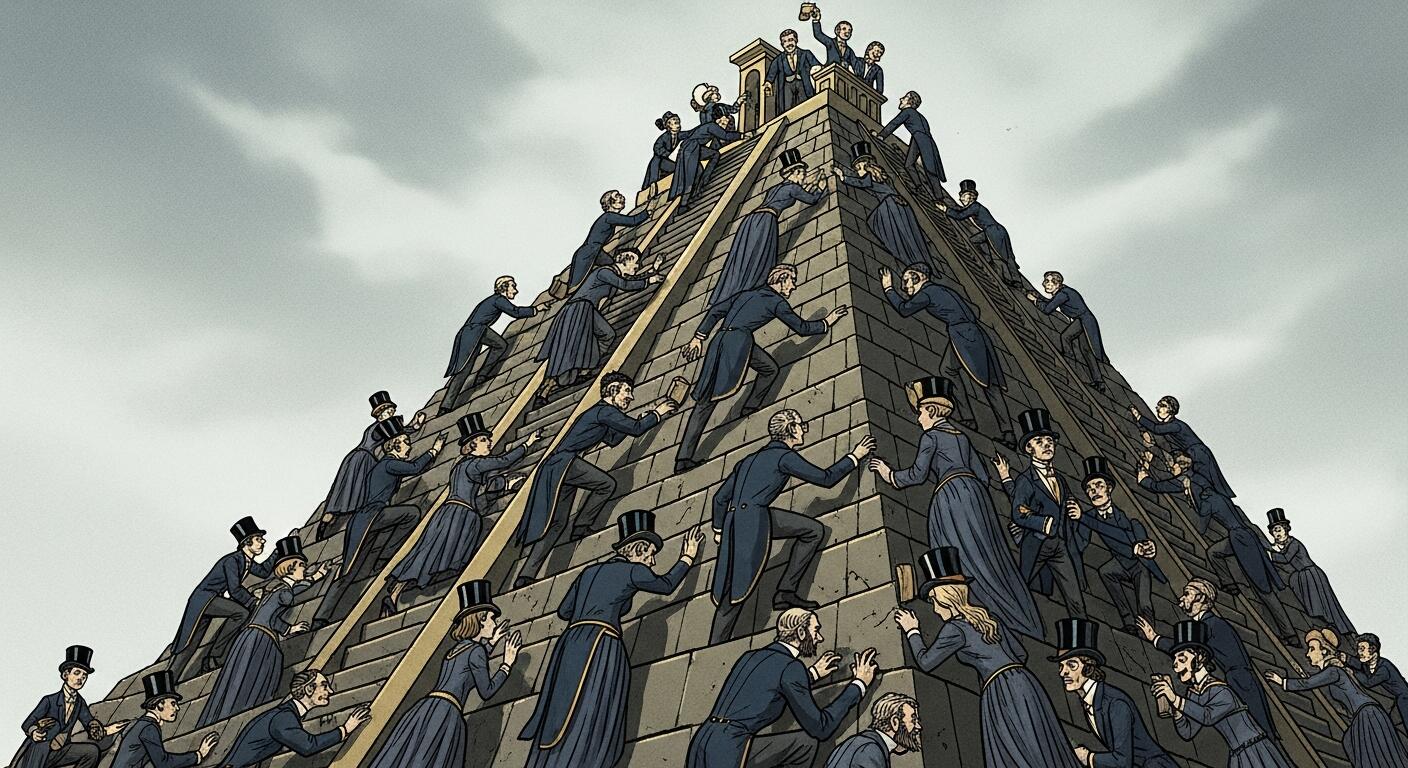
The contrast between elite overproduction and elite scarcity helps clarify the concept. In a society with elite scarcity, there are more positions of power than people to fill them. Such societies actively recruit ambitious individuals from lower strata, offering rapid advancement to those with talent and drive. Competition among elites is muted because opportunities are plentiful. The ruling class tends to be cohesive and united in defense of the existing order because that order serves their interests well. In a society with elite overproduction, the opposite conditions prevail. There are more ambitious individuals than positions to accommodate them. Competition is fierce and often vicious. Factions form and vie for advantage. Those who cannot find positions within the establishment become critics of it, seeking to change the rules to their benefit or to overthrow the system entirely.
History provides numerous examples of what happens when elite overproduction reaches critical levels. Frustrated elites do not simply accept their diminished status. They seek alternative paths to power, often by challenging the existing political order. They may become revolutionaries, seeking to overthrow the current system entirely. They may become demagogues, mobilizing popular discontent to support their own rise to power. They may form factions and engage in vicious infighting that tears the political fabric of society apart. The late Roman Republic offers a classic case study. As wealth concentrated in fewer hands, a growing number of ambitious men from established families found themselves shut out of traditional paths to power. These frustrated elites turned to populist politics, military adventurism, and ultimately civil war. Figures like Marius, Sulla, Pompey, and Caesar were products of this elite overproduction, channeling their ambition into increasingly destructive competition. The result was the destruction of the Republic and its replacement by an autocratic Empire.
Elite overproduction connects to the third key variable in Structural-Demographic Theory: popular well-being, which Turchin often measures through real wages. As population grows relative to resources, competition for jobs increases, and employers can pay less for labor. Real wages decline, making life harder for ordinary workers. This dynamic, which Turchin calls popular immiseration, has two important effects. First, it creates a pool of desperate people who may be willing to support radical political movements that promise to improve their situation. Second, it generates upward pressure on elite numbers as ambitious individuals from the lower classes seek to climb into the elite, adding to the competitive pressure within that stratum. The combination of frustrated elites seeking popular support and immiserated masses seeking leadership creates conditions ripe for political instability.
The distinction between popular immiseration and poverty is worth noting. Poverty refers to an absolute condition: lacking the resources necessary for a decent life. Immiseration refers to a relative condition: deteriorating circumstances compared to what one experienced before or what one expected. A society can have low absolute poverty but high immiseration if living standards are declining from a previous peak. Conversely, a society can have high absolute poverty but low immiseration if conditions are stable or improving from a lower baseline. It is immiseration, the perception of declining fortunes, that generates political discontent. People who have always been poor may accept their condition as natural. People who expected to do better than their parents and find themselves falling behind are angry and seek someone to blame.
The fourth key variable is state fiscal health. Governments require resources to function: to maintain armies, administer territories, provide public goods, and suppress internal conflicts. These resources come primarily from taxation, which depends on the wealth of the population being taxed. When the economy is growing and wages are high, tax revenues tend to be robust, and the state can meet its obligations. But when the economy is stagnating and wages are falling, tax revenues decline even as demands on the state increase. Popular immiseration creates pressures for redistribution and social services. Elite competition creates pressures for government jobs and contracts to placate frustrated aspirants. Military threats, which often increase during periods of internal weakness, create pressures for defense spending. The state finds itself squeezed between declining revenues and rising demands, a condition that Turchin calls state fiscal crisis.
A state in fiscal crisis loses legitimacy as it fails to meet the expectations of both elites and masses. It becomes unable to suppress the conflicts that elite overproduction and popular immiseration have generated, and the society slides toward political breakdown. The state may raise taxes, but this only accelerates economic decline. It may borrow, but debt eventually comes due. It may debase the currency, but inflation erodes purchasing power. It may cut services, but this generates further discontent. Each response creates new problems, and the state finds itself trapped in a downward spiral from which escape becomes increasingly difficult.
These four variables, population, elite numbers, popular well-being, and state fiscal health, do not operate independently. They are connected by feedback loops that create complex dynamics over time. Population growth leads to declining wages, which leads to declining state revenues. Elite overproduction leads to factional conflict, which leads to state dysfunction. State dysfunction leads to inability to maintain order, which leads to economic disruption, which worsens popular immiseration. These connections can be modeled mathematically using a framework called ordinary differential equations, often abbreviated as ODEs. A differential equation describes how the rate of change of a variable depends on the current values of various factors. By specifying how each of the key variables changes based on the others, we can create a mathematical model of the entire system and use computers to simulate its behavior over time.
The mathematical formalism may seem intimidating, but the core idea is intuitive. Imagine that we know the current population of a society, the current number of elites, the current level of real wages, and the current fiscal health of the state. The differential equations tell us how fast each of these variables is changing at this moment. Population might be growing at a certain rate based on current resource availability. Elite numbers might be growing at a different rate based on wealth accumulation and social mobility. Wages might be falling at a rate that depends on the ratio of population to jobs. State finances might be deteriorating at a rate that depends on the gap between revenues and expenditures. If we know all these rates of change, we can calculate where each variable will be a short time later. Then we can repeat the process, using the new values to calculate new rates of change and project further into the future. By iterating this process many times, we can trace the trajectory of the entire system over decades or centuries.
To make this concrete, consider a simplified example of how population dynamics might be modeled. Let N represent the population size and K represent the carrying capacity. A simple logistic growth model describes population change as dN/dt = rN(1 - N/K), where r is the intrinsic growth rate. This equation says that population growth is proportional to the current population (more people means more births) but also depends on how close the population is to the carrying capacity (as N approaches K, the term (1-N/K) approaches zero, and growth slows). This single equation captures the essential dynamic of population growth and its limits. More sophisticated models add additional terms to capture the effects of other variables, such as how wages or state policy might affect birth and death rates.
What makes Structural-Demographic Theory scientifically interesting is not merely that it can describe historical dynamics in mathematical terms. Many models can do that. What matters is that it generates predictions that can be tested against historical evidence. If the theory is correct, societies should exhibit certain characteristic patterns over time. Specifically, they should go through cycles of expansion and contraction that Turchin and his collaborator Sergey Nefedov call secular cycles. The word secular here has nothing to do with religion. It comes from the Latin saeculum, meaning a long period of time, roughly a human lifespan or about a century. A secular cycle typically lasts between one hundred and three hundred years and consists of two phases: an integrative phase when the society is expanding and stable, and a disintegrative phase when the society is contracting and unstable.
During the integrative phase, population is growing but has not yet reached the carrying capacity. Resources are relatively abundant, wages are high, and ordinary people are doing reasonably well. Elite numbers are manageable, and competition among elites is contained within established political channels. The state is fiscally healthy and able to maintain order and provide public goods. Society is not necessarily peaceful or conflict-free, but conflicts are resolvable through existing institutions. This is a period of building: infrastructure is constructed, territories are expanded, art and culture flourish, and the society projects confidence about its future. The integrative phase represents social cohesion, where the various components of society work together reasonably harmoniously toward common goals.
But the integrative phase carries the seeds of its own destruction. The very success of the society creates conditions that will eventually undermine it. Population growth continues until it approaches the carrying capacity, at which point wages begin to decline. Wealth concentrates at the top, creating more aspirants for elite positions and more frustrated elites when those positions are not available. The state faces growing demands from both elites seeking patronage and masses seeking relief, while its tax base erodes along with wages. These pressures accumulate gradually, often invisible to those living through them, until the society tips into the disintegrative phase.
The disintegrative phase is characterized by political instability, social conflict, and often violence. Frustrated elites form factions and compete viciously for power. Immiserated masses provide recruits for revolutionary or reactionary movements. The state, weakened by fiscal crisis, struggles to maintain order. Civil wars, rebellions, and coups become common. Population may decline through violence, famine, or emigration. The society may fragment into competing polities or fall under foreign domination. This phase is painful but not necessarily permanent. Eventually, the conflicts burn themselves out. Population declines reduce pressure on resources. Elite ranks thin through death or departure. A new political order emerges from the chaos. The society enters a new integrative phase, and the cycle begins again.
The transition between phases is not always smooth or predictable. Societies can resist the slide into disintegration through wise policy, fortunate circumstances, or structural reforms that address the underlying pressures. Alternatively, external shocks like invasions, plagues, or natural disasters can accelerate the transition or alter its trajectory. The theory identifies tendencies, not inevitabilities. But the general pattern, integrative phases followed by disintegrative phases driven by the interaction of population, elite, wage, and fiscal dynamics, appears repeatedly across different societies and historical periods.
Turchin and Nefedov documented these patterns in their 2009 book Secular Cycles, which analyzed the historical trajectories of eight societies across different times and places: medieval and early modern England, France, the Roman Empire, and pre-modern Russia and Egypt. In each case, they found evidence of the predicted dynamics: integrative phases of growth and stability followed by disintegrative phases of decline and instability, driven by the interaction of the key variables identified by Structural-Demographic Theory. The patterns were not identical across societies. Local conditions, cultural factors, and contingent events shaped how the cycles unfolded in each case. But the underlying structural dynamics were recognizably similar, suggesting that the theory captures something real about how complex societies function.
The most striking application of Structural-Demographic Theory has been to the contemporary United States. In 2010, the scientific journal Nature invited leading researchers to make predictions about what would happen in the coming decade. Turchin's contribution was stark: he predicted that America would enter a period of high social instability around 2020. This prediction was made before the rise of Donald Trump, before the MAGA movement, before the January 6th insurrection, and before the political polarization that now defines American public life. It was based entirely on the structural indicators that Structural-Demographic Theory identifies as precursors to instability: stagnating wages for ordinary workers since the 1970s, a dramatic increase in inequality, an explosion in the number of people seeking elite positions (measured by indicators like law school graduates and doctoral degrees), and growing state fiscal strain.
The precision of this prediction deserves emphasis. Turchin did not merely say that America might face challenges at some point. He specified a time frame, around 2020, based on the trajectory of structural indicators. He identified specific mechanisms, elite overproduction and popular immiseration, that would drive the instability. And he made these predictions publicly, before the events he predicted occurred, creating a clear test of his theory. The events of the past several years, from the contentious 2016 and 2020 elections to the pandemic-era unrest to the ongoing political polarization, align remarkably well with what the theory predicted. This does not prove the theory is correct, one successful prediction could be coincidence, but it provides significant evidence in its favor.
Turchin expanded this analysis in his 2016 book Ages of Discord: A Structural-Demographic Analysis of American History. He argued that America has gone through two secular cycles since its founding. The first ran from the late eighteenth century through the Civil War, with the antebellum period representing the disintegrative phase. The second began with the post-Civil War era and continued through the twentieth century. The integrative phase lasted roughly from 1865 to 1970, a period of generally rising wages, expanding opportunity, and political stability punctuated by crises that the system was able to absorb. The disintegrative phase began around 1970, as wages stagnated, inequality rose, and elite overproduction accelerated. By Turchin's analysis, the United States entered the crisis zone around 2020, and the turbulent events of recent years are manifestations of the structural pressures his theory predicted.
The concept that most vividly captures the dynamics driving American instability is what Turchin calls the wealth pump. This metaphor describes economic mechanisms that extract wealth from ordinary workers and transfer it to the wealthy. The wealth pump has many components: declining union power, globalization of labor markets, automation, tax policies that favor capital over labor, and the financialization of the economy. These factors interact to create a system in which productivity gains are captured almost entirely by those at the top, while wages for most workers stagnate or decline in real terms. The wealth pump has been operating, in Turchin's phrase, at full blast for two generations, creating a Second Gilded Age comparable to the original Gilded Age of the late nineteenth century.
The analogy to the original Gilded Age is instructive. The period from roughly 1870 to 1900 saw massive industrialization, dramatic increases in productivity, and vast fortunes accumulated by a small number of robber barons. It also saw labor unrest, violent strikes, political corruption, and growing popular discontent. The Progressive Era that followed represented a political response to these pressures, implementing reforms that redistributed some of the gains from economic growth and reduced elite overproduction by creating new positions in an expanding government bureaucracy. The New Deal continued this process, establishing a social contract that balanced the interests of capital and labor and ushered in the integrative phase that lasted until the 1970s. Understanding this history helps contextualize our current moment: we are living through a recurrence of dynamics that America has experienced before.
The political consequences of the wealth pump are profound. As wealth concentrates, more resources become available for aspiring elites, creating more lawyers, more MBAs, more people with the education and ambition to seek positions of power. But the positions themselves do not multiply at the same rate. The result is intense competition among elites for limited slots, and this competition spills over into politics. Wealthy individuals fund candidates and causes, creating a proliferation of political organizations and increasing polarization. Frustrated aspirants who cannot find satisfying positions within the establishment become counter-elites, seeking to overthrow or transform the existing order rather than join it. Both the populist right and the activist left draw energy from this pool of frustrated ambition.

Understanding Turchin's work requires engaging with it seriously, which means not just reading about it but actually working with the data and models he has developed. This is the purpose of our replication project. Replication is a cornerstone of scientific methodology. When a researcher publishes findings, other researchers should be able to reproduce those findings using the same data and methods. This serves as a check on errors and a guard against bias. If a result cannot be replicated, it may indicate a mistake in the original analysis, or it may reveal that the finding depends on assumptions or conditions that were not fully specified. Replication failures have become a major concern in fields like psychology and medicine, leading to what some have called a replication crisis. By attempting to replicate Turchin's work, we contribute to the scientific process of verification and refinement.
But replication also serves a deeper purpose: it forces the replicator to understand the work at a level that reading alone cannot achieve. To replicate a model, you must understand every assumption, every equation, every data processing step. You discover ambiguities in the original work that were invisible on first reading. You encounter difficulties that the original authors may not have fully documented. This process of struggling to reproduce someone else's results is one of the most effective ways to truly learn a scientific methodology. By the end of the replication, you understand not just what the researchers did, but why they did it, what choices they made, and what alternatives they rejected.
Our project aims to replicate and extend Turchin's cliodynamics research using modern software engineering practices and tools. We will download and process data from the Seshat Global History Databank, a comprehensive database of historical information that Turchin helped create. Seshat, named after the ancient Egyptian goddess of knowledge and record-keeping, contains over fifteen hundred variables for each polity (a technical term for any political entity from a city-state to an empire), covering everything from population and territory to government structure, economic activity, military capability, and religious practices. The data spans from the Neolithic Revolution to the Industrial Revolution, with sampling at roughly hundred-year intervals. This is the richest quantitative resource for testing theories of historical dynamics ever assembled, and we will use it to test and calibrate the models of Structural-Demographic Theory.
The Seshat project itself represents a remarkable scholarly achievement. Building such a database required the collaboration of historians, archaeologists, anthropologists, and data scientists from dozens of institutions around the world. Each data point had to be carefully sourced, evaluated, and coded according to consistent standards. Disagreements among experts had to be resolved or documented. Missing data had to be identified and, where possible, imputed. The result, released in stages with the Equinox-2020 and Polaris-2025 datasets, provides an unprecedented foundation for quantitative historical research. Our project will build on this foundation, using the data to test whether the patterns predicted by Structural-Demographic Theory actually appear in the historical record.
The scope of Seshat is worth appreciating in detail. The database covers what its creators call Natural Geographic Areas, regions defined by ecological and geographical features rather than political boundaries. For each area, Seshat tracks the polities that occupied it over time, from small chiefdoms to vast empires. For each polity, it records hundreds of variables organized into thematic categories: social complexity variables that measure things like the number of levels in administrative hierarchies and the presence of writing systems, economic variables that track things like the dominant mode of subsistence and the presence of markets, military variables that record things like army sizes and fortification types, and social variables that capture things like the nature of kinship systems and the presence of slavery. This comprehensive coverage enables comparative analysis across vastly different societies, testing whether patterns that appear in one context also appear in others.
The temporal resolution of Seshat is necessarily limited by the availability of historical evidence. For well-documented societies like Rome or medieval England, data can sometimes be reconstructed at relatively fine time scales. For less documented societies, data may be available only in rough estimates spanning centuries. This unevenness creates challenges for statistical analysis, requiring methods that can handle irregular sampling and varying levels of uncertainty. Our project will need to develop approaches that take these limitations into account, being appropriately cautious about drawing conclusions that the data cannot support while still extracting what information the data does contain.
One distinctive feature of Seshat is its treatment of uncertainty. Rather than recording a single value for each variable, Seshat often records a range of values along with assessments of confidence. This acknowledges the reality that historical knowledge is often imprecise. We may know that a city's population was substantial but cannot pin down whether it was thirty thousand or fifty thousand. We may know that a state had multiple administrative levels but be uncertain whether there were three or four. Traditional databases often force researchers to choose single point estimates, discarding valuable information about uncertainty. Seshat's approach preserves this information, enabling analyses that properly account for what we do not know as well as what we do.
The mathematical models themselves will be implemented in Python, a programming language widely used in scientific computing. We will code the differential equations that define how the key variables interact over time, create numerical solvers to simulate the models over historical periods, develop calibration routines to find parameter values that best fit historical data, and build visualization tools to display the results in ways that illuminate the dynamics at work. The code will be fully documented and made publicly available, so that others can verify our work and build upon it. This commitment to transparency and reproducibility is essential to maintaining the scientific character of the project.
The case studies we plan to tackle are ambitious. We will begin with two of the most thoroughly studied examples in Turchin's work: the Roman Empire and the United States. The Roman case offers a nearly ideal testing ground for Structural-Demographic Theory. The historical record is rich enough to permit quantitative analysis, the time span is long enough to observe multiple secular cycles, and the ultimate outcome is dramatic enough to command attention. The fall of the Roman Empire has fascinated historians for centuries, and dozens of explanations have been proposed: barbarian invasions, moral decay, lead poisoning, climate change, economic collapse, and many others. Structural-Demographic Theory offers an explanation that integrates many of these factors into a coherent framework, showing how they interacted to produce the outcome we observe.
The American case is compelling for different reasons. It is our own society, which gives the analysis an urgency that historical studies of ancient civilizations lack. If Structural-Demographic Theory correctly diagnoses the forces driving American instability, then understanding those forces may help us navigate the turbulent period we are living through. Turchin does not claim that history determines the future with certainty. The theory identifies structural pressures, not iron laws. Societies have choices about how to respond to those pressures, and different choices lead to different outcomes. But making wise choices requires understanding the situation accurately, and that is what the theory aims to provide.
The process by which we are building this project is itself an experiment worth documenting. We are using Claude Code, an artificial intelligence development environment created by Anthropic, to write the software, analyze the data, and produce the essays that will explain our findings. Claude Code is a command-line tool that allows a human operator to collaborate with an AI assistant on complex software projects. The human provides direction and feedback; the AI generates code, runs tests, and proposes solutions. This collaboration is more intimate and productive than traditional software development in ways that are difficult to convey without experiencing it directly.
The experience of working with Claude Code differs fundamentally from traditional programming. In traditional programming, the human writes code, tests it, debugs it, and iterates. The computer executes instructions but does not participate in the creative process. With Claude Code, the collaboration is bidirectional. The human describes what they want to accomplish; the AI proposes implementations, identifies potential problems, and suggests improvements. The human reviews the AI's work, provides feedback, and guides the direction. The result is code that emerges from a dialogue rather than from solitary effort. This process can be remarkably efficient, with complex tasks completed in minutes that would take hours of human-only effort.
The fundamental unit of work in our project is the GitHub issue. GitHub is a platform that hosts software projects and provides tools for managing their development. An issue is a description of a task that needs to be completed: a bug to fix, a feature to implement, or a question to investigate. Each issue has a number, a title, and a description that specifies what needs to be done. Our project is organized as a series of issues, each representing a meaningful chunk of work that advances the project toward its goals. The issue we are addressing in this essay is Issue 12, which called for setting up the GitHub Pages site and writing this introduction.
The worker framework we use to implement issues involves creating a separate workspace, called a worktree, for each task. A worktree is a copy of the project's codebase that can be modified independently without affecting the main version. When a worker begins an issue, it creates a new worktree, makes the changes specified by the issue, commits those changes, and submits them for review. This approach has several advantages. It keeps work on different issues isolated from one another, preventing conflicts and confusion. It creates a clear record of what was done for each issue. And it allows multiple issues to be worked on simultaneously if needed.
The code review process is central to maintaining quality. When a worker completes an issue and submits a pull request, which is a proposal to merge changes into the main codebase, another agent reviews the changes. The reviewer checks that the code is correct, that it follows the project's conventions, that tests pass, and that the implementation matches the requirements specified in the issue. If problems are found, the worker addresses them. Only after the review is complete does the code get merged into the main project. This process, standard in professional software development, serves as a quality gate that catches errors before they become entrenched.
Issue 1, the first substantive issue we completed, established the scaffolding for the project. It created the package structure that organizes our code, defined the dependencies that our software needs to run, set up the testing framework that will verify our implementations, and established conventions for documentation. The specific deliverables were a pyproject.toml file, which is the modern standard for Python project configuration, a src directory containing the cliodynamics package with submodules for data handling, mathematical models, and analysis, and a tests directory containing initial tests that verify the package can be imported correctly. The pull request for Issue 1 was reviewed and merged, establishing the foundation on which all subsequent work will build.
The experience of completing Issue 1 revealed both the power and the limitations of the AI-assisted development approach. The power lies in speed and comprehensiveness. Tasks that would take a human developer hours can be completed in minutes when the AI understands what is needed. The AI can generate boilerplate code, write tests, update documentation, and handle the many small details that consume time in software development. The limitation lies in the need for careful specification. The AI does exactly what it is asked to do, which means that ambiguous or incomplete instructions lead to results that miss the mark. Effective use of Claude Code requires clear thinking about what you want, which is itself a valuable discipline.
The essays we publish on our GitHub Pages site serve two purposes that may seem distinct but are actually deeply connected. First, they explain our findings: what we learned from the data, how the models behave, what patterns emerge, and how our results compare to Turchin's published work. Second, they document our process: how we used Claude Code to build the software, how the worker framework structures our development, how GitHub issues organize our tasks, and how code review maintains quality. These two purposes intertwine because understanding the findings requires understanding how they were produced. Science is not a collection of facts; it is a method for producing reliable knowledge. By documenting our methods in detail, we invite scrutiny and make it possible for others to evaluate, replicate, and extend our work.
The style of these essays follows guidelines we have established to ensure clarity and accessibility. We write from first principles, building understanding layer by layer rather than assuming prior knowledge. We avoid jargon, and when technical terms are necessary, we define them on first use. We spell out acronyms, like Structural-Demographic Theory before abbreviating it as SDT, to help readers who may not be familiar with the terminology. We differentiate similar concepts by explicitly contrasting them with related ideas and with their opposites. For example, when discussing elite overproduction, we contrast it with elite scarcity, distinguish it from general population growth, and differentiate it from wealth concentration, which is related but distinct.
The visual elements of our essays, including the illustrations generated for this introduction, are woven into the surrounding prose rather than standing alone. Before presenting an image, we explain what the reader should look for. After presenting it, we discuss what it reveals and acknowledge its limitations. This approach treats visuals as integral parts of the argument rather than decorative additions. The illustrations in this essay were generated using Google's Gemini image generation system, which creates images from text descriptions. We specified prompts that captured the conceptual content we wanted to convey, then selected and placed the resulting images in positions where they reinforce the text. These images are not photographs of historical events or precise diagrams of mathematical relationships; they are conceptual illustrations designed to evoke the ideas we are discussing and provide visual anchors for complex abstractions.
The commitment to length in these essays, a minimum of twelve thousand words each, reflects our belief that deep understanding requires sustained engagement. Many topics in cliodynamics are complex and require extended development to explain properly. A shorter format would force us to simplify in ways that distort the subject matter or to assume knowledge that readers may not have. We would rather err on the side of thoroughness than leave readers confused or misinformed. At the same time, length must come from depth, not repetition. Each paragraph should advance the argument or add new information. If we find ourselves restating points we have already made, that is a sign that we need to go deeper or move on.
Looking ahead, the issues queued for our project trace a path from the foundations we have established to increasingly sophisticated analyses. The immediate next steps involve downloading and processing data from the Seshat databank. This requires writing code that can fetch the data files from their public repository, parse the various file formats in which the data is stored, handle missing values and inconsistencies that inevitably arise in large historical datasets, and create a clean, queryable interface that the rest of our code can use. Data processing may seem mundane compared to the grand theoretical questions that motivate the project, but it is essential. Models are only as good as the data that feed them, and careful data handling is the foundation of any empirical science.
After data processing comes model implementation. We will code the differential equations of Structural-Demographic Theory, creating numerical routines that can simulate how the key variables evolve over time given different initial conditions and parameter values. These simulations will allow us to explore the behavior of the models: under what conditions do they produce secular cycles? How sensitive are the outcomes to changes in parameters? Do small changes lead to small differences, or are there tipping points where the dynamics shift dramatically? These questions are central to understanding whether the theory captures something real about societal dynamics or is merely a mathematical exercise.
Calibration connects the models to data. A mathematical model contains parameters, numbers that specify the strength of various effects: how strongly does population growth depend on wages? How quickly do elite numbers respond to wealth accumulation? These parameters cannot be deduced from theory alone; they must be estimated from historical data. Calibration is the process of finding parameter values that make the model's predictions match the observed history as closely as possible. This is a challenging statistical problem, particularly when the data is sparse and noisy, as historical data often is. We will develop calibration routines that can handle these challenges and quantify the uncertainty in our parameter estimates.
Visualization brings the results to life. Numbers in a table are hard to interpret; graphs and animations make patterns visible. We will create visualizations that show how the key variables evolve over time, how different historical periods compare, how calibrated model outputs match or diverge from observed data, and how phase space trajectories reveal the underlying dynamics. Some of these visualizations will be static images suitable for printed pages; others will be interactive or animated, taking advantage of the web medium to convey information that static images cannot. The visualization work is not merely cosmetic. Good visualizations are analytical tools that reveal features of the data that would otherwise remain hidden.
The culmination of these efforts will be a series of case studies applying Structural-Demographic Theory to specific historical societies. The Roman Empire and the United States are our primary targets, but we may extend to other cases depending on data availability and time. Each case study will involve gathering the relevant data, calibrating the model to that data, analyzing the fit and the residuals, and interpreting the results in light of what historians know about the society in question. These case studies will test whether the theory can actually explain historical outcomes, or whether it remains an interesting framework that does not survive contact with evidence.
The forecasting component of our work is the most speculative and the most important. Structural-Demographic Theory is not just a tool for understanding the past; it is a framework for anticipating the future. If the theory is correct, then the structural pressures operating in a society today should give some indication of where that society is headed. Turchin has made such forecasts for the United States, predicting instability around 2020 and suggesting that multiple years of turbulence lie ahead. Our project will develop tools for making and evaluating such forecasts, always with appropriate acknowledgment of uncertainty. Predictions about human societies cannot have the precision of predictions in physics or chemistry. Too many factors influence outcomes, and human choices can alter trajectories in unpredictable ways. But probabilistic forecasts that identify likely tendencies can still be valuable, even if they are not deterministic.
One of the quantitative tools Turchin developed for tracking instability is the Political Stress Index, often abbreviated as PSI. This composite measure combines indicators of popular immiseration, elite overproduction, and state fiscal strain into a single number that can be tracked over time. The PSI is not meant to be a precise predictor of when instability will occur; rather, it indicates the level of pressure building within the system. High PSI values suggest that conditions are ripe for instability, even if the specific triggering event remains unpredictable. The distinction between structural pressure and triggering events is crucial. The assassination of Archduke Franz Ferdinand triggered World War I, but the underlying structural pressures, the alliance systems, the arms race, the nationalist tensions, had been building for decades. Without those pressures, the assassination of one aristocrat would have been a minor incident. Similarly, specific events may spark episodes of instability in America, but the fuel for those fires has been accumulating through decades of stagnating wages, rising inequality, and elite overproduction.
The PSI for the United States shows a characteristic pattern over the past two centuries. It was elevated in the antebellum period, reflecting the sectional tensions that culminated in the Civil War. It then declined through the late nineteenth and twentieth centuries, reaching a low point around 1960, during what many Americans remember as an era of shared prosperity and political consensus. Since then, the PSI has risen steadily, reaching levels comparable to the pre-Civil War period by 2020. This trajectory aligns with the lived experience of increasing political polarization, declining trust in institutions, and episodic political violence that has characterized recent American life. The PSI provides a quantitative framework for understanding these trends, connecting them to the structural forces that Structural-Demographic Theory identifies as drivers of instability.
Critics of cliodynamics raise several objections that deserve serious consideration. One common criticism is that the theory is too deterministic, treating societies as mechanical systems that follow predictable trajectories rather than as collections of individuals making free choices. Turchin responds that the theory is probabilistic, not deterministic. It identifies structural pressures that make certain outcomes more likely, not inevitable. Just as knowing that a bridge is structurally unsound does not tell you exactly when it will collapse, knowing that a society faces elevated instability pressures does not tell you exactly when or how instability will manifest. But in both cases, the information is valuable for decision-making, even if it does not provide certainty.
Another criticism concerns the selection of cases. Critics note that Turchin focuses on societies that experienced the dynamics his theory predicts, raising questions about survivorship bias. What about societies that faced similar structural pressures but did not experience the predicted disintegrative phase? Were there cases where elite overproduction or popular immiseration did not lead to instability? Answering this criticism requires systematic examination of a broader range of cases, including apparent counterexamples. This is one reason why the Seshat database is so valuable: it provides data on many societies, not just those selected to illustrate a particular theory. Our replication project will examine this question by looking for cases that might challenge the theory as well as cases that support it.
A related concern involves the potential for post-hoc fitting. It is easy to explain events after they happen; the test of a theory is whether it can predict events before they occur. Turchin's 2010 prediction of instability around 2020 addresses this concern to some degree, demonstrating that the theory can generate predictions in advance. But a single successful prediction, even a striking one, does not establish that the theory is correct. Multiple predictions across different societies and time periods are needed to build confidence. Our project will contribute to this testing process by generating predictions for the historical cases we study and comparing them to what actually happened, being careful to maintain methodological rigor and avoid unconsciously biasing our analyses toward confirming the theory.
The question of how societies exit periods of instability is as important as understanding how they enter them. Turchin has devoted increasing attention to this question in recent work, recognizing that the path out of crisis is not determined by the same factors that drove the society into crisis. He uses a vivid metaphor: once a society steps on the road to crisis, it resembles a massive ball rolling down a narrow valley with steep slopes, very difficult to stop or deflect. But once the ball arrives at the crisis point, the valley opens up, and there are many paths to exit the crisis, with some leading to disaster and others managing to avoid bloodshed. This metaphor captures an important asymmetry. The structural pressures that create instability are relatively deterministic in their effects, but the resolution of instability involves choices, contingencies, and opportunities for human agency.
Historical examples illustrate the variety of exit paths from periods of instability. Some societies have collapsed entirely, fragmenting into smaller units or being absorbed by neighbors. Others have experienced prolonged periods of civil war, violence, and population decline before eventually stabilizing. Still others have managed relatively peaceful transitions through reforms that addressed the underlying structural pressures, reducing elite numbers, raising wages, or restoring state fiscal health. The United States after the Civil War illustrates a relatively successful exit from crisis, though at enormous cost in lives. The Progressive Era and New Deal represent efforts to address structural pressures before they reached the crisis point. Understanding what makes some exits more successful than others is crucial for thinking about how contemporary societies might navigate their current difficulties.
Turchin has suggested several factors that influence whether a society exits crisis through reform or collapse. The cohesion of elites matters: societies where elites can cooperate to implement reforms are more likely to avoid violent collapse than societies where elite factions are so hostile that compromise is impossible. The availability of external pressure valves also matters: societies that can expand into new territories, access new resources, or export surplus population face less internal pressure than societies that are boxed in. The strength of existing institutions matters: societies with robust legal systems, established norms of peaceful power transfer, and traditions of civic participation have more tools for managing conflict than societies where institutions are weak or illegitimate. None of these factors guarantees a peaceful exit, but they shift the probabilities.
The implications for contemporary America are sobering but not hopeless. The structural pressures identified by the theory are real and will not disappear on their own. But the theory also suggests that deliberate policy interventions could address those pressures: reducing inequality, creating pathways for frustrated aspirants, strengthening state fiscal capacity, and building institutions that can channel conflict into productive rather than destructive directions. Whether such interventions are politically feasible is a separate question from whether they would work. The theory does not tell us how to achieve the political will for reform; it only identifies what kinds of reforms might be effective. This is a limitation, but perhaps an inevitable one. Social science can identify what is needed without being able to guarantee that societies will do what is needed.
Throughout this work, we maintain awareness that we are dealing with difficult subject matter that touches on present-day political conflicts. Discussing the structural causes of American instability inevitably raises questions about who is to blame and what should be done. We do not pretend to neutrality on these questions, but we try to let the analysis speak for itself rather than fitting the evidence to predetermined conclusions. Structural-Demographic Theory does not belong to any political faction. Its implications cut across conventional ideological lines. Understanding why societies become unstable may suggest interventions that neither conservatives nor progressives have embraced, or it may suggest that certain popular proposals would make things worse rather than better. Our job is to follow the evidence and report what we find, not to confirm anyone's preexisting views.
The collaboration between human and artificial intelligence that drives this project raises its own questions. Can an AI system genuinely contribute to scientific research, or is it merely a sophisticated tool that executes human intentions? The answer, we believe, is somewhere between these extremes. Claude Code does not have independent research interests or the intrinsic motivation that drives human scientists. It works on the tasks we assign, in the ways we specify. But within those constraints, it brings capabilities that humans lack: the ability to process vast amounts of text quickly, to generate code without the fatigue that human programmers experience, to maintain consistency across large projects, and to engage in sustained interaction without the limitations of human attention. These capabilities make it a genuine collaborator, not just a tool, even if the nature of the collaboration differs from collaboration between humans.
The use of AI in this project is itself a kind of experiment in scientific methodology. Traditional scientific projects are built by teams of human researchers who bring different expertise, meet to discuss progress, review each other's work, and collectively refine the project over months or years. Our project compresses some of this process by having an AI system that can rapidly generate code, produce documentation, and iterate on designs based on feedback. This allows faster progress on certain tasks but also raises questions about the nature of the research. Is work produced through human-AI collaboration the same as work produced by humans alone? Does the AI's participation change the scientific validity of the results? We believe the answer is no, that the validity of research depends on whether the methods are sound and the evidence supports the conclusions, not on who or what performed the analysis. But this is itself a position that can be debated, and we welcome scrutiny of our methods and conclusions.
This project also reflects a particular vision of how scientific research might be conducted in the future. The traditional model of academic research involves small teams working intensively on narrow problems over extended periods, publishing papers that are read by other specialists, slowly accumulating knowledge through many incremental contributions. This model has been enormously successful, producing most of the scientific knowledge we possess. But it has limitations: it is slow, it favors work that fits into established categories, and it often fails to produce the kind of integrative synthesis that addresses big questions spanning multiple disciplines. Cliodynamics is itself a challenge to this model, attempting to synthesize insights from history, economics, sociology, and mathematics into a coherent framework. Our project extends this challenge by using AI tools to accelerate the synthesis, potentially demonstrating a new way of conducting integrative research.
Whether this new approach will prove valuable remains to be seen. The proof will be in the results: do we produce insights that advance understanding of historical dynamics? Do our replications strengthen or weaken confidence in Structural-Demographic Theory? Do the tools and methods we develop prove useful for others pursuing similar questions? These are empirical questions that can only be answered by doing the work and evaluating the outcomes. We enter this project with optimism tempered by realism. Many ambitious research projects fail to achieve their goals, and we may find that the challenges are greater than we anticipated or that the tools are less powerful than we hoped. But even failure, if honestly documented, contributes to knowledge by clarifying what does not work and suggesting where to look next.
The title of our project, Cliodynamics Replication, may suggest a narrow technical exercise, but the implications are broader. If human societies follow predictable patterns, even imprecisely, then history becomes a different kind of discipline than it has traditionally been. It becomes possible to ask not just what happened and why, but what will happen and why. It becomes possible to intervene in societal dynamics with some understanding of likely consequences, rather than stumbling blindly through political choices that affect millions of lives. This is an ambitious vision, and we approach it with appropriate humility. The history of prediction in social science is not encouraging. Many confident forecasts have proven spectacularly wrong, and the complexity of human societies may ultimately defeat all attempts at systematic understanding. But the potential payoff justifies the effort. Even partial success, even models that are right more often than random guessing, would represent a significant advance in our ability to understand and navigate the world we live in.
Peter Turchin's work stands as a challenge to the intellectual community. He has developed a theory, tested it against historical data, made predictions, and seen some of those predictions come true. The appropriate response is not to dismiss his work as impossible or to accept it uncritically, but to engage with it seriously: to replicate his analyses, to probe his assumptions, to test his models against new data, and to develop alternative theories that might explain the same phenomena. This is how science advances, through a community of researchers building on, challenging, and refining each other's work. Our project is a contribution to that process, small in the grand scheme of cliodynamics but meaningful in its commitment to rigor and transparency.
We invite readers to follow along as this project develops. The essays we publish will document each milestone: the data pipelines we build, the models we implement, the case studies we conduct, and the conclusions we draw. The code we write will be publicly available on GitHub, allowing anyone with programming skills to examine, critique, and extend our work. The issues we create will describe what we plan to do and why, providing a roadmap for where the project is headed. This transparency is not just methodological good practice; it is an invitation to participate in the scientific process, whether by replicating our work, pointing out our errors, or building on our foundation to pursue questions we have not thought to ask.
The science of history remains a controversial proposition. Many historians regard it as a category error, an attempt to impose methods suited to natural phenomena onto human events that are fundamentally different. Turchin and his collaborators have pushed back against this skepticism, arguing that the objections are empirical rather than logical. The question is not whether history can be scientific in principle, but whether scientific approaches to history can actually produce useful knowledge in practice. That is a question that can only be answered by doing the work: formulating theories, testing them against data, making predictions, and evaluating results. Our project is a small contribution to that larger enterprise, a test of whether cliodynamics can deliver on its promise when pursued with the tools and methods of modern computational science.
The road ahead is long, and we make no guarantees about what we will find. Perhaps our replications will confirm Turchin's results and demonstrate the robustness of Structural-Demographic Theory. Perhaps we will uncover problems, inconsistencies, or limitations that require significant revisions to the framework. Perhaps we will discover that the theory works well for some societies and periods but fails for others, suggesting the need for a more nuanced approach. All of these outcomes would be valuable. Science progresses as much through the identification of problems as through the confirmation of theories. Whatever we find, we will report it honestly, with full documentation of our methods and data so that others can evaluate our conclusions for themselves.
This essay has covered substantial ground: the scientific study of history and its challenges, Peter Turchin and his cliodynamics research program, the mathematical framework of Structural-Demographic Theory and its key concepts, the predictions the theory makes about societal instability, the organization and methods of our replication project, the tools we use including Claude Code and GitHub, the completion of our first issue, and the work that lies ahead. These topics are not separate compartments but aspects of a single integrated enterprise. Understanding cliodynamics requires understanding how it was developed and how we are testing it. Understanding our project requires understanding the theoretical framework that motivates it. By weaving these threads together, we hope to convey not just information but a way of thinking about history, science, and the tools we use to pursue them.
The challenges facing human societies in the twenty-first century are immense: climate change, technological disruption, geopolitical competition, demographic transitions, and internal divisions that threaten the stability of established democracies. Navigating these challenges requires the best understanding we can achieve of how societies function and change. Cliodynamics offers one approach to developing that understanding, not the only approach, but one that deserves serious attention. If it succeeds, even partially, in identifying the structural forces that shape societal outcomes, it will have made a contribution of real practical significance. If it fails, the attempt will at least have clarified the limits of our knowledge and pointed the way toward better approaches. Either way, the effort is worthwhile, and we are honored to be part of it.
We conclude this introduction where we began, with the recognition that we are attempting something difficult and uncertain. History has resisted quantification for good reasons, and those reasons have not disappeared. Human societies are complex, contingent, and shaped by factors that may elude systematic analysis. The individual decisions of millions of people, the unpredictable impacts of disease and weather, the accidents of geography and timing, all conspire to make historical outcomes genuinely uncertain in ways that may never be fully captured by any model. This humility is essential to maintaining intellectual honesty. We are not claiming to have found the key to history or to possess a crystal ball that reveals the future. We are claiming only that systematic analysis can illuminate patterns that casual observation misses, and that mathematical models can help us think more clearly about complex systems.
But the potential rewards of success justify the risk of failure. If there are patterns in how societies rise and fall, we should try to find them. If mathematical models can capture even part of the dynamics that drive societal change, we should build those models and test them against evidence. If predictions about the future are possible, even imprecise ones, we should make them and learn from their successes and failures. The alternative, abandoning the attempt to understand societal dynamics scientifically, leaves us with only intuition, ideology, and hope to guide our collective choices, a prospect that seems inadequate to the challenges we face as a civilization. Given the profound stakes involved, surely it is worth trying earnestly to do better. This is the fundamental spirit in which we undertake this project: ambitious but humble, rigorous but open to revision, genuinely committed to following the evidence wherever it leads. We hope you will join us on this fascinating and important journey through the science of history.