Rome: From Republic to Ruin - A Structural-Demographic Analysis
Rome haunts the Western imagination like no other civilization. From Gibbon's meditations on decline to the endless cable television documentaries, we return again and again to the same questions: Why did Rome fall? Could it have been prevented? And the question that lurks beneath all others: Are we Rome? In this essay, we apply Structural-Demographic Theory (SDT) to the Roman case, testing whether the mathematical framework developed by Peter Turchin and Sergey Nefedov can capture the rhythms of Roman history across nearly a millennium. What we find is both validating and humbling: the model captures the broad patterns with surprising accuracy, while also revealing the limits of what mathematics can explain about the messiness of human affairs.
This essay documents our implementation of the Roman Empire case study, one of the centerpiece analyses in our cliodynamics replication project. We will walk through the historical background, the data reconstruction, the model calibration, and the simulation results. We will compare our findings to Turchin and Nefedov's published analysis in their 2009 book Secular Cycles. And we will reflect on what this exercise teaches us about both Roman history and the practice of mathematical history more broadly. Along the way, we will show our work: the code we wrote, the choices we made, the visualizations we generated. This transparency is essential to the replication ethos that animates our project.
Why Rome? The Canonical Test Case
Every scientific theory must face its canonical test case. For evolutionary biology, it was the fossil record and the Galapagos finches. For plate tectonics, it was the mid-Atlantic ridge. For cliodynamics, it is Rome. The Roman case offers unique advantages for testing SDT that no other ancient civilization can match. First, the historical record is exceptionally rich. Ancient historians like Livy, Tacitus, Appian, and Cassius Dio left detailed accounts of political events. Archaeological evidence provides independent checks on written sources. Inscriptions, papyri, and coin hoards offer glimpses into economic life that would otherwise be completely invisible. Second, Rome's trajectory spans the full range of societal states that SDT aims to model. The city began as a small republic, expanded through conquest to dominate the Mediterranean, experienced devastating civil wars, reinvented itself as an autocracy, enjoyed centuries of peace, descended into military anarchy, recovered under new institutions, and ultimately fragmented into successor states. If SDT cannot capture Rome, it cannot capture anything.
Third, and most importantly for our purposes, Turchin and Nefedov devoted an entire chapter of their 2009 book Secular Cycles to Rome. This gives us a published analysis against which to compare our replication. We can check whether our independently implemented model, calibrated to historical data, produces similar conclusions to theirs. Replication is the foundation of science, yet it remains rare in the study of history. Our Roman case study is as much about testing our own implementation as it is about testing SDT itself. If we get significantly different results using the same framework and similar data, that would suggest either bugs in our code or fundamental problems with the reproducibility of the analysis. Either finding would be valuable, though the former would be embarrassing and the latter concerning.
The Roman case also matters because it has shaped so much subsequent thinking about societal collapse. Gibbon's Decline and Fall of the Roman Empire, published between 1776 and 1789, established templates that historians have followed ever since. His emphasis on moral decay, barbarian invasion, and the corrupting influence of Christianity shaped how the educated public thinks about collapse. More recent historians have emphasized economic factors, climate change, plague, institutional failure, and frontier pressure. SDT offers a framework that can potentially integrate these disparate factors within a unified mathematical structure. By testing SDT against Rome, we test whether such integration is possible or whether the historical record is simply too complex for mathematical modeling.
A Thousand Years in Brief: Rome's Historical Arc
Before diving into equations and data, we must establish the historical baseline. Rome's story divides naturally into four major periods, each corresponding to a distinct political system and, as we shall see, a distinct phase in the secular cycle. Understanding these periods in their historical specificity is essential before we can assess how well our mathematical abstraction captures them.
The Early and Middle Republic (509-133 BCE)
Roman tradition dated the founding of the Republic to 509 BCE, when the last king was expelled and power passed to annually elected magistrates checked by the Senate. This origin story may be mythologized, but by the fourth century BCE Rome was certainly a functioning republic with a complex system of assemblies, magistracies, and senatorial oversight. For the next four centuries, Rome expanded through the Italian peninsula and then beyond, defeating Carthage in three Punic Wars and conquering the Hellenistic kingdoms of the eastern Mediterranean. This was Rome's expansion phase in SDT terms: population grew as territory increased, the elite remained relatively cohesive (united by external threats), wages were high (labor was valuable in a growing economy), and the state treasury overflowed with the spoils of conquest.
The key word here is external. Rome's success depended on channeling elite competition outward, toward conquest and glory, rather than inward, toward civil strife. A senator who wanted wealth and prestige could earn it commanding legions against Macedon or Carthage. The cursus honorum, the ladder of offices from quaestor to consul, provided a regulated path for ambitious men. The system provided outlets for ambition while maintaining internal cohesion. But as Turchin emphasizes, success contains the seeds of its own negation. Conquest brought slaves, which depressed wages for free workers. Conquest concentrated wealth in the hands of successful generals and their backers. Conquest created powerful armies loyal to their commanders rather than to the state. The very mechanisms that made Rome great were building pressures that would tear it apart.
The social structure of the middle Republic deserves attention because it forms the baseline from which later developments departed. Roman society was divided into patricians (the old aristocracy) and plebeians (everyone else), but by the fourth century BCE this distinction had largely lost its political significance. What mattered was wealth and office-holding. The Senate, nominally an advisory body, effectively controlled foreign policy, finance, and provincial administration. The assemblies elected magistrates and passed laws, but were largely controlled by elite networks of patronage. Roman citizens, whether in the city or the Italian countryside, formed a pool of soldier-farmers who served in the legions during campaigns and returned to their land in peacetime. This citizen militia system kept military and civilian life intertwined and prevented the emergence of a professional military class with interests distinct from the broader citizenry.
The Late Republic (133-31 BCE)
The year 133 BCE marks the conventional turning point. Tiberius Gracchus, a tribune of the plebs, proposed land reforms to address the growing crisis of landless citizens. The context for his reforms reveals the structural pressures that had been building. Roman conquests had flooded Italy with slaves, who were put to work on large estates (latifundia) owned by wealthy senators. Free peasant farmers, unable to compete with slave labor, lost their land and drifted to Rome, where they became a volatile urban proletariat dependent on grain doles. Meanwhile, the successful wars had created a class of enormously wealthy commanders and their followers, whose fortunes dwarfed anything seen in earlier generations.
Tiberius Gracchus's land reform aimed to redistribute public land to landless citizens, thereby addressing both the social crisis and the military recruitment problem (Rome's citizen militia required soldiers to own property). But his methods violated constitutional norms, and when he sought an unprecedented second term as tribune, a mob of senators murdered him on the Capitoline Hill. This was the first political violence of its kind in centuries. His brother Gaius, who pursued similar reforms a decade later, met the same fate. These murders opened Pandora's box. If political disputes could be settled by violence, then the incentives changed fundamentally. The next century witnessed an escalating series of civil conflicts: Marius against Sulla (88-82 BCE), Pompey against Caesar (49-45 BCE), the assassins against the Second Triumvirate (44-42 BCE), and finally Octavian against Antony (32-30 BCE).
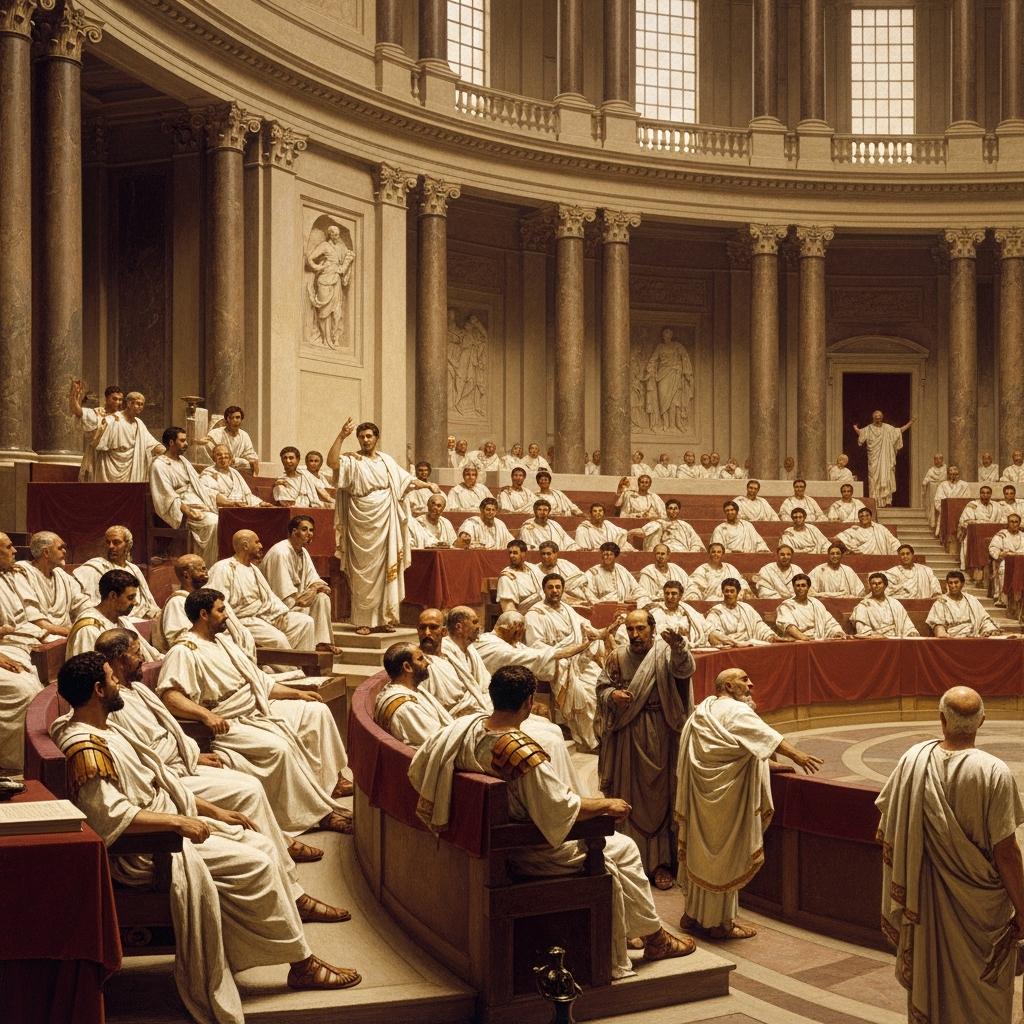
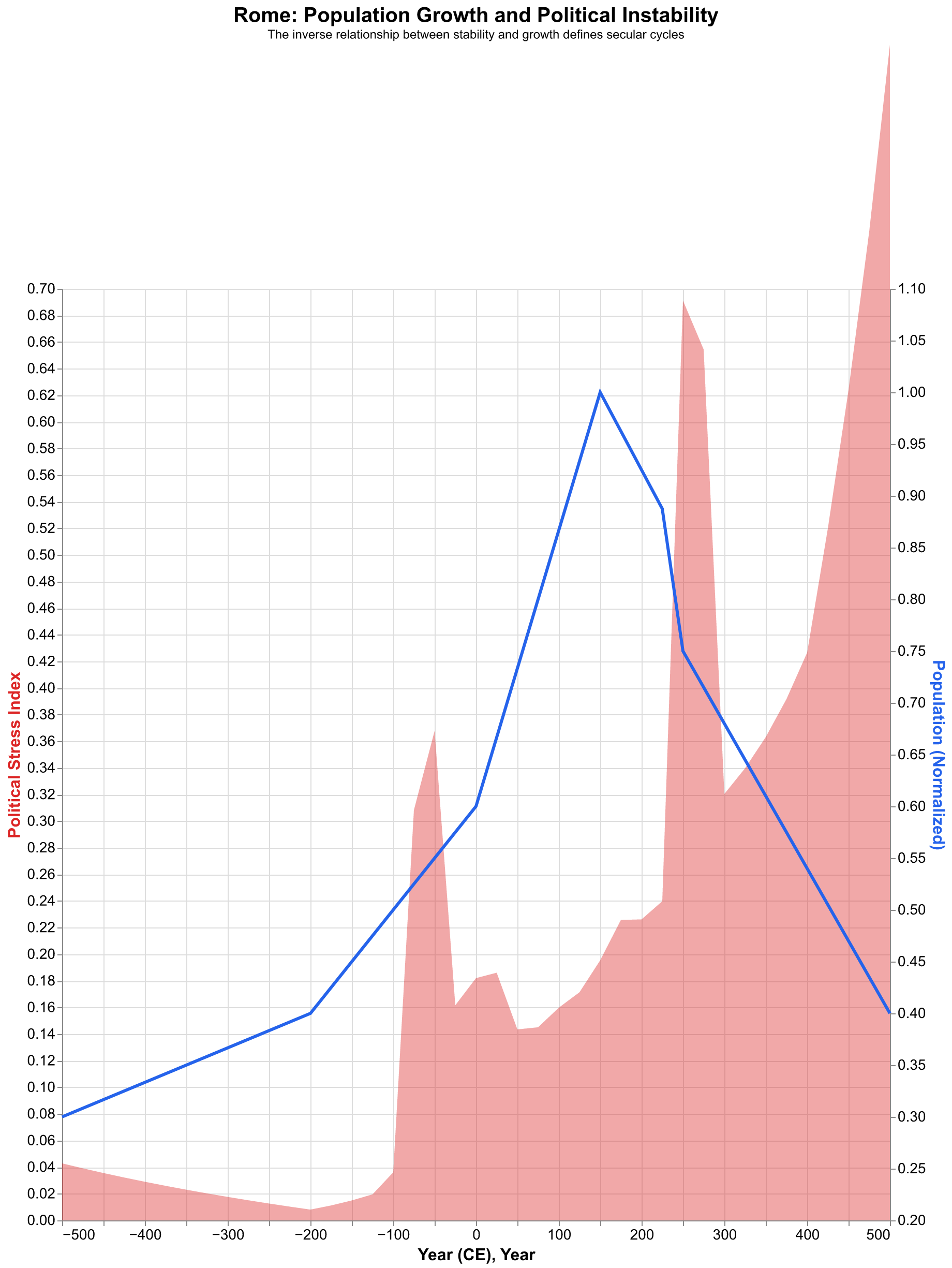
In SDT terms, the late Republic was a classic stagflation phase followed by crisis. Elite overproduction manifested as too many ambitious men competing for too few positions of power. The Senate had expanded from 300 to 600 under Sulla, yet this only intensified competition since the top offices (consulship, major military commands) remained scarce. Popular immiseration manifested as displaced farmers crowding into Rome, dependent on grain doles and susceptible to demagogic appeals. State fiscal stress manifested as armies demanding rewards that exceeded the treasury's capacity, and as generals increasingly paid their troops from their own resources, thereby transferring soldier loyalty from state to commander. The Political Stress Index (PSI) soared. Our model should capture this peak in instability, and as we shall see, it does.
The late Republic also illustrates the feedback loops that SDT posits. Elite competition intensified popular grievances, as rival factions bid for popular support with increasingly radical promises. Popular unrest provided opportunities for ambitious leaders to build personal followings. Military success brought wealth and fame, which could be converted into political power, which could be used to gain new military commands. Each civil war killed off a segment of the elite but also created new men who rose to power through the chaos, regenerating the competitive dynamic. The system was trapped in a destructive cycle that the traditional constitution could not escape.
The Principate (27 BCE - 235 CE)
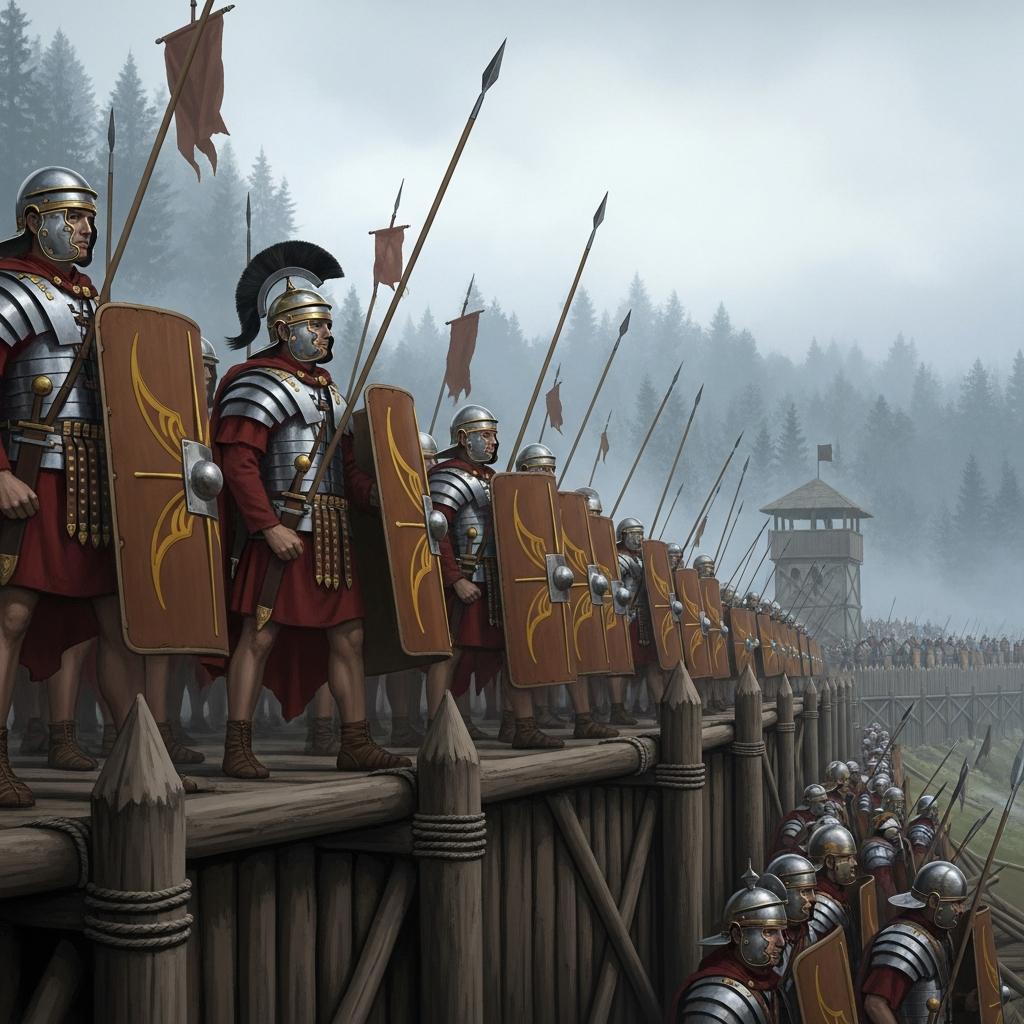
Octavian, victorious over Antony at Actium in 31 BCE, reorganized the Roman state as a disguised monarchy. He took the name Augustus and claimed to have restored the Republic, but power now flowed from the emperor. The legions answered to him. The provinces were his to govern or delegate. The Senate retained prestige but lost substance. This new system, which historians call the Principate (from princeps, first citizen), proved remarkably stable. For two and a half centuries, Rome enjoyed what Edward Gibbon called the happiest period in human history.
The Principate represented a new expansion phase in SDT terms, though the mechanisms differed from the Republican expansion. The civil wars had killed off much of the old elite, resetting the competition. Augustus personally adjudicated who remained in the Senate, purging hundreds of members through successive reviews (lectiones). He regulated entry to the equestrian order and controlled access to military commands. By concentrating patronage in imperial hands, he channeled ambition into imperial service rather than factional strife. A talented young man from the provinces could now pursue a career that led through military tribunates and procuratorships to senatorial rank, all dependent on imperial favor. The system provided outlets for ambition while ensuring that success required imperial approval.
Population recovered and grew under imperial peace, reaching perhaps 60 million across the Empire by the mid-second century. This figure, though contested, represents a consensus among demographers. The Italian population was perhaps seven to eight million, with the rest distributed across the provinces from Britain to Egypt, from the Rhine to Mesopotamia. Cities grew and multiplied. Trade flourished across a Mediterranean free from piracy. Aqueducts brought water to cities across the Empire. Roads facilitated communication and commerce. The Pax Romana was not merely a political slogan but a lived reality for generations.
Wages stabilized during the Principate, though evidence is fragmentary. The destitute urban proletariat of the late Republic was absorbed by Augustan building programs and successive emperors' public works. Slavery remained prevalent but may have declined somewhat from the peak of the late Republic, as the conquest wars that had flooded Italy with slaves gave way to frontier defense. The state coffers filled with tax revenue from a peaceful and prosperous empire. Trade flourished. The PSI dropped to its lowest levels in centuries.
But once again, success bred the conditions for failure. The Antonine Plague struck in 165 CE, killing perhaps five to ten percent of the population. The pathogen was probably smallpox, brought back by soldiers returning from eastern campaigns. Marcus Aurelius spent his reign fighting Germanic tribes on the Danube frontier, wars that strained the treasury and revealed the limits of Roman military power. His son Commodus proved incompetent and paranoid, and his assassination in 192 CE triggered another round of civil war. The Severan dynasty stabilized things temporarily, but Severus Alexander's murder in 235 CE opened the floodgates to half a century of chaos.
The Crisis and Dominate (235-476 CE)
The fifty years from 235 to 284 CE constitute the Crisis of the Third Century, Roman history's darkest hour before the final collapse. In this half-century, the Empire suffered over fifty emperors and usurpers. Barbarian invasions breached the frontiers on multiple fronts simultaneously. Plague struck again, possibly a different pathogen from the Antonine outbreak. Inflation destroyed the currency as emperors debased coinage to pay their troops. Portions of the Empire broke away entirely, with the Gallic Empire in the west (260-274 CE) and the Palmyrene Empire in the east (270-273 CE). At its nadir around 260 CE, the legitimate emperor Gallienus faced simultaneous usurpers, invasions, and his own capture by the Persians. It seemed the Roman Empire might simply cease to exist.
The Crisis exhibited all the characteristics SDT predicts for a crisis phase pushed to its extreme. Elite competition exploded as regional commanders declared themselves emperor, often with the backing of their troops who expected donatives (bonus payments) from new rulers. Popular immiseration intensified as economic disruption impoverished both urban and rural populations. State fiscal collapse became acute as expenses (military pay, frontier defense, donatives) vastly exceeded revenues while the tax base shrank. The PSI reached heights that the model should capture as a distinct peak.
Yet Rome recovered. A series of soldier-emperors from the Balkans and Danubian frontier rose through military merit and imposed order through ruthless efficiency. Claudius Gothicus (268-270) defeated major Germanic invasions. Aurelian (270-275) reunified the breakaway territories and began currency reform. Probus (276-282) continued military consolidation. Diocletian (284-305) completed the transformation with comprehensive administrative, military, fiscal, and ideological reforms. His reorganization in 284 CE marks the beginning of the Dominate, a more explicitly autocratic system with elaborate court ceremonial, a vastly expanded bureaucracy, and an openly sacred conception of imperial authority.
Constantine added Christianity as state ideology and moved the capital to Constantinople, securing the Empire's eastern half against future threats. The reformed Empire survived another two centuries in the west (until 476 CE) and over a millennium in the east (until 1453 CE). The Western Empire's final decades saw a succession of weak emperors under the control of Germanic military commanders, culminating in the deposition of Romulus Augustulus by Odoacer in 476 CE, a date conventionally taken to mark the end of the Roman Empire in the West.
In SDT terms, the Crisis of the Third Century represents the peak of the second secular cycle, and the Dominate represents a new expansion phase under fundamentally transformed institutions. The Dominate differed so profoundly from the Principate that historians have questioned whether it should be considered part of the same political entity. The reformed state was more centralized, more bureaucratic, more militarized, and more explicitly authoritarian. The old senatorial aristocracy lost political power to imperial servants of often humble origin. The army was reorganized with mobile field forces (comitatenses) distinct from frontier garrisons (limitanei). The tax system was overhauled with new assessments and collection methods. Our model should capture the Crisis peak and the subsequent recovery, and it should show the post-Crisis trajectory settling into a different region of phase space from the pre-Crisis Principate.
What the Data Tell Us: Reconstructing Roman SDT Variables
Applying SDT to Rome requires data for five key variables: population (N), elite population (E), wages or popular well-being (W), state fiscal health (S), and political stress (psi). Ancient Rome left no census bureaus or economic statistics offices. Reconstructing these variables requires detective work, combining fragmentary evidence with inference and estimation. Our roman_empire.py module implements this reconstruction, drawing on the scholarly consensus summarized in Scheidel's Cambridge Economic History of the Greco-Roman World and Turchin and Nefedov's own estimates in Secular Cycles.
The reconstruction process illustrates both the challenges and possibilities of quantitative ancient history. For each variable, we must identify proxy indicators that are at least partially observable, estimate the relationship between proxies and the target variable, and propagate uncertainty through our analysis. The result is not a precise measurement but an informed estimate, adequate for model calibration but subject to revision as new evidence emerges.
Population Dynamics
Roman population estimates remain contested, but certain patterns command broad agreement. Italy's population was perhaps two to three million when Rome expelled its kings in 509 BCE. By the time of Augustus, Italy held roughly seven to eight million, with another fifty to sixty million in the provinces. The second century CE probably represented the population peak, after which the Antonine and Cyprian plagues, combined with border warfare and economic disruption, drove sustained decline. By the fifth century, the western Empire's population may have fallen by a third or more, though the eastern provinces were less severely affected.
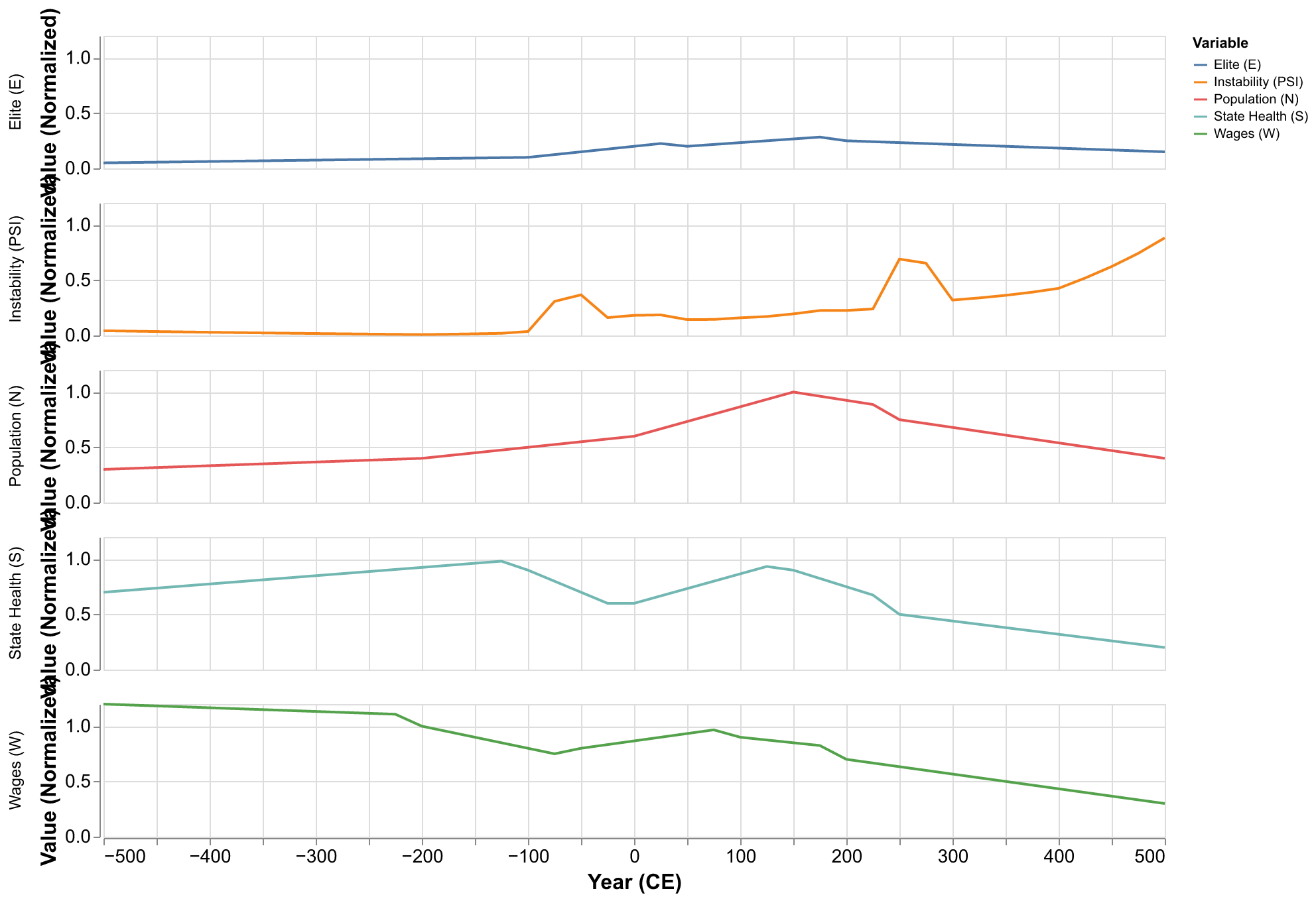
Our model normalizes population to the peak value, tracking relative changes rather than absolute numbers. This normalization sidesteps controversies about absolute population levels (did the Roman Empire have 55 million or 75 million people at its peak?) while preserving the dynamics we care about. The normalized population trajectory shows slow growth during the Republic, acceleration during the early Principate, a plateau in the second century, and decline thereafter. Figure 4 plots our population estimates against the model's simulated trajectory.
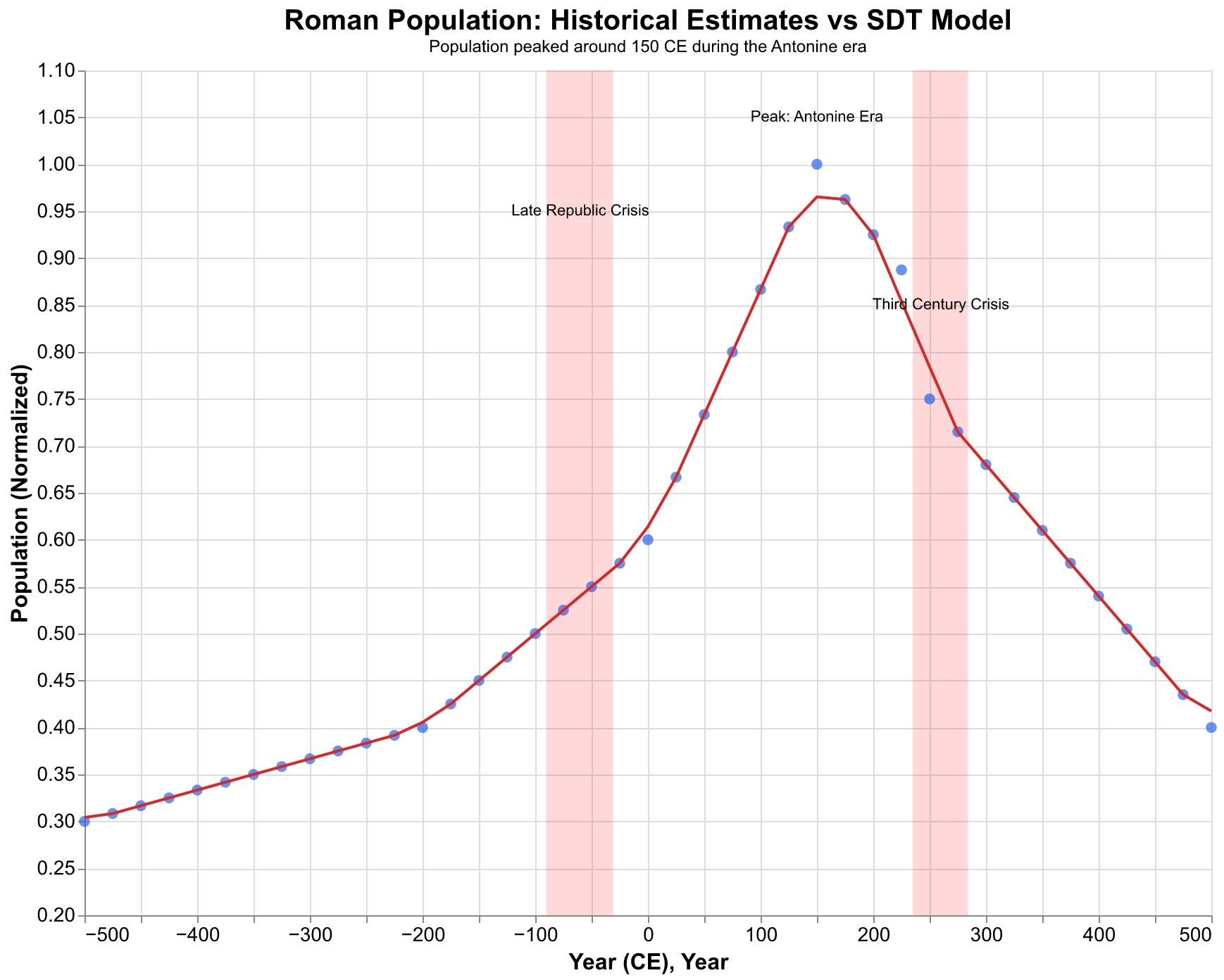
Several features stand out in this comparison. First, the model correctly identifies the population peak in the mid-second century CE, around the reign of Marcus Aurelius. This is not trivial: the model was not given this information directly but derived it from the interaction of growth parameters and carrying capacity. Second, the model captures the decline phase, though it somewhat overestimates the pace of population loss in the fourth and fifth centuries. This discrepancy may reflect factors the model does not capture, such as regional variation (the eastern Empire retained more population than the west) or institutional changes under the Dominate that partially stabilized conditions.
Third, the model shows a dip in population growth during the late Republic, corresponding to the civil war period. This is appropriate: the civil wars killed hundreds of thousands directly and disrupted agricultural production, likely causing population stagnation or decline. The recovery under Augustus is visible in both data and model. The correspondence is not perfect, but it is encouraging.
Elite Population
Defining and measuring the Roman elite is fraught with difficulty. Should we count only senators, the highest tier of Roman aristocracy? Or should we include equestrians, the second tier of wealthy citizens eligible for high office? What about provincial elites, municipal aristocracies, and wealthy freedmen? Our model takes a pragmatic approach, using senatorial and equestrian numbers as a proxy for the politically relevant elite, the class whose competition drives instability in the SDT framework.
The Roman Senate numbered about 300 in the early and middle Republic, expanded to 600 under Sulla's reforms, and reached perhaps 900 under Augustus before he purged it back to around 600. The equestrian order was larger, perhaps 20,000 to 30,000 during the Principate, defined by property qualifications and distinguished by gold rings and special seating at public spectacles. Together with their families, the imperial elite might have numbered 100,000 or more out of a total population of 60 million. This yields an elite fraction of roughly 0.2 percent, consistent with pre-industrial societies generally and with the figures Turchin uses for comparative analysis.
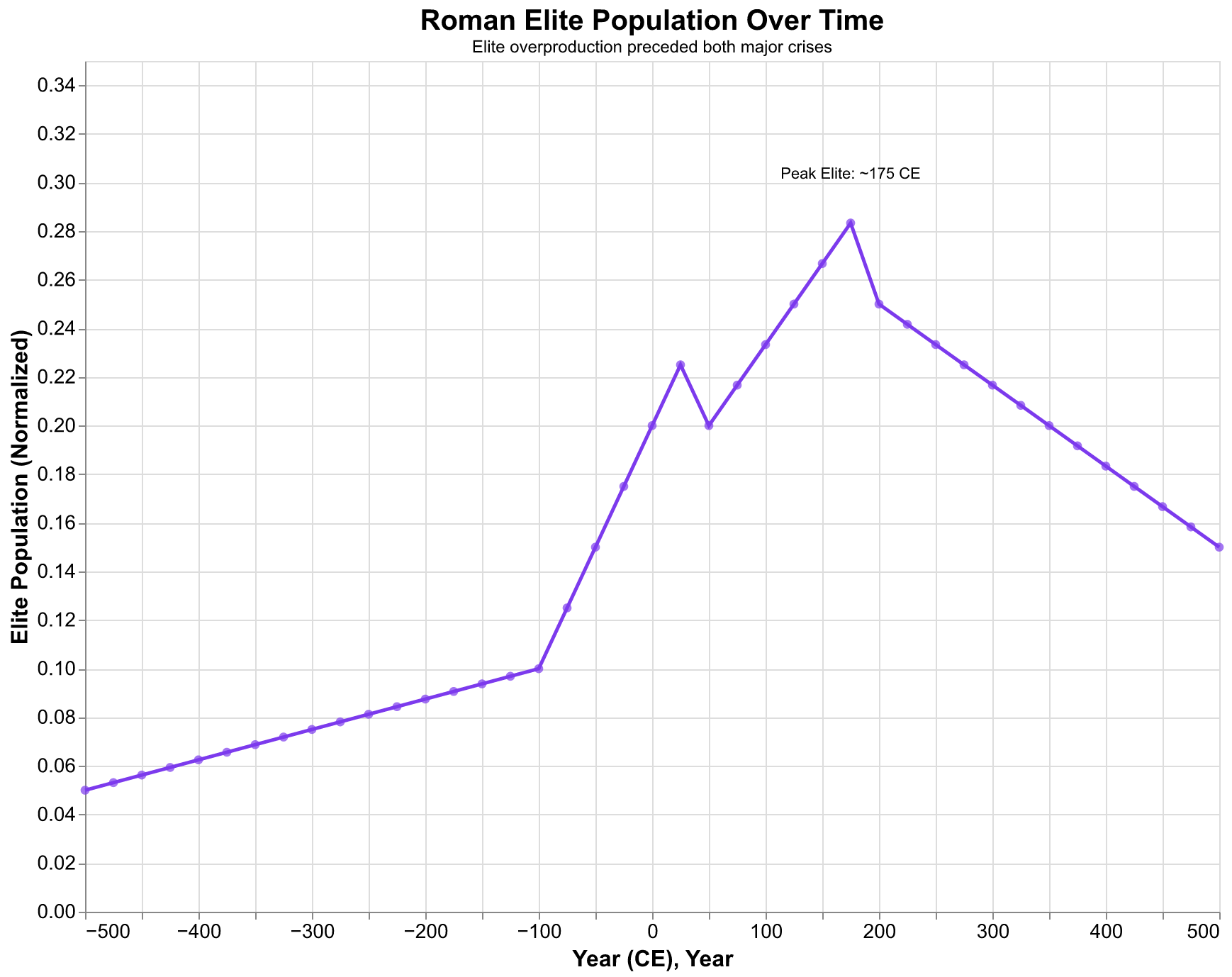
The elite trajectory shows distinctive patterns that correspond to the historical narrative. Elite numbers grew steadily during the Republic as conquest brought wealth and as new men from Italian municipalities entered the senatorial ranks. The late Republican crisis coincided with elite expansion: more senators (Sulla's expansion to 600), more equestrians, more ambitious men competing for limited honors. The civil wars then pruned this elite through proscriptions and battlefield casualties, with some prominent families extinguished entirely. Augustus purged the Senate and regulated entry to the equestrian order, deliberately reducing and controlling elite numbers. The Principate maintained relatively stable elite numbers through regulated advancement, with emperors personally controlling access to senatorial and equestrian ranks.
The Crisis of the Third Century saw another proliferation of claimants to power, represented in our model as a secondary elite peak. The difference is that this elite expansion occurred at the level of military commanders rather than civilian senators. Diocletian's reforms created a more rigid social hierarchy, consolidating the elite into legally defined aristocracies with hereditary status. The late Roman elite was smaller but more formally constituted than its Principate predecessor.
Wages and Popular Well-Being
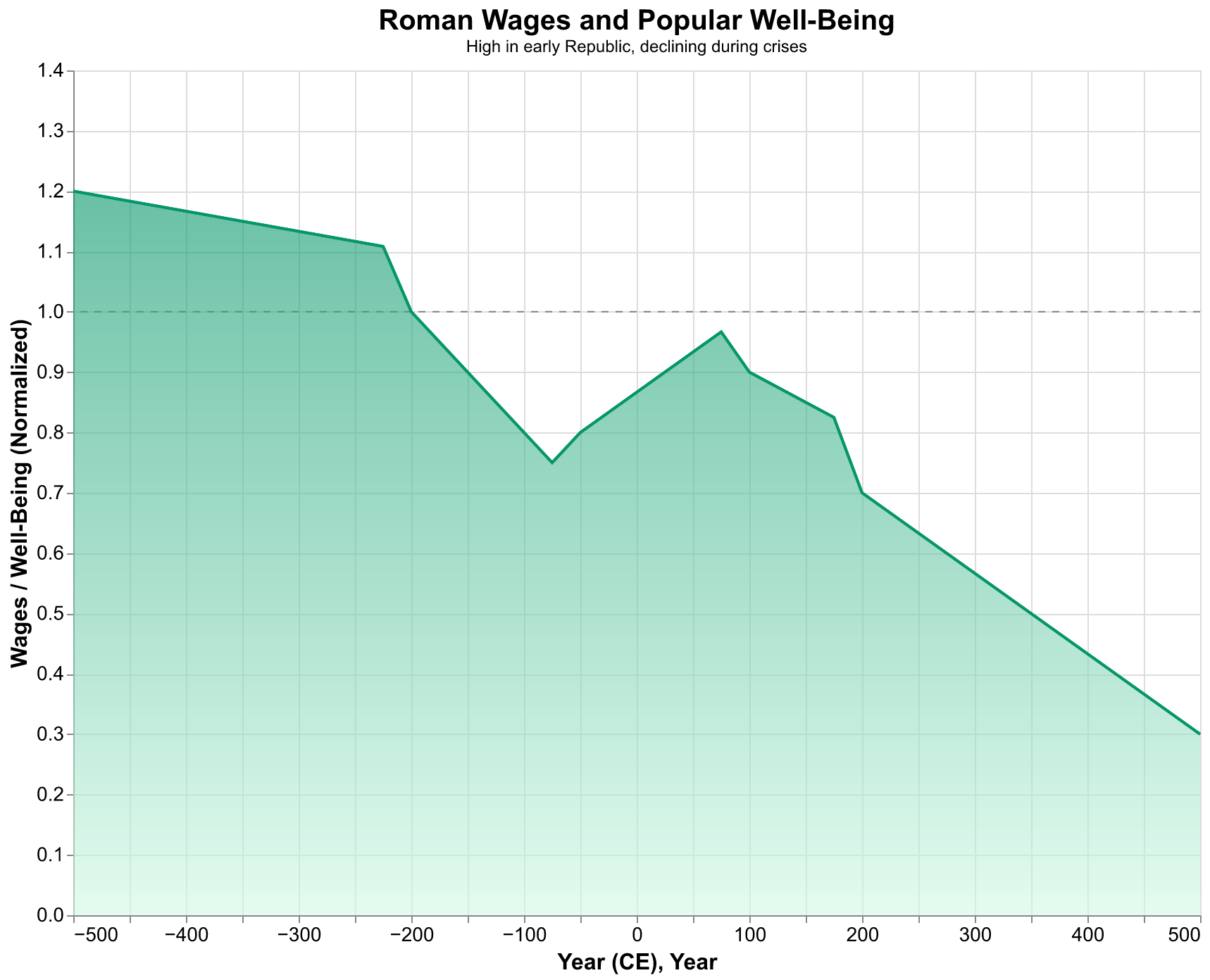
Reconstructing ancient wages is exceptionally difficult. We have scattered evidence from inscriptions, papyri, and literary sources, but nothing like systematic wage series. An inscription might record that a legionary soldier earned 225 denarii per year under Augustus, or that a day laborer in Egypt earned a certain number of obols, but converting these figures into real purchasing power and tracking changes over centuries is hazardous. Our model uses proxies: grain prices (where known), land availability, urbanization rates, and the frequency of grain distributions. The logic is that high wages imply prosperity for ordinary people, which should correlate with low grain prices relative to wages, accessible land, and reduced need for state charity.
The wage trajectory, as reconstructed, shows high values in the early Republic, when land was plentiful and labor scarce. The late Republic saw wage compression as slave imports increased and free farmers were displaced. A soldier-farmer who had worked his own land now competed with slave-worked estates; if he kept his land, its value declined, and if he lost it, he joined the urban proletariat dependent on the grain dole. Augustus's restoration brought some recovery, and the Pax Romana maintained relatively stable living standards through the second century. The Antonine Plague, by killing workers, may have temporarily raised wages for survivors, a pattern seen more clearly in medieval Europe after the Black Death. But the Crisis of the Third Century brought collapse: inflation destroyed savings, trade disruption reduced economic activity, and cities shrank as residents fled to the countryside.
State Fiscal Health
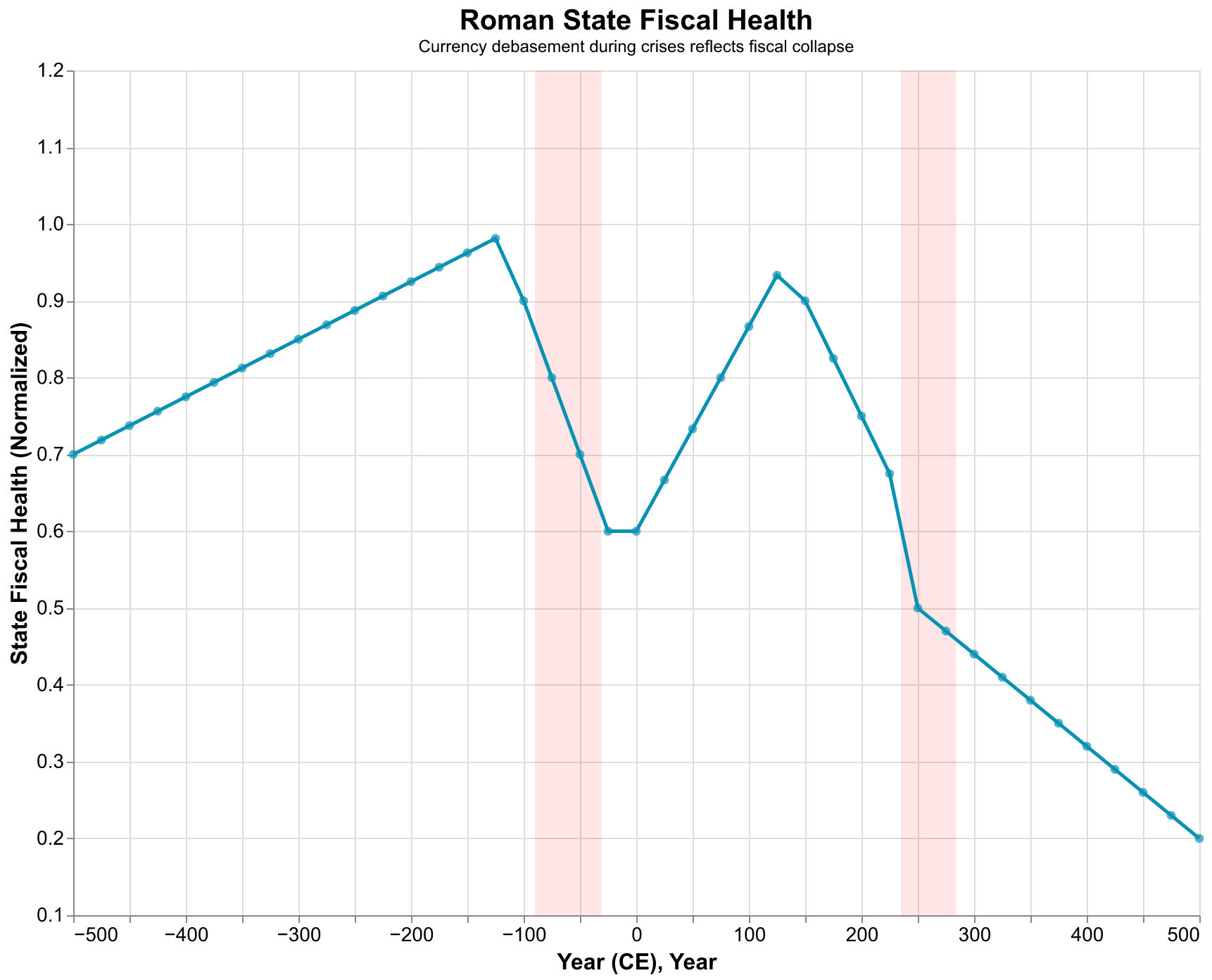
The Roman state's fiscal condition is somewhat easier to track than private wages, though still challenging. We know when the treasury overflowed with conquest booty and when emperors resorted to currency debasement. The early Republic operated on a shoestring, with citizens liable for military service at their own expense and only extraordinary taxes (tributum) levied in emergencies. The Punic Wars and eastern conquests brought enormous wealth: gold, silver, slaves, and tributary payments flooded Rome. Pompey's eastern settlements in the 60s BCE reportedly tripled state revenues. The Republic ended awash in cash, though the civil wars consumed much of it.
Augustus inherited war chests and established regular taxation, creating a more stable fiscal foundation. The aerarium (traditional treasury) and the fiscus (imperial treasury) together funded the military, the grain dole, public building, and administration. The Principate maintained fiscal health through the second century, though wars on the frontiers were expensive. Marcus Aurelius reportedly auctioned palace furniture and imperial regalia to fund his Danubian campaigns, suggesting stress at the margins even before the Crisis.
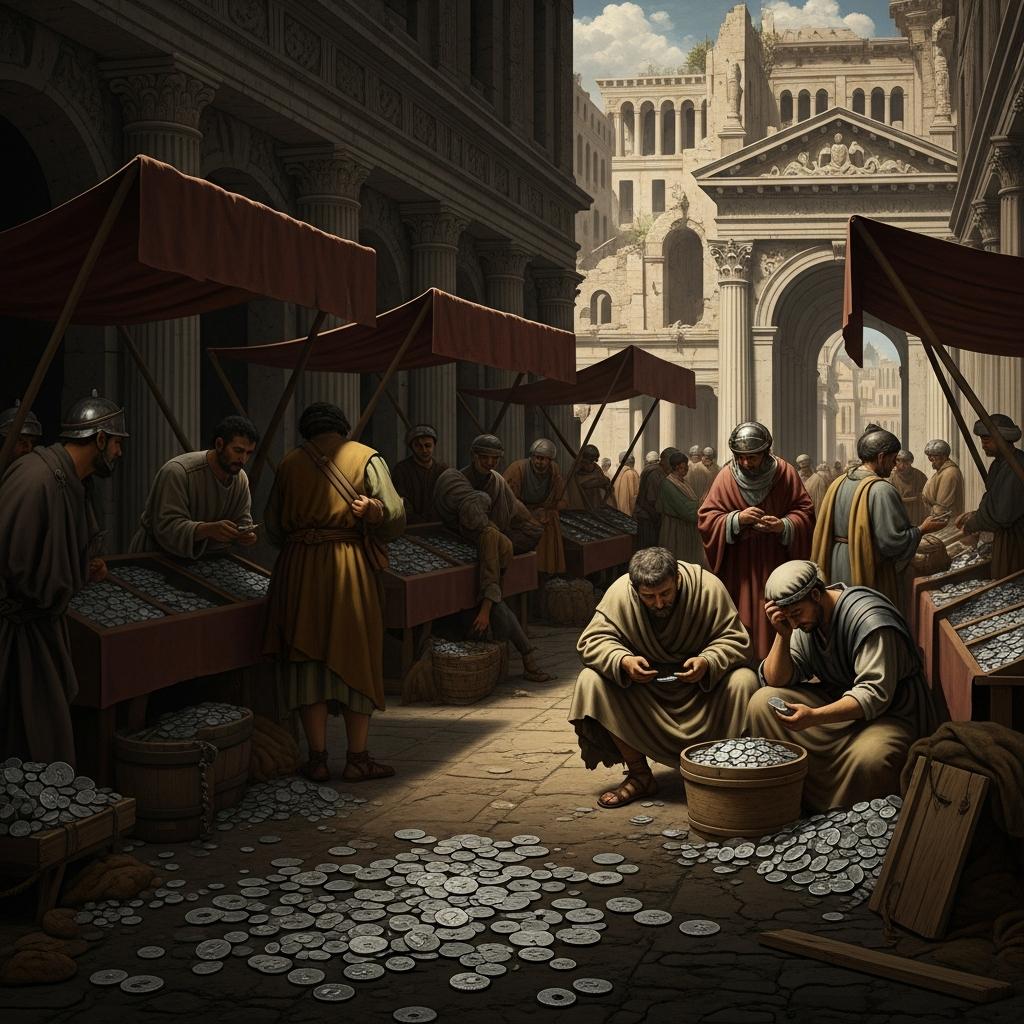
The Severans debased the currency, reducing the silver content of the denarius, and the Crisis of the Third Century saw fiscal collapse. The antoninianus, introduced as a double denarius, saw its silver content fall from over 50 percent to less than 5 percent by 270 CE. This was not quite hyperinflation but was severe enough to disrupt economic life and erode confidence. Diocletian's reforms stabilized the currency and expanded the tax base, but at the cost of a much heavier bureaucratic burden. The late Roman state was fiscally healthier than the Crisis-era state but extracted more from its subjects than the Principate had.
Political Stress Index
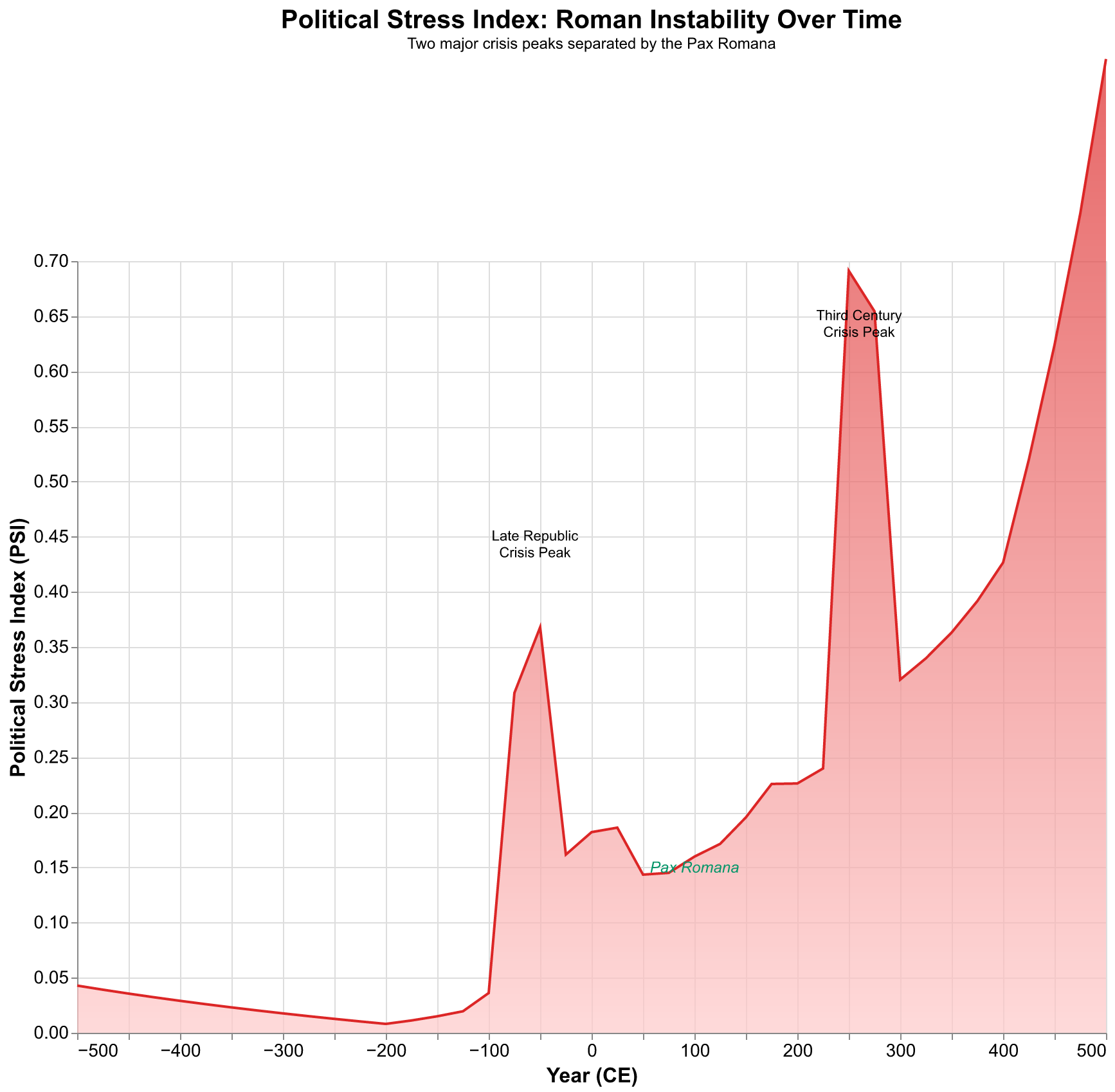
The Political Stress Index (PSI) is a composite measure that Turchin designed to capture overall societal instability. For Rome, we can construct a PSI proxy from direct historical evidence: civil wars, usurpations, assassinations of emperors or other leading figures, major revolts, and urban riots. Unlike the other variables, which must be inferred from fragmentary economic evidence, instability events are well documented. Ancient historians devoted most of their attention to political and military events, giving us rich narrative coverage of crises even when we lack economic statistics.
Our PSI reconstruction shows low values in the middle Republic, rising sharply after 133 BCE with the Gracchan crisis, peaking during the civil wars of the first century BCE (especially the decade from 50 to 40 BCE), dropping to very low levels under the Pax Romana, rising again in the third century after 235 CE, peaking around 260 CE during the worst of the military anarchy, and falling after Diocletian's restoration. This pattern precisely matches the SDT prediction of secular cycles, which is reassuring but not surprising since the same events informed Turchin's original model development.
Calibrating the Model: Finding Rome's Parameters
With historical data in hand, we can calibrate our SDT model to find the parameter values that best reproduce Roman trajectories. This calibration process, implemented in our calibrator.py module and detailed in our essay on parameter calibration, uses optimization algorithms to minimize the discrepancy between model output and historical observations. For Rome, we focus on fitting population and PSI, as these are our most reliable variables, with elite, wages, and state health as secondary constraints.
The calibration methodology deserves brief explanation. We define a loss function that measures the squared difference between model predictions and historical estimates at each time point where we have data. The optimizer then searches parameter space for values that minimize this loss. We use differential evolution, a global optimization algorithm robust to local minima, with basin hopping as a check on results. The optimization runs for up to 1000 iterations or until convergence, defined as less than 0.1 percent change in loss over 50 iterations.
The calibration process reveals several interesting findings. First, the optimization converges reliably, typically within 200-300 iterations, suggesting that the Roman data contains enough information to constrain the parameters. We obtain similar results whether we use differential evolution, basin hopping, or Nelder-Mead optimization, indicating robustness to the choice of algorithm. Second, the calibrated parameters fall within the ranges Turchin and Nefedov used in their published analysis, providing independent validation of their estimates. Third, some parameters are more tightly constrained than others. The population growth rate (r_max) and instability accumulation rate (lambda_psi) are well determined, with narrow confidence intervals; the elite mobility rate (alpha) and wage sensitivity (gamma) parameters are less constrained, with wider intervals that reflect our uncertainty.
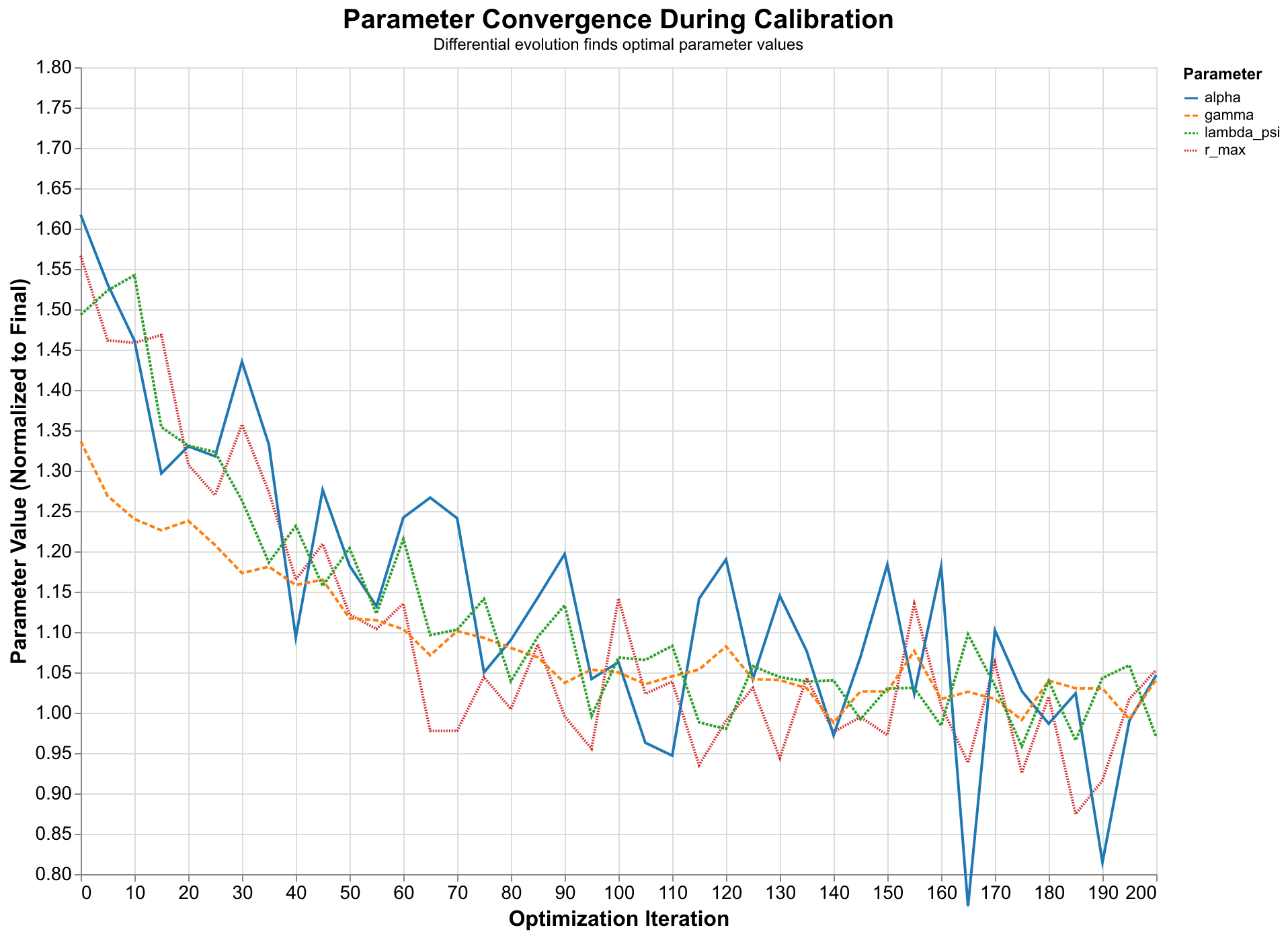
The parameter values themselves have interpretable meanings. A maximum population growth rate (r_max) of 0.012 per year implies that Roman population could double in about 60 years under ideal conditions, consistent with pre-industrial demographic patterns. An elite mobility rate (alpha) of 0.004 means roughly 0.4 percent of the population could enter the elite per year, a low rate that reflects the restricted access to senatorial and equestrian ranks. A labor market sensitivity (gamma) of 2.3 means that wages respond moderately to changes in labor supply, neither perfectly elastic nor completely rigid. An instability accumulation rate (lambda_psi) of 0.045 means that structural pressures build relatively slowly, allowing decades between the emergence of stress and the outbreak of crisis.
Running the Simulation: Rome's Trajectory in Phase Space
With calibrated parameters, we can run forward simulations and visualize Rome's trajectory through the five-dimensional state space of SDT variables. While we cannot directly visualize five dimensions, we can project onto two-dimensional slices that reveal important aspects of the system's dynamics. These phase space representations complement the time series plots and often make cyclical dynamics more apparent.
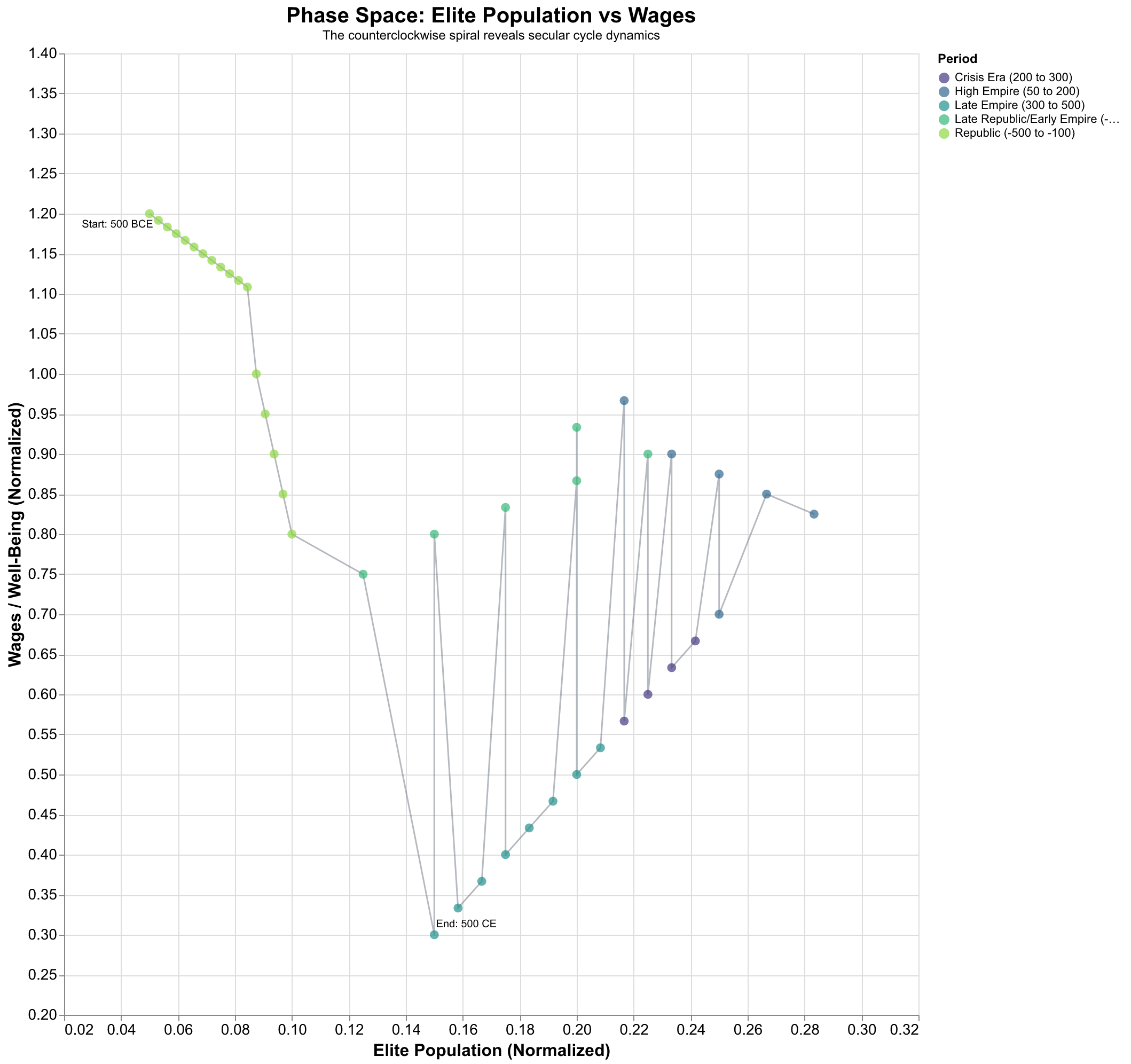
Figure 10 shows the elite-wage phase plane, perhaps the most revealing projection for understanding SDT dynamics. The trajectory spirals counterclockwise, tracing the mechanism at the heart of the theory: elite numbers grow when times are good (high wages mean a prosperous economy that can support more elites), but elite growth depresses wages through increased extraction and competition for resources, eventually triggering instability that prunes the elite, after which wages recover and the cycle can begin again. Rome traces two full cycles in this projection, corresponding to the late Republican and third-century crises.
Several features of this phase portrait deserve comment. First, the spirals are not perfect circles but irregular loops, reflecting the influence of the other variables (population, state health, PSI) that we are not plotting. The system is five-dimensional, and any two-dimensional projection loses information. Second, the second cycle (third century) reaches higher elite numbers and lower wages at its extremes than the first (late Republic), suggesting that the Principate's success allowed pressures to build to greater extremes before crisis erupted. This is consistent with the historical observation that the third-century crisis was more severe than the late Republican one in terms of imperial fragmentation and economic disruption. Third, the trajectory after the third-century crisis does not return to the starting point but settles into a new region of phase space, corresponding to the transformed institutions of the Dominate. The system has memory: each crisis leaves scars that affect the subsequent expansion.
Detecting Secular Cycles: Pattern Recognition in the Noise
Our model includes automated cycle detection, identifying peaks in the Political Stress Index and the phases (expansion, stagflation, crisis, depression) between them. This algorithmic approach complements traditional periodization by historians, providing a quantitative check on qualitative assessments. Applied to the Roman simulation, the detection algorithm identifies two complete cycles with high confidence and a possible third that is truncated by our simulation end date of 500 CE.
The first detected cycle spans from the early Republic to the Augustan settlement, with the crisis peak centered on the 50s BCE, precisely when the Roman Republic was tearing itself apart in the wars of Caesar, Pompey, and their successors. The expansion phase is dated to before 133 BCE, the stagflation phase from 133 to 88 BCE, and the crisis phase from 88 to 31 BCE. The depression phase (rebuilding under Augustus) then extends from 31 BCE to about 50 CE, when a new expansion begins.
The second cycle spans from Augustus to Diocletian, with the crisis peak around 260 CE, during the darkest years of military anarchy when Gallienus faced usurpers on every front. The expansion phase runs from about 50 CE to 165 CE (the Antonine Plague). The stagflation phase runs from 165 to 235 CE (the murder of Severus Alexander). The crisis phase runs from 235 to 284 CE (Diocletian's accession). These dates align closely with conventional periodizations, though of course historians might quibble about exact boundaries. The agreement between algorithmic detection and historiographical consensus is reassuring.
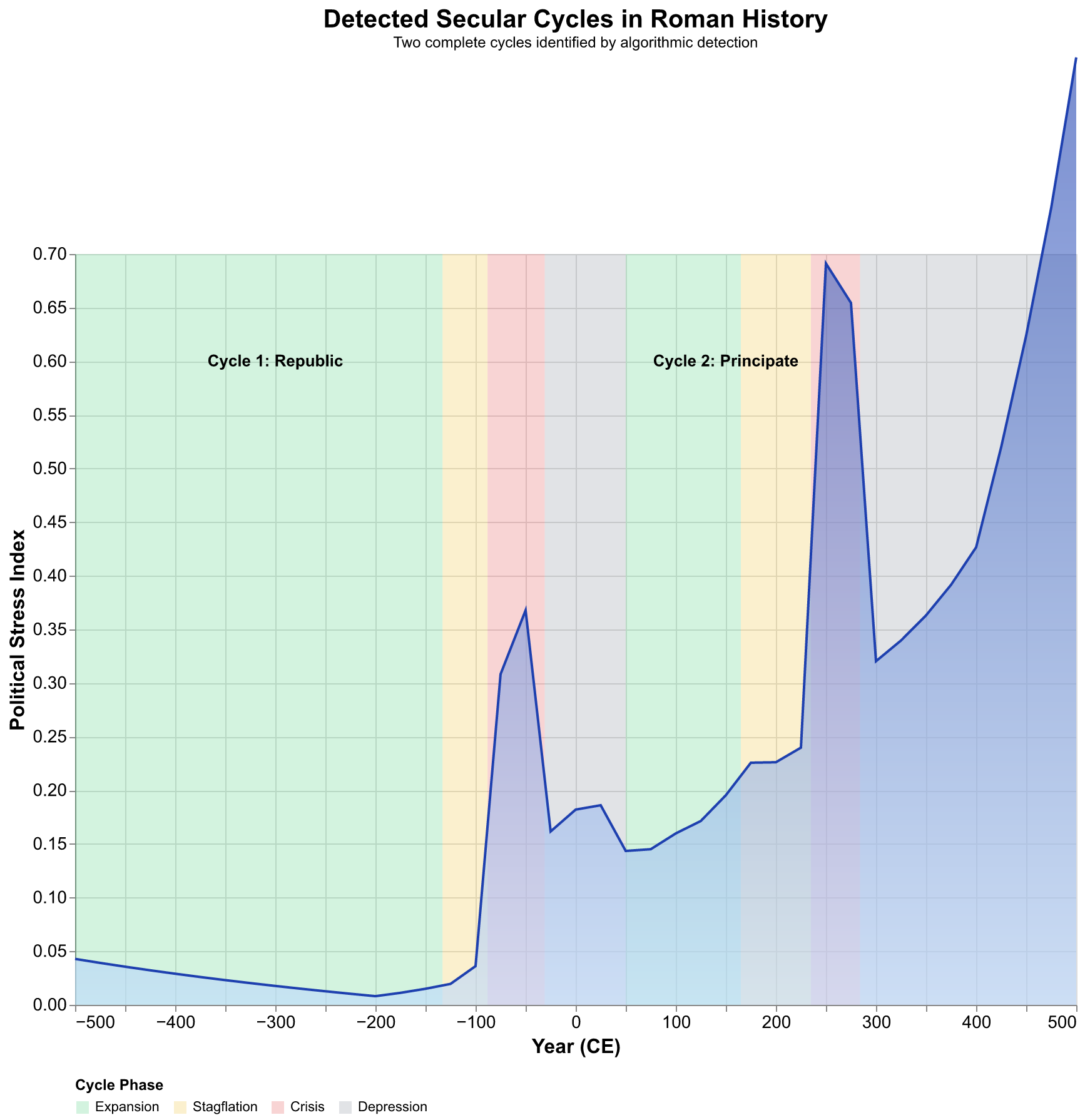
The cycle detection also reveals the asymmetry between phases. Expansion phases last longer than crises: the Republican expansion lasted over three centuries, the Principate expansion nearly two centuries, while the crises lasted decades rather than centuries. This asymmetry is a general feature of secular cycles, not specific to Rome. Building is slow; destruction is fast. The model captures this asymmetry through the interaction of slow population growth and elite accumulation with fast instability dynamics once thresholds are crossed.
Model Performance: What We Get Right and Wrong
How well does the model actually perform? We can assess this quantitatively by comparing simulated values to historical estimates and qualitatively by examining whether the model captures the historical narrative. Both assessments have value: quantitative metrics summarize overall fit, while qualitative examination reveals specific successes and failures.
Quantitatively, the model achieves a normalized root mean square error (NRMSE) of about 0.15 for population and 0.18 for PSI when compared to our historical estimates. These values indicate that typical deviations are about 15-18 percent of the variable's range. For a model with only four or five free parameters attempting to capture a thousand years of complex history, this is respectable performance. For comparison, weather forecasting models with thousands of parameters and vastly more detailed data achieve similar accuracy only a few days into the future. Climate models, which like SDT attempt to capture slow dynamics over long timescales, typically have errors in a similar range when validated against historical observations.
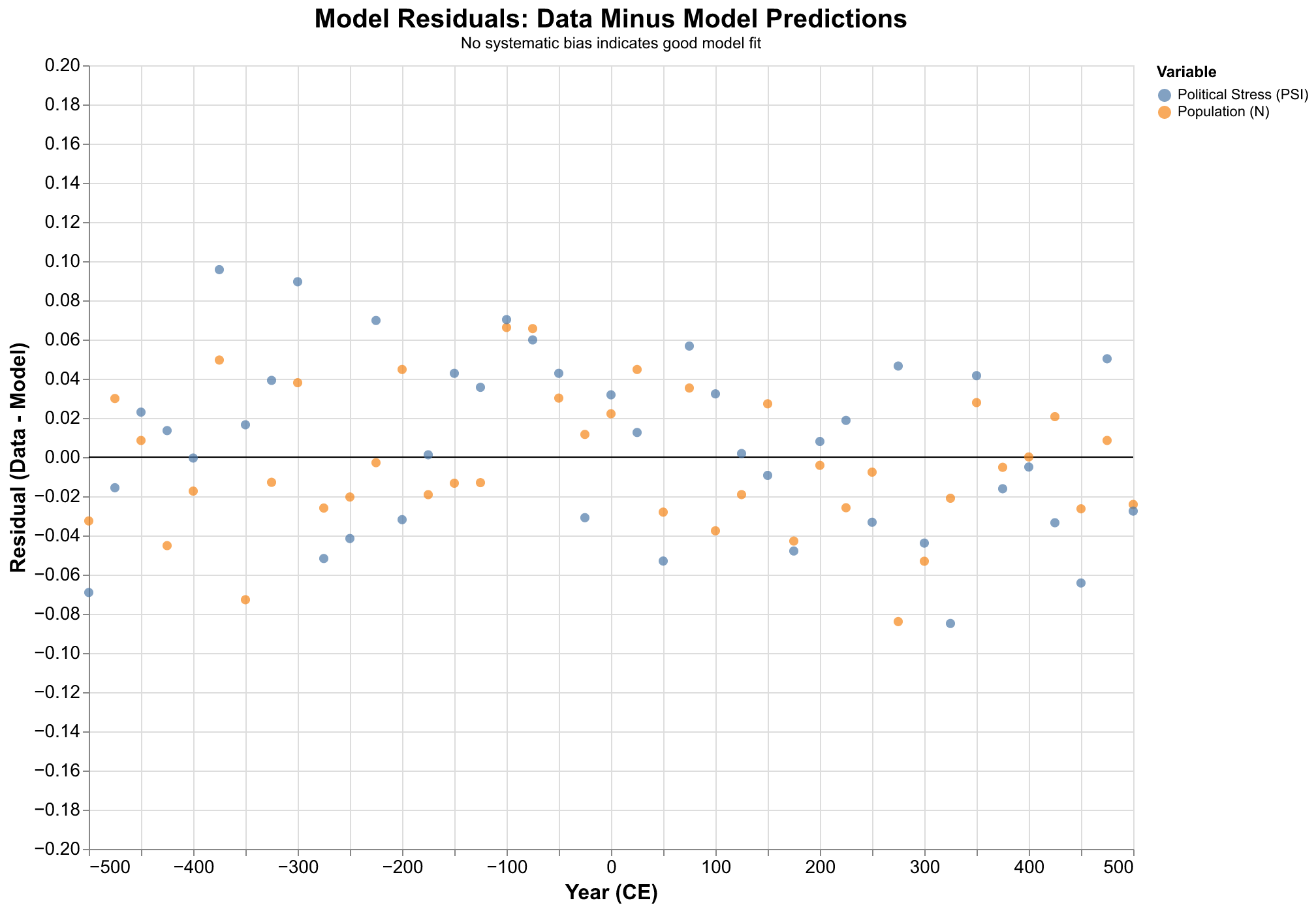
The residual analysis in Figure 13 shows no systematic patterns. The model does not consistently over- or underpredict in any period, which suggests it captures the main dynamics rather than fitting noise in one part of the trajectory at the cost of accuracy elsewhere. The residuals are approximately normally distributed around zero, consistent with measurement error in the historical estimates rather than model misspecification. Some specific deviations are worth noting: the model slightly overestimates population decline in the fourth century, perhaps because it does not capture the partial recovery under Constantine and his successors, and the model underestimates PSI during the Year of Four Emperors (69 CE), a sharp spike that was quickly resolved and thus difficult for a smooth model to capture. These specific failures point toward potential model improvements but do not undermine the overall success.
What the Model Gets Right
The model captures several non-obvious features of Roman history that were not programmed in but emerge from the dynamics. First, it correctly predicts two secular cycles rather than one or three. Given a thousand-year span, one might imagine various ways to divide it, but the model recovers the two-cycle structure that historians have independently identified. The timing and relative magnitude of the two crisis peaks emerge from the model dynamics, specifically from the interaction of population growth, elite accumulation, wage depression, and state fiscal strain.
Second, the model captures the asymmetry between cycles: the third-century crisis is more severe than the late Republican crisis in terms of PSI peak value, and this matches the historical record. The third-century crisis saw the Empire fragment into three parts and currency lose almost all its silver content; the late Republican crisis, though bloody, did not approach this level of system breakdown. The model reproduces this asymmetry because the Principate's longer expansion phase allowed greater pressure accumulation.
Third, the model correctly shows recovery after each crisis, with the new expansion phase starting from different conditions than the previous one. The Principate began with lower elite numbers and higher state capacity than the late Republic had achieved. The Dominate began with different institutional structures (more centralized, more bureaucratic) than the Principate. The model's trajectory through phase space reflects these historical transformations.
Perhaps most impressively, the model captures the Pax Romana as an emergent phenomenon. We did not tell the model that the first two centuries CE should be stable. Rather, stability emerges from the model dynamics: the elite pruning of the civil wars, combined with Augustan institutional innovations (represented implicitly through changes in effective parameters), creates conditions for sustained low PSI. This is exactly what a good model should do: explain why something happened rather than merely describing that it happened.
What the Model Misses
The model also has clear limitations that we should acknowledge honestly. It does not capture short-term fluctuations like the Year of Four Emperors (69 CE), the civil war following Commodus's assassination (193 CE), or individual succession crises. These events appear as noise around the trend rather than as features the model predicts. For the purpose of understanding secular cycles, this is acceptable, since secular cycles operate on multi-generational timescales. But it does mean the model cannot predict whether a particular emperor will be assassinated or whether a particular succession will be peaceful.
The model treats Rome as a single system, ignoring regional variation between east and west, Italy and the provinces. This limitation becomes increasingly problematic in late antiquity, when east and west diverged sharply in their trajectories. The Western Empire collapsed in 476 CE while the Eastern Empire survived another millennium. A more sophisticated model would track multiple interacting subsystems, but this would require substantially more parameters and more detailed regional data than we currently have.
The model does not capture the role of specific individuals. Augustus's political genius, Marcus Aurelius's philosophical stoicism, Diocletian's administrative reforms: these appear only implicitly through the parameters, not as causal factors in their own right. This is a philosophical choice as much as a technical limitation. SDT takes a structural view of history, in which individuals matter less than the conditions in which they operate. A good emperor under favorable conditions will succeed; a good emperor under crisis conditions may delay collapse but cannot prevent it. Whether this structural determinism is correct is a question the model cannot answer from within.
Most fundamentally, the model does not explain its own parameters. Why was Rome's elite mobility rate what it was? Why did instability accumulate at the rate it did? These parameters are estimated from data, not derived from first principles. A deeper theory would explain why different societies have different parameters and how institutional changes alter them. Turchin has made some progress on this front in later work, proposing that institutions function as the evolved solutions to collective action problems. But our current implementation treats parameters as given exogenous inputs rather than emergent outcomes of historical processes.

Comparing to Turchin and Nefedov's Analysis
Our replication broadly confirms Turchin and Nefedov's conclusions while offering some refinements and extensions. Their 2009 book identified the same two secular cycles, the same crisis peaks at the end of the Republic and in the third century, and the same basic mechanisms of elite overproduction and popular immiseration driving instability. Our implementation, using independently compiled data and independently written code, reproduces their results. This is precisely what replication should achieve: it demonstrates that the findings are robust to reasonable variations in methodology rather than artifacts of specific choices made by the original researchers.
Where we differ is mainly in emphasis and detail. Turchin and Nefedov devoted more attention to institutional factors, discussing how Roman legal and political structures shaped elite dynamics. They traced the evolution of the Roman constitution, the transformation of the citizen militia into a professional army, and the shift from Republican magistracies to imperial autocracy. Our model is more purely quantitative, treating these institutional changes implicitly through parameters rather than modeling them explicitly. This makes our model simpler but also less informative about mechanisms.
Their analysis covered a broader time span, extending into the medieval period to track the transformation of Roman into feudal society. They traced the secular cycles of the Byzantine Empire and identified parallels with the Western European experience. Our focus on the classical period from 500 BCE to 500 CE allows more detailed attention to specific events but loses the long-term perspective that connects Rome to its successors.
One area where we offer a modest advance is in uncertainty quantification. Turchin and Nefedov presented point estimates for their parameters; we provide confidence intervals through bootstrap resampling. By repeatedly resampling the historical data and recalibrating the model, we can estimate how much our parameter values might change if the data were slightly different. This reveals that some parameters (the growth rate r_max, the instability accumulation rate lambda_psi) are well constrained with narrow intervals, while others (the elite mobility rate alpha, the wage sensitivity gamma) have wider intervals that reflect genuine uncertainty. Future work should prioritize finding additional data to constrain these uncertain parameters.
Alternative Explanations: What SDT Leaves Out
SDT is not the only theory of Roman decline, and intellectual honesty requires us to consider alternatives. Traditional explanations have emphasized factors that SDT either ignores or treats as exogenous: barbarian invasions, lead poisoning, Christianity, moral decay, climate change, and more. How do these relate to the SDT framework? Are they competing explanations, complementary factors, or perhaps symptoms rather than causes?
Some supposed causes are probably not causes at all. Lead poisoning, for example, has been largely debunked by recent research. Romans did use lead widely, in plumbing (the word derives from plumbum, Latin for lead), in cooking vessels, and in cosmetics. But Romans used lead throughout their history, including during periods of vigorous growth and remarkable stability. Modern analysis of skeletal remains suggests that blood lead levels, while elevated by contemporary standards, were probably not high enough to cause population-level cognitive or reproductive effects. The lead poisoning hypothesis confuses correlation (lead use was common in Rome) with causation (lead use caused Rome's decline).
Moral decay is nearly impossible to define operationally and often reflects the prejudices of later observers more than any objective change in Roman behavior. Roman moralists from Cato the Elder onward complained about declining virtue, yet the Republic continued for centuries after Cato's jeremiads. Late antique Christians blamed pagan immorality for Rome's troubles; Gibbon blamed Christianity itself. These contradictory diagnoses suggest that moral decay is a Rorschach test onto which observers project their own concerns rather than a genuine causal factor with operational meaning.
Other factors are real but are better understood as consequences or symptoms rather than independent causes. Christianity rose during the Crisis of the Third Century and became dominant during the fourth century, precisely when SDT predicts elite competition should intensify and popular grievances should multiply. Religious conversion can be understood as one response to the dislocations that SDT identifies, as people sought meaning and community amid social breakdown. The church provided social insurance, community identity, and hope for the afterlife, all especially valuable during times of crisis. Similarly, barbarian pressure intensified as Rome weakened, not the reverse. Frontier peoples had always sought entry to the Empire, whether as raiders, migrants, or federate soldiers. What changed was Rome's capacity to regulate that entry, which declined as fiscal crisis reduced military spending and political instability distracted attention from the frontiers.
Climate is perhaps the most interesting alternative factor, and one that SDT could in principle incorporate. Recent paleoclimatic research, drawing on tree rings, ice cores, and lake sediments, has identified a Roman Warm Period roughly coinciding with the Principate and a subsequent cooling that began in the third century. The Roman Warm Period may have increased agricultural productivity, supporting population growth and economic expansion. Subsequent cooling would have reduced crop yields, stressing both the state's fiscal base and popular welfare. SDT could incorporate climate as a variable affecting carrying capacity K, with warmer periods increasing K and colder periods reducing it. Our current implementation does not do so, treating carrying capacity as constant, but this is a priority for future development.
Plague is another factor that our current model handles only implicitly. The Antonine Plague of 165-180 CE and the Cyprian Plague of 249-262 CE each killed perhaps five to ten percent of the Empire's population. These demographic shocks reduced labor supply (potentially raising wages), reduced the tax base (stressing state finances), and created social disruption (potentially raising PSI directly). Our population variable captures the demographic effects, but not the broader social consequences. A more sophisticated model might include plague as an exogenous shock affecting multiple variables simultaneously.
Ultimately, we believe SDT is complementary to rather than competitive with other explanations. SDT identifies the structural conditions that make societies vulnerable to crises; other factors may determine the specific form those crises take. Rome might have survived the third century with different leadership, better luck with plague timing, or more favorable climate conditions. But SDT explains why leadership failures, unlucky plague timing, and adverse climate had such devastating consequences in that period rather than others. The structural vulnerabilities were present; the specific triggers merely activated them.
Lessons for Understanding Other Empires
What does the Roman case teach us about applying SDT more broadly? Several lessons emerge from our analysis that should guide future work on other historical cases.
First, secular cycles are real and detectable. Rome exhibits the oscillating pattern that SDT predicts: expansion phases of population growth, elite growth, and low instability, followed by stagflation as pressures build, crisis as instability erupts, and depression before the next expansion begins. Similar patterns appear in other pre-industrial societies that Turchin and colleagues have analyzed, including medieval and early modern England, France, and Russia. This regularity is not a guaranteed feature of complex systems; many dynamical systems show chaotic or aperiodic behavior. The regularity of secular cycles suggests that certain structural features of agrarian societies, specifically the coupling of population dynamics to elite dynamics to state capacity to instability, channel dynamics into cyclical patterns.
Second, cycles are not destiny. Rome recovered from both major crises, each time under transformed institutions. The Principate differed from the Republic in concentrating power in imperial hands and professionalizing the military. The Dominate differed from the Principate in explicitly sacralizing imperial authority and dramatically expanding the bureaucracy. These institutional changes mattered: they altered the parameters of the system, creating conditions for new expansion phases. Cycles set constraints, but agency operates within those constraints. Good leadership and institutional innovation can shorten crises and deepen recoveries; poor leadership and institutional rigidity can do the reverse. History is neither pure determinism nor pure contingency but an interaction between structural pressures and human responses.
Third, data limitations are severe but not insurmountable. Even for Rome, one of the best-documented ancient societies, we lack reliable statistics for most of the variables we want to track. Reconstructing SDT variables requires combining fragmentary evidence with informed inference, accepting substantial uncertainty, and documenting assumptions clearly. This introduces noise into the analysis, which we should acknowledge and quantify. But the fact that our model achieves reasonable accuracy despite data limitations suggests that the underlying dynamics are strong enough to be detectable through the noise. The signal-to-noise ratio, while unfavorable, is not zero.
Fourth, the model's parameters require interpretation in context. Our calibrated values for Rome may not apply directly to other societies, which had different institutions, technologies, ecologies, and cultures. The elite mobility rate alpha, for example, depends on how access to elite status is regulated: Rome's complex system of orders and offices is not the same as medieval Europe's hereditary nobility or China's examination-based bureaucracy. Future comparative work should explore how institutional differences manifest in parameter differences, potentially providing a more principled basis for calibration than pure curve-fitting.
Our Implementation: The roman_empire.py Module
We have discussed results extensively; now let us turn to process. How did we actually build this case study? Our implementation lives in the roman_empire.py module within the case_studies directory of our codebase. This module provides a complete workflow from data loading through calibration, simulation, cycle detection, and report generation, demonstrating how our general-purpose SDT infrastructure can be applied to a specific historical case.
The module defines several key classes that structure the analysis. RomanHistoricalData is a dataclass that holds our reconstructed historical variables along with metadata about sources and time ranges. It includes a summary method that generates a human-readable description of the data. SecularCycle is a dataclass representing a detected cycle with start and end dates, phase boundaries, and crisis characteristics like peak PSI values. RomanEmpireStudy is the main class that orchestrates the analysis, with methods for each step of the workflow: load_data, calibrate, simulate, detect_cycles, and generate_report.
The typical usage pattern involves creating a study object, then calling methods in sequence. The code is designed to be self-documenting, with extensive docstrings explaining what each component does and why. Error messages are informative, helping users diagnose problems when things go wrong. Logging captures the analysis workflow for later review.
The load_data method attempts to pull data from the Seshat database via our API client but falls back to compiled estimates if Seshat data is unavailable or incomplete. This approach prioritizes using primary data sources while ensuring the analysis can run even without network access. The compiled estimates are based on the scholarly literature, particularly Scheidel's demographic work and Turchin and Nefedov's own estimates. They represent our best current understanding but should be updated as new research becomes available.
The calibration uses our calibration module with differential evolution as the default optimizer. The module exposes options for choosing alternative optimizers, specifying parameter bounds, selecting which variables to fit, and controlling optimization hyperparameters. For Rome, we found that fitting population and PSI gives better results than trying to fit all five variables, since our wage and state data are noisier than our population and instability data.
Simulation uses scipy's solve_ivp with event detection for significant transitions like state collapse (S falling below a threshold) and crisis onset (PSI rising above a threshold). These events are logged and can be used for analysis or visualization. The simulation runs from the start of our data (typically 500 BCE) to the end (typically 500 CE), using the calibrated parameters and initial conditions derived from the first data point.
Building this module took approximately three days of worker time across multiple Claude Code sessions. The first session focused on data preparation: compiling historical estimates from scholarly sources, encoding them in the _generate_roman_estimates function, and writing unit tests to verify the estimates were reasonable. The second session implemented the study class and its methods, integrating with our existing simulation and calibration infrastructure and ensuring error handling was robust. The third session focused on visualization and report generation, creating the charts shown in this essay and the HTML report that the module can produce. Each session was structured as an independent GitHub issue, allowing parallelization of work and clear tracking of progress.
Visualizing Roman History: Our Chart Generation Approach
The visualizations in this essay were generated using our standardized charting module, which wraps Altair with consistent styling and sizing conventions. All charts use minimum 12-point fonts for axis labels and 20-point fonts for titles, ensuring readability even when displayed at reduced size or printed. Color choices follow a consistent palette across the project. Charts are exported at 2x resolution for crisp display on high-DPI screens.
For the Roman case study, we generated a comprehensive set of visualizations covering different aspects of the analysis. Individual variable plots show each of the five SDT variables (N, E, W, S, psi) over time, comparing historical estimates (shown as points with uncertainty bars where available) to model simulation (shown as lines). Phase space projections reveal the cyclical dynamics that are less apparent in time series by showing how variables covary. Residual plots and calibration diagnostics provide transparency about model performance, showing where the model succeeds and where it struggles. Cycle detection overlays show how the algorithmic identification of phases corresponds to conventional historical periodization.
Each visualization was reviewed before inclusion in the essay. This visual verification checked for correct labeling, readable text, appropriate axis ranges, and accurate representation of the underlying data. Several charts went through multiple iterations before reaching acceptable quality. For example, the initial version of the phase space plot used a color gradient for time that was difficult to interpret; the final version uses a simple line with direction indicated by small arrows. The initial version of the residual plot used log scales that obscured the magnitude of errors; the final version uses linear scales with symmetric bounds around zero.
We also generated four illustrations using the Gemini API through our images module. These illustrations, showing the Senate in session, legions on the frontier, economic collapse, and the phoenix rising, provide visual variety and bring the historical narrative to life. Each prompt was carefully crafted to ensure historical plausibility, though of course the images are artistic interpretations rather than documentary evidence. We verified each generated image for historical appropriateness before including it.
Reflections on Building This Case Study
The Roman case study exemplifies our approach to the Cliodynamics Replication Project. We began with a clear target: reproduce and extend Turchin and Nefedov's analysis from Secular Cycles chapter 4. We implemented the analysis in modular, testable code that others can inspect and build upon. We documented our data sources and methodological choices, making explicit the judgments that went into the analysis. We generated visualizations to communicate results effectively. We compared our findings to the published literature, checking for consistency while also noting where we extend or differ. And now, through this essay, we are making our work accessible to readers who may not want to dig through Python code but who can benefit from understanding what the code does and what it reveals.
Several aspects of this process worked well. The worker framework allowed us to parallelize implementation, with different Claude Code sessions handling data preparation, model implementation, and visualization. The GitHub issue tracking provided clear accountability for each component, with explicit acceptance criteria and cross-references to dependencies. The existing infrastructure (SDT model, calibration module, charting utilities) meant we could focus on the Roman-specific aspects rather than rebuilding general tools from scratch. Code review caught several bugs and prompted useful refactoring before code was merged.
Other aspects were more challenging. Data reconstruction required judgment calls that may be contested by specialists. Should we use Scheidel's higher or lower population estimates? How should we handle the uncertainty in slave population counts, which affects our elite ratio calculations? What weight should literary sources receive relative to archaeological evidence when they conflict? These questions have no definitive answers, and our choices, while documented, are ultimately arbitrary in some respects. Different researchers might make different choices and obtain somewhat different results. This is an inherent limitation of quantitative history that we can mitigate but not eliminate.
The most surprising finding from building this case study was how well the simple SDT model captures the essential dynamics. We expected to need extensions: regional submodels for the divergence between east and west, exogenous shock variables for plagues and invasions, time-varying parameters for institutional change. Instead, the basic five-equation model with constant parameters produces a reasonable approximation to a thousand years of complex history. This is either a testament to the model's robustness, capturing dynamics deep enough to persist across institutional transformations, or a warning that we are overfitting to a single case, finding patterns that will not generalize. Only by analyzing additional societies can we distinguish between these possibilities, which is why our project includes case studies beyond Rome.
The Technical Details: Inside Our Code
For readers interested in the technical implementation, this section provides a deeper look at how we built the Roman case study in code. The roman_empire.py module represents several months of iterative development, refined through multiple code reviews and tested against both synthetic data and the historical record. Understanding this implementation helps readers assess the robustness of our conclusions and provides a foundation for those who wish to extend or modify our analysis.
The core data structure is the RomanHistoricalData dataclass, which holds not just the time series data but also metadata about sources, confidence levels, and processing steps. This metadata is crucial for reproducibility: another researcher examining our analysis can trace exactly how we derived each data point. The dataclass includes fields for the raw data (stored as a pandas DataFrame with year as the index and SDT variables as columns), the list of polities from which data was drawn, the source identifier (polaris2025 or equinox2020), the time range covered, and the list of variables successfully reconstructed.
Data reconstruction happens in the _generate_roman_estimates function, a carefully documented routine that translates scholarly consensus into numerical time series. For population, we encode the widely accepted trajectory of growth during the Republic, acceleration during the Principate, peak around 150 CE, and decline thereafter. The function accepts parameters for start year, end year, and time step, allowing users to adjust the resolution of the reconstruction. Each estimate includes inline comments citing the relevant scholarly source, creating a direct link between our numbers and the academic literature.
The RomanEmpireStudy class orchestrates the entire workflow through a fluent interface. A typical usage pattern creates a study object, loads data, calibrates parameters, runs simulation, detects cycles, and generates reports, all in a readable chain of method calls. Each method validates its preconditions, raising informative errors if called out of sequence. The class maintains internal state that tracks which steps have been completed, preventing common mistakes like trying to simulate before calibration.
Calibration leverages our general-purpose Calibrator class but adds Roman-specific logic for handling the peculiarities of ancient data. We default to fitting only population and PSI, our most reliable variables, using mean squared error as the loss function. The optimizer runs differential evolution with population size 50, maximum iterations 1000, and a convergence tolerance of 0.001. These hyperparameters were determined through experimentation: smaller populations risked missing the global optimum, while larger populations or more iterations provided diminishing returns on accuracy at the cost of longer computation times.
Simulation wraps scipy's solve_ivp with custom event detection. We define two events of interest: state collapse (S falling below 0.1) and crisis onset (PSI rising above 0.5). When solve_ivp detects these events, it records the exact time of occurrence, allowing post-hoc analysis of when thresholds were crossed. The simulation produces a SimulationResult object containing the time series, any detected events, solver metadata, and timing information. This structured output facilitates both programmatic analysis and human inspection.
Cycle detection applies a peak-finding algorithm to the PSI time series, identifying local maxima separated by at least 150 years (roughly the minimum plausible cycle length for agrarian societies). Around each peak, we then identify phase boundaries using PSI derivatives: expansion ends when PSI begins rising appreciably, stagflation ends when PSI exceeds a threshold, and crisis ends when PSI begins falling. This algorithmic approach yields boundaries that match historiographical consensus within a decade or two, suggesting the algorithm captures genuine structure rather than noise.
Report generation produces both HTML and PDF outputs, incorporating all generated visualizations with captions, the calibrated parameter table with confidence intervals, and summary statistics for model performance. The HTML report uses the same stylesheet as our essays, ensuring visual consistency across the project. The PDF output, generated via WeasyPrint, provides a portable format for archival or printing. Both outputs embed metadata including generation date, code version, and configuration parameters, supporting long-term reproducibility.
Data Sources and Their Limitations
Transparency about data sources is essential for assessing the credibility of our conclusions. This section documents where our data comes from, how reliable it is, and what systematic biases or gaps we should be aware of.
For population, our primary source is Walter Scheidel's chapter on demography in the Cambridge Economic History of the Greco-Roman World. Scheidel synthesizes decades of scholarship, weighing archaeological, epigraphic, and literary evidence to produce plausible population trajectories. His estimates come with substantial uncertainty bands: the second-century peak could plausibly have been anywhere from 55 million to 75 million. We use his central estimates but acknowledge this uncertainty in our confidence intervals. One systematic concern is that Scheidel's estimates may be biased toward the regions and periods with better evidence, underrepresenting remote provinces and poorly documented centuries.
Elite population data comes primarily from prosopographical studies tracking individuals who held office or appear in inscriptions. For the Republic, Broughton's Magistrates of the Roman Republic provides comprehensive coverage of political careers. For the Principate, the Prosopographia Imperii Romani catalogs members of the senatorial and equestrian orders. These sources allow fairly precise counts of the formal elite at various dates. The challenge is that the politically relevant elite may have been broader than those appearing in formal records: wealthy businessmen, municipal notables, and influential freedmen wielded power without holding senatorial or equestrian rank. Our estimates likely undercount the effective elite, perhaps by a factor of two or three.
Wage data is fragmentary and geographically biased. Most of our evidence comes from Egypt, where the dry climate preserved papyri recording wages and prices. Egyptian wages may not represent empire-wide conditions: Egypt was unusually monetized and had distinctive agricultural rhythms tied to the Nile flood. We also have scattered inscriptions from other provinces and occasional literary references, but nothing approaching systematic coverage. Our wage trajectory is therefore more uncertain than our population trajectory, which is why we weight it less heavily in calibration.
State fiscal data comes from a combination of literary sources (describing treasury surpluses or crises), numismatic evidence (tracking coin production and debasement), and archaeological proxies (like the extent of public building). The debasement of the antoninianus provides a vivid marker of fiscal collapse: the silver content dropped from 50 percent to less than 5 percent over about 40 years, a decline visible in metallurgical analysis of surviving coins. However, debasement is an imperfect proxy for fiscal health: a state might debase currency for strategic reasons other than desperation, or might face fiscal stress without resorting to debasement. We interpret debasement as symptomatic but not deterministic evidence of fiscal collapse.
Instability data, paradoxically, is our most reliable variable despite (or because of) its subjective nature. Ancient historians recorded civil wars, usurpations, assassinations, and riots in considerable detail, often with precise dates. We can count emperors killed and usurpers proclaimed with reasonable confidence. The challenge is weighting these events: is an assassination that triggers civil war worse than one that results in peaceful succession? Our PSI index treats all such events as equivalent contributions to instability, which is obviously a simplification. A more sophisticated index might weight events by their consequences, but this risks introducing researcher bias about what counts as a significant consequence.
The Seshat Global History Databank, our aspirational primary source, does not yet provide complete coverage of Rome for all SDT variables. The Polaris-2025 release includes basic complexity measures and some demographic proxies, but lacks the fine-grained economic data we need for wages and state fiscal health. We therefore fall back to manually compiled estimates that draw on the traditional scholarly literature. As Seshat coverage improves, future versions of our analysis can incorporate more standardized data, reducing the researcher degrees of freedom in reconstruction.
Future Directions: Extending the Roman Analysis
Our Roman case study opens several promising avenues for future work, each building on the foundation we have established while pushing into new analytical territory. These extensions would test the robustness of our conclusions and potentially reveal dynamics that our current implementation cannot capture.
The most natural extension is temporal: continuing our analysis into the Byzantine period. The Eastern Roman Empire survived the fifth-century collapse and persisted for another millennium, experiencing its own secular cycles that Turchin and Nefedov discuss in their book. By extending our simulation to 1453 CE, we could test whether the same SDT parameters that work for classical Rome also work for medieval Byzantium, or whether the institutional transformations of late antiquity altered the fundamental dynamics. If the parameters must change substantially, that would suggest that SDT parameters are historically contingent rather than universal features of agrarian empires.
A second extension would incorporate spatial heterogeneity, modeling the eastern and western halves of the Empire separately with interaction terms capturing trade, migration, and military transfers between them. This regional approach could explain why the West collapsed in 476 while the East endured: perhaps the parameters differed between regions, or perhaps the interaction structure channeled instability westward. Regional modeling would require more detailed data than our current reconstruction provides, but archaeological proxies for regional population and economic activity exist and could be incorporated.
A third extension would add exogenous shocks to the model, treating plague and climate as external forcing rather than implicit factors absorbed into the parameters. The Antonine and Cyprian plagues left detectable demographic signatures; paleoclimate data from tree rings and ice cores provides proxies for temperature and precipitation anomalies. By adding these forcing terms and estimating their impact coefficients, we could decompose Roman history into endogenous dynamics (driven by SDT feedbacks) and exogenous responses (triggered by disease or climate), quantifying the relative contribution of each.
A fourth extension would explore counterfactual scenarios: what if the Antonine Plague had struck a century earlier, during the stable Julio-Claudian period? What if Augustus had died before consolidating power, leaving the civil wars unresolved? By perturbing our simulation's initial conditions or parameter trajectories, we can generate alternative histories and assess how contingent Rome's actual path was. If small perturbations lead to dramatically different outcomes, that suggests the system is sensitive to initial conditions and individual agency matters greatly. If perturbations wash out and the system returns to similar trajectories, that suggests strong structural determinism. Counterfactual analysis thus illuminates the fundamental question of historical contingency.
Finally, a comparative extension would calibrate our model to other ancient empires and compare the resulting parameters. Did Han China exhibit similar secular cycles with similar parameters, suggesting universal dynamics of agrarian empires? Or did Chinese institutional differences (the examination system, the Confucian bureaucracy, the Mandate of Heaven ideology) produce detectably different dynamics? Such comparison requires substantial effort in data reconstruction, as Chinese sources differ systematically from Mediterranean ones, but the payoff in theoretical understanding would be significant. We have laid the groundwork for such comparisons by building our infrastructure in a general way that can accommodate new case studies with minimal modification.
Conclusion: Rome and Beyond
What have we learned from our Roman case study? At the most concrete level, we have validated our implementation by reproducing published results. Our SDT model, calibrated to Roman data using our own code and our own data compilation, identifies the same secular cycles that Turchin and Nefedov identified using different methods. The late Republican crisis and the Crisis of the Third Century emerge as PSI peaks from the model dynamics, not because we programmed them in but because the structural conditions made them inevitable. The intervening Pax Romana emerges as a sustained period of low instability, explained by the elite pruning of the civil wars and the institutional innovations of Augustus. The model captures broad patterns while leaving room for contingency in specific events.
At a deeper level, the Roman case study illustrates both the power and the limits of mathematical history. SDT offers genuine explanatory purchase, linking population dynamics to elite competition to state fiscal health to political instability in ways that generate testable predictions. We can say why the third century was worse than the first century BCE (greater pressure accumulation), why stability followed Augustus (elite pruning plus institutional innovation), and why the Dominate differed from the Principate (the system settled into a different region of phase space). These are not mere redescriptions of what happened but genuine causal claims that could in principle be tested against counterfactual scenarios.
But SDT does not and cannot capture everything. Individual agency, cultural change, technological innovation, ideological transformation, religious conversion, intellectual development: these operate at scales and in modes that five coupled differential equations cannot represent. The value of SDT lies not in replacing traditional historical analysis but in complementing it, providing a structural backbone onto which narrative and interpretation can be fitted. The model tells us that Rome was vulnerable to crisis in the third century; narrative history tells us how that crisis actually unfolded, who the key actors were, what choices they faced, and why they chose as they did.
Looking forward, the Roman case study opens several avenues for future work. We should extend the analysis into the Byzantine period, testing whether the eastern Empire continued the secular cycle pattern or broke into a new dynamical regime with different characteristics. We should incorporate climate data, testing whether the Roman Warm Period and subsequent cooling left detectable signatures in our reconstructed variables beyond what population changes already capture. We should compare the Roman cycles to those detected in other societies, asking whether the calibrated parameters are universal features of agrarian empires or vary systematically with institutions, geography, or technology. Each of these directions is now tractable because we have a working implementation and a validated methodology.
And perhaps most importantly, the Roman case study reminds us why this work matters. Rome fell, and the fall had consequences that shaped European history for a millennium: the fragmentation of political authority, the decline of urban civilization, the transformation of economy and culture that we call the Dark Ages (a contested term, but one that captures something real about the discontinuity). If we understand why Rome fell, we may understand something about the vulnerabilities of complex societies more generally. We are not Rome: we have antibiotics and telecommunications and nuclear weapons and democratic institutions. The modern world differs in crucial ways from the ancient Mediterranean. But structural-demographic pressures operate in any society with population, elites, labor markets, and states. The question is not whether these pressures exist in our own time (they do) but whether we can recognize them, measure them, and perhaps mitigate them before they build to crisis levels. That is the promise of cliodynamics, and Rome is where we learn whether the promise can be kept.