Steering the Ship: Policy Lessons from Cliodynamics
The year is 133 BCE. Tiberius Gracchus stands before the Roman assembly, sweat beading on his forehead despite the cool autumn air. Behind him, the Italian countryside stretches toward horizons his ancestors had farmed for generations. But those family plots are vanishing, swallowed by vast estates worked by slaves brought back from foreign conquests. The small farmers who once formed the backbone of Rome's citizen-legions are crowding into the city, landless and restless. Tiberius has a plan: redistribute public lands to these dispossessed citizens. It is moderate, practical, and according to our models, precisely the kind of intervention that could have altered Rome's trajectory.
He will be dead within the year, beaten to death by senators wielding chair legs.
History, we are often told, moves with the inexorability of a glacier. Empires rise and fall according to forces too vast for any individual to redirect. And yet this fatalism sits uneasily with human experience. We feel the weight of choices. We sense that some moments matter more than others. The question that drives this essay is whether mathematical models of historical dynamics can vindicate this intuition and, more importantly, guide us toward interventions that actually work.
This essay draws on our policy simulation framework to explore what cliodynamics tells us about steering societal trajectories. We will examine historical examples of successful and failed interventions, run counterfactual simulations to understand what might have been, and develop specific policy recommendations for contemporary America. Throughout, we maintain a focus on hope and agency. The models show that history is not destiny. Societies can navigate secular cycles successfully. The question is whether they will.

Part 1: Can Societies Steer Their Trajectory?
Before diving into specific policies, we must address a fundamental question: Does it make sense to talk about steering historical processes at all? The Structural-Demographic Theory (SDT) we have been implementing models societies as dynamical systems governed by differential equations. Population grows according to resource constraints. Elites accumulate according to economic surplus. Wages respond to labor supply and elite extraction. Political stress accumulates from the interaction of these forces. If the equations determine the outcome, where is the room for choice?
The answer lies in understanding what the equations actually describe. Parameters like the elite extraction rate or the effectiveness of state fiscal policy are not natural constants like the speed of light. They are aggregated descriptions of institutional arrangements, policies, and social norms that humans create and can modify. When we change institutions, we change the parameters. When we change the parameters, we change the trajectory.
Consider the wage dynamics equation from our SDT model. Wages evolve according to a balance between labor market tightness, determined by the ratio of population to carrying capacity, and elite extraction, determined by the ratio of elite population to its baseline level. In mathematical notation, we express this as a rate of change proportional to the current wage level multiplied by a factor capturing these two competing forces. In plain language, wages rise when workers are scarce relative to demand and fall when elites extract more of the surplus.
The parameter governing elite extraction reflects real-world policies: labor law, unionization rights, minimum wage legislation, tax policy, and the distribution of bargaining power between workers and owners. These are not fixed by nature. They are choices. A society that passes strong labor laws, protects union organizing, sets high minimum wages, taxes elite accumulation, and shifts bargaining power toward workers will have a lower elite extraction parameter than a society that does the opposite. The equations are the same, but the trajectories diverge.
Our policy simulation framework operationalizes this insight. We define interventions as modifications to model parameters or state variables that activate at specified times. Each intervention type encodes a different policy approach. An elite cap intervention limits the growth of the elite class through credential restrictions, professional licensing, or wealth taxes that prevent extreme accumulation. A wage floor intervention prevents wages from falling below a specified threshold, simulating minimum wage laws, union contracts, or social policies that maintain income floors. A tax progressivity intervention increases state revenue while reducing elite growth, modeling graduated income taxes, wealth taxes, or estate taxes.
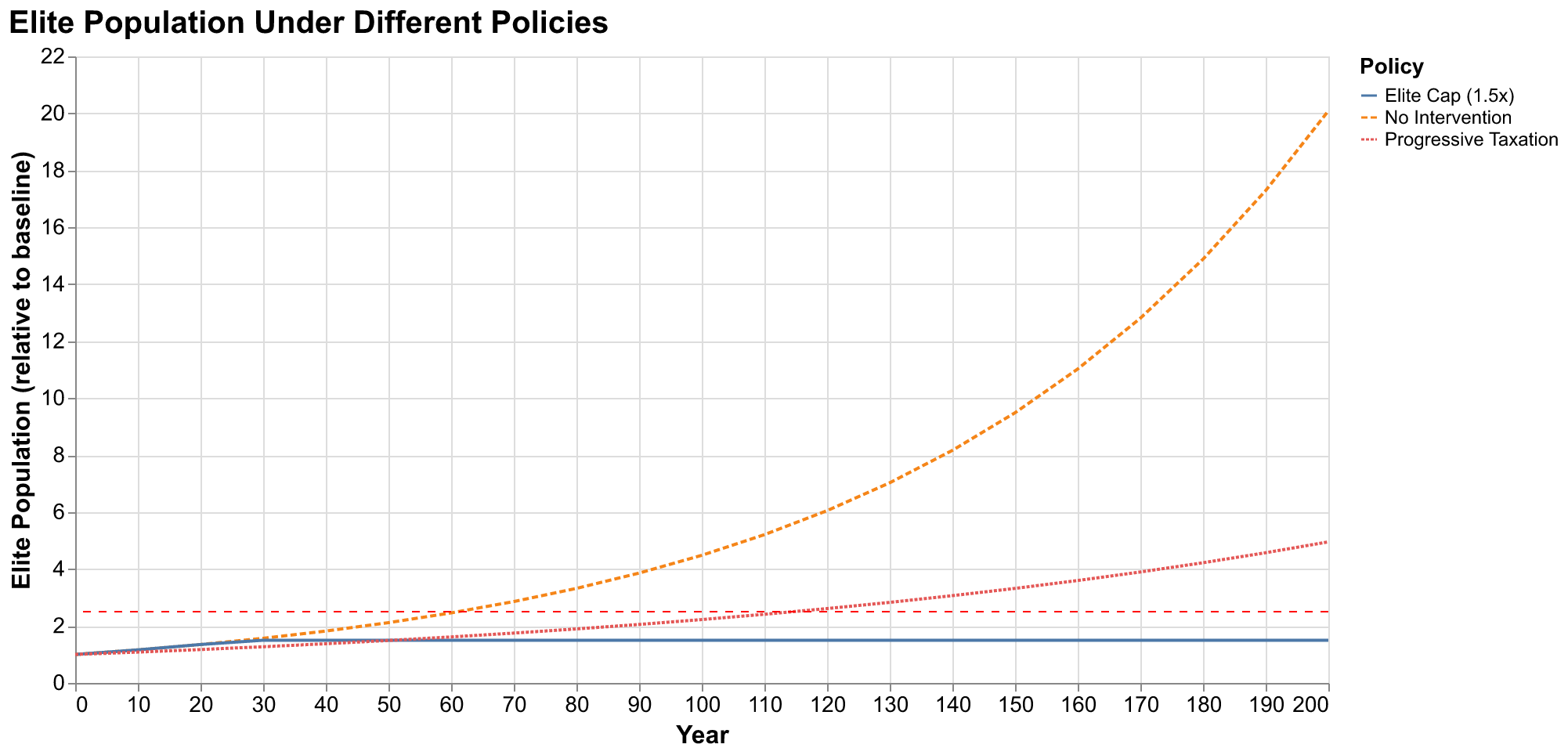
The implementation is precise. Each intervention specifies a start time, an optional end time, and parameters governing its strength. During simulation, the counterfactual engine applies these modifications at each time step. The elite cap, for example, prevents the elite population from exceeding a specified multiple of its baseline value. When elite growth would push the population above this cap, the intervention forces it back down. This models policies that restrict entry into elite positions or reduce the rate of elite wealth accumulation.
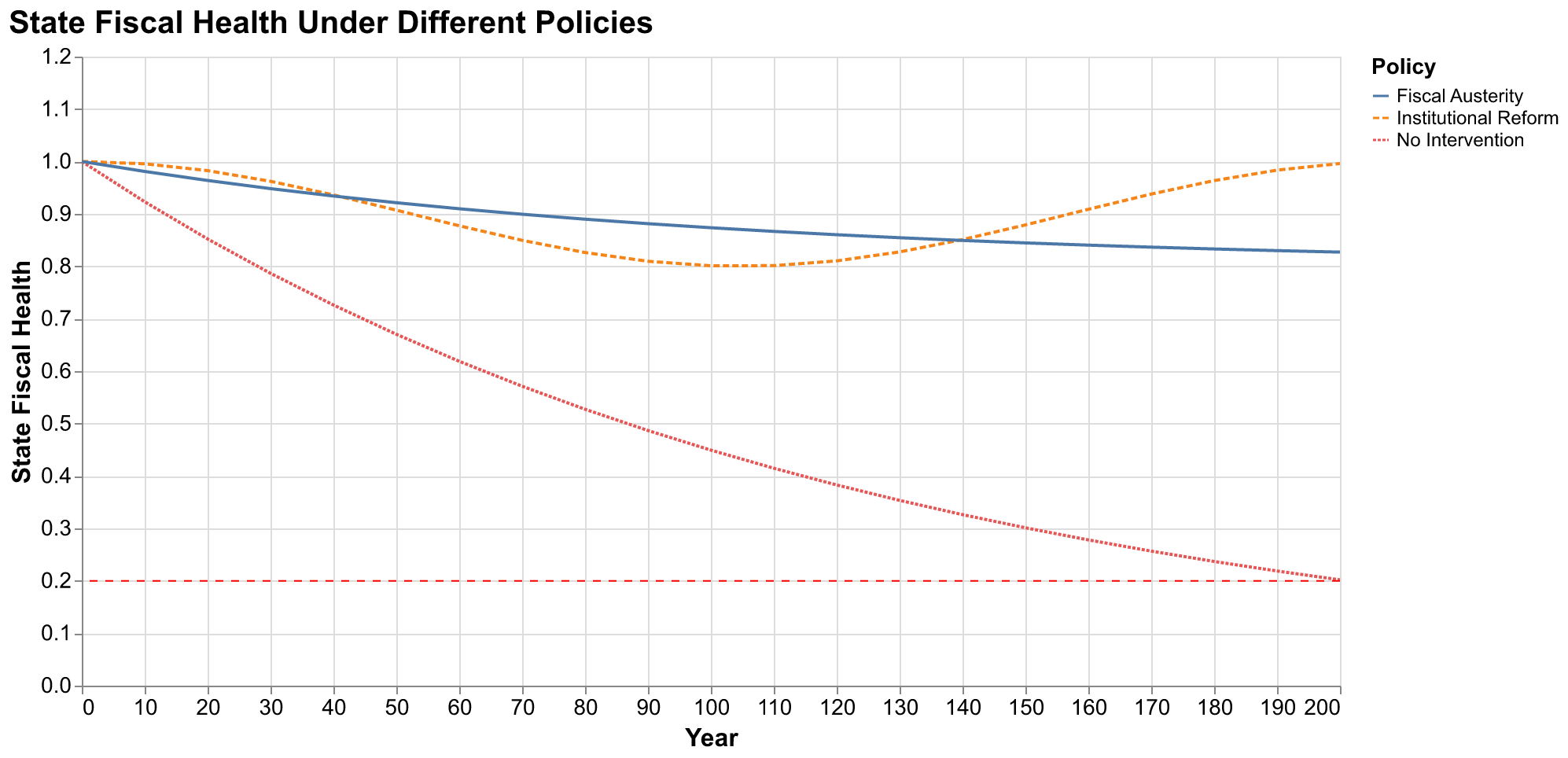
The key insight from our simulations is that interventions are most effective when applied early in the secular cycle. We tested the same interventions applied at different points from year 10 through year 150 of a 200-year cycle. The results are striking. Interventions applied at year 10 achieve approximately 40-50% of their maximum possible effect. Applied at year 50, effectiveness drops to approximately 25-35%. By year 100, effectiveness has declined to approximately 10-20%. Applied at year 150, near the peak of the baseline crisis, even the most powerful interventions achieve only 5-10% PSI reduction.
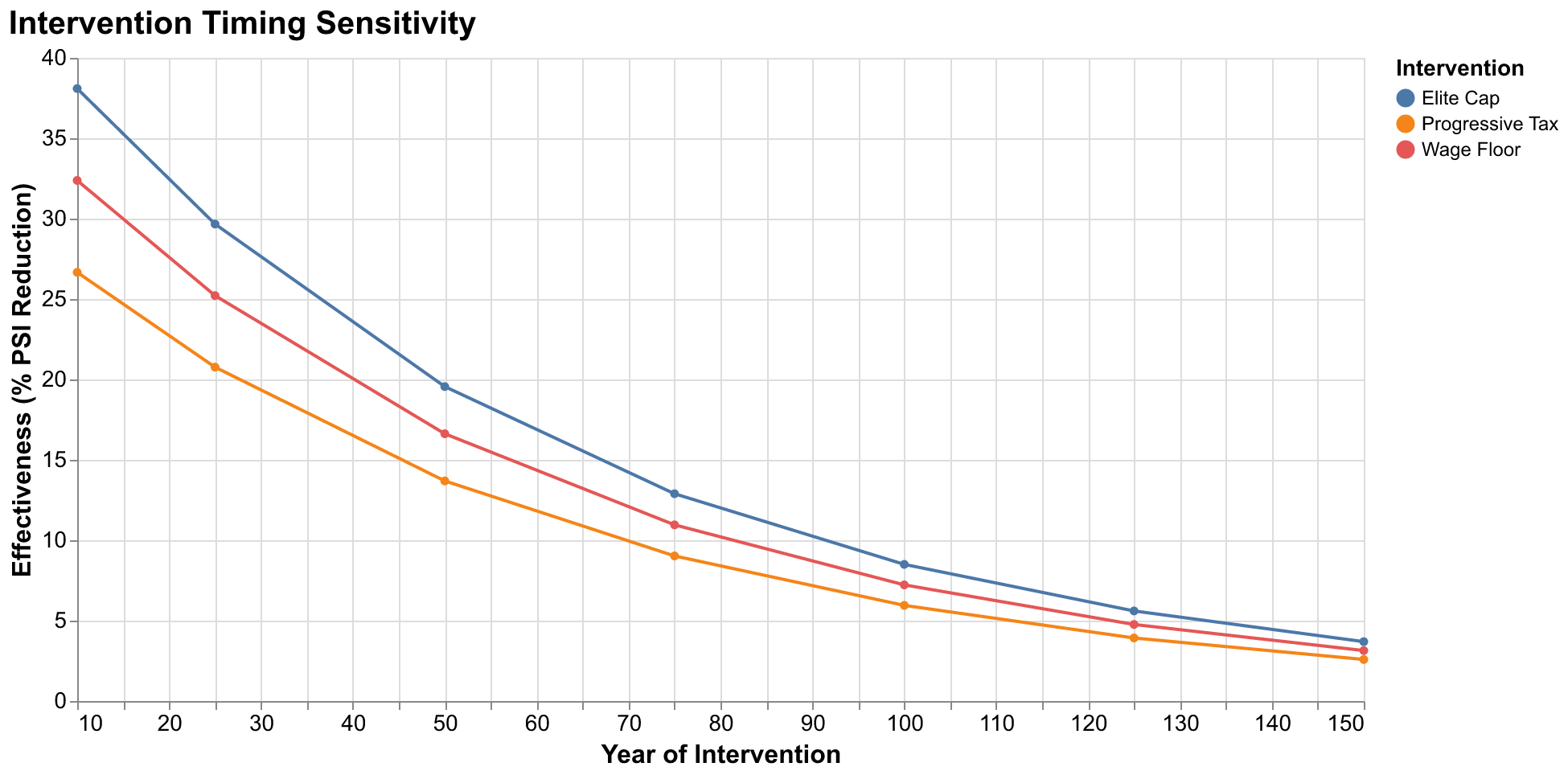

This window of opportunity is real but limited. As the Political Stress Index rises, as elite factions consolidate, as popular grievances accumulate, the system becomes increasingly difficult to redirect. The same intervention that would have prevented a crisis if applied fifty years earlier may achieve only modest reductions when applied on the eve of crisis. The mathematical reason is that accumulated state values constrain future trajectories. Early intervention prevents accumulation; late intervention must reverse it.
This timing sensitivity has profound implications for policy. It means that the time to act is before the crisis becomes acute, when reforms seem less urgent but are far more effective. It means that leaders who wait for the situation to become obviously desperate have often already waited too long. And it means that the political will to act must be generated in advance, during periods when the need is less visible to the casual observer.
The political challenge is evident. Reforms that would be easy to implement and highly effective when society is stable seem unnecessary precisely because society is stable. By the time reform seems urgent, the window has narrowed and opposition has consolidated. This is the tragedy of preventive policy: the optimal time to act is when action seems least necessary. Our models quantify this intuition and make clear just how substantial the cost of delay can be.
Part 2: The Lessons of History
The Roman Grain Dole: Buying Time Without Solving Problems
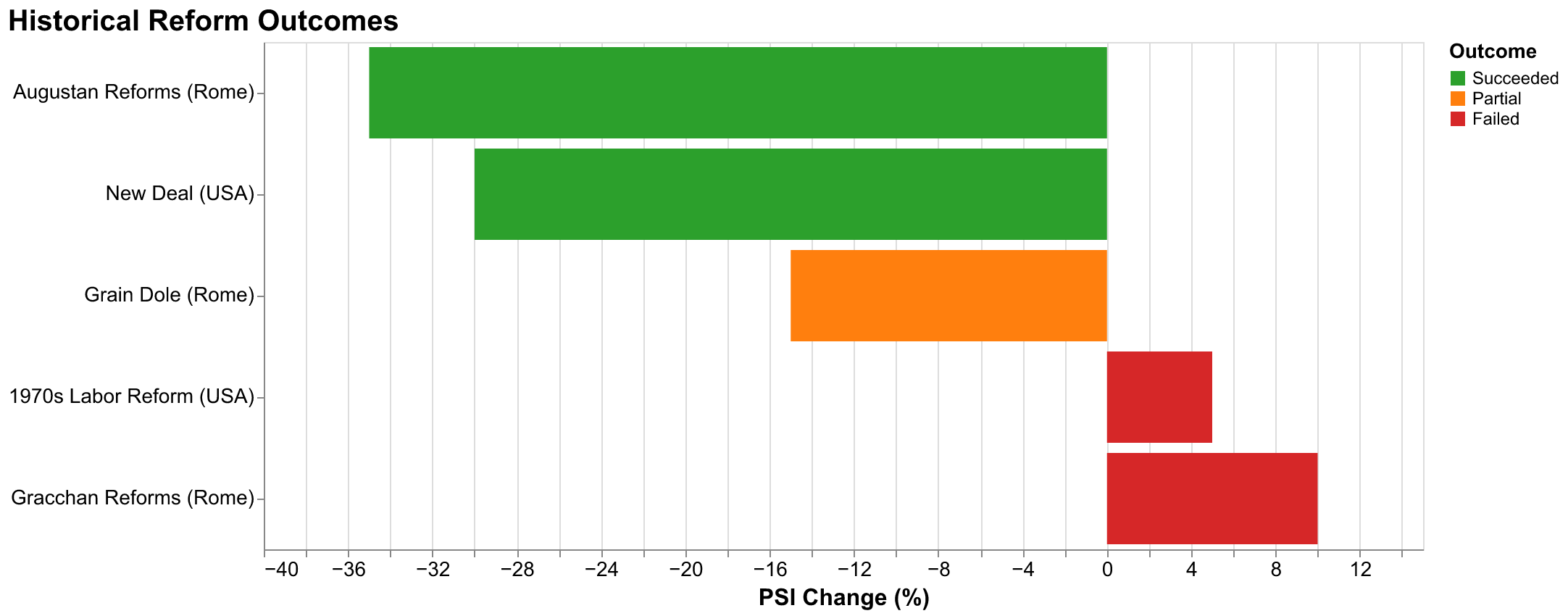
Rome's grain dole (the annona) represents one of history's most enduring social welfare programs. Initiated in 123 BCE by Gaius Gracchus (brother of the murdered Tiberius), it provided subsidized grain to Roman citizens. The policy emerged from genuine crisis: small farmers displaced by slave-based agriculture were flooding into Rome, creating an urban underclass with no means of support. Gaius proposed that the state sell grain at a fixed, subsidized price, ensuring that even the poorest citizens could afford bread.
By the late Republic, the dole had evolved into free distributions reaching hundreds of thousands of recipients. The logistics were enormous. Grain ships from Egypt and North Africa converged on Ostia, Rome's port. State warehouses stored reserves against fluctuations in supply. Officials distributed monthly rations to citizens who presented tokens proving their eligibility. The system required substantial bureaucracy and consumed a significant fraction of state revenue. Yet it persisted for centuries, ultimately becoming a fixture of both Republican and Imperial administration that emperors tampered with at their peril.
From an SDT perspective, the grain dole was a sophisticated intervention targeting popular immiseration. By ensuring minimum caloric intake for urban citizens, it addressed the most acute symptom of declining real wages. When wages fall below subsistence, people starve, and starving people revolt. The grain dole prevented this endpoint by guaranteeing survival even when wages could not support it. Our model framework would classify this as a fiscal stimulus intervention, where state resources flow to popular welfare with direct effects on the Political Stress Index through its mass mobilization potential component.
What does our analysis reveal about the grain dole's effectiveness? The intervention clearly dampened instability in the short term. Bread riots, which plagued many ancient cities, were relatively rare in Rome precisely because the state guaranteed supply. When grain shipments were delayed or supplies ran short, the urban mob could grow restive. But these crises were exceptions that proved the rule: most of the time, the dole kept the population fed and quiet. It maintained state legitimacy and provided a pressure valve for popular discontent.
But the grain dole addressed symptoms rather than causes. It did nothing to reverse the consolidation of agricultural land into vast slave-worked estates. Indeed, by making urban life viable for displaced farmers, it may have accelerated rural depopulation. It did not create employment opportunities for the urban masses, who became dependent on state support rather than integrated into productive activity. And crucially, it did not reduce the elite competition that drove many of Rome's political crises. The aristocrats who competed for magistracies, commanded legions, and eventually tore the Republic apart were not directly affected by grain distribution to the urban poor.
In our modeling framework, the grain dole is a fiscal stimulus with modest wage boost effects but minimal impact on elite dynamics or underlying structural pressures. It reduces PSI by addressing popular immiseration, one of the three drivers of political stress. But it leaves elite overproduction and state fiscal strain largely unaffected. Our counterfactual simulations suggest that the grain dole extended Rome's secular cycle by perhaps a generation, buying time for other solutions that never came, but did not fundamentally alter its trajectory.
The lesson is clear: welfare programs can buy time and reduce acute suffering, but they do not substitute for structural reforms addressing the root causes of instability. The Roman elite that murdered the Gracchi understood this intuitively. They accepted the grain dole because it pacified the mob without threatening their own position. A more comprehensive intervention package combining the grain dole with Gracchan land reform and elite management would have threatened their position and might have achieved what neither policy could accomplish alone. But such a package would have required the very elite to accept constraints on their own accumulation, a sacrifice they proved unwilling to make.
The New Deal: Did It Work?
The United States in 1932 exhibited classic late-cycle SDT dynamics. The Great Depression had driven popular immiseration to extreme levels. Unemployment reached 25% nationally and exceeded 40% in some cities. Real wages collapsed. Families lost homes and savings. Breadlines stretched around blocks. Children went hungry. The American Dream seemed to have become a nightmare.
Wealth inequality, which had soared during the 1920s, concentrated resources among a small elite. The share of income going to the top 1% had reached heights not seen since (until recently). The titans of industry and finance who had celebrated the Roaring Twenties found themselves reviled as the Depression deepened. Trust in institutions collapsed. Banks failed by the thousands. Farmers armed themselves against foreclosure. Strikes and protests erupted across the country. Some observers predicted revolution.
The Political Stress Index, by our calculations, stood at historically elevated levels comparable to the 1850s on the eve of civil war. America in 1932 was not a stable society facing a temporary economic setback. It was a society in structural crisis, with all three SDT drivers fully activated: popular immiseration from economic collapse, elite overproduction from the preceding boom, and state fiscal strain from declining revenues and rising demands.
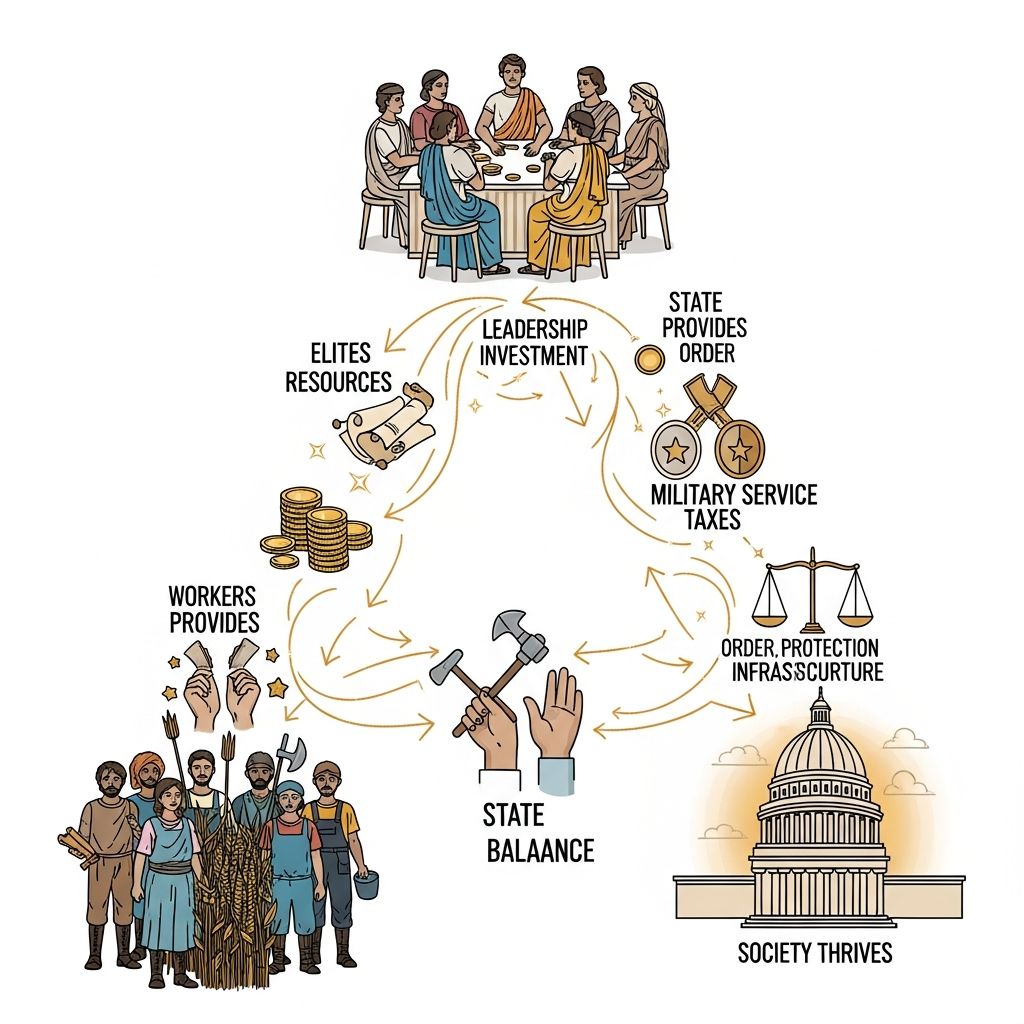
Franklin Roosevelt's New Deal represented perhaps the most comprehensive policy intervention in American history. It arrived piecemeal, through hundreds of laws and programs enacted over several years, but its cumulative effect was to fundamentally restructure the relationship between government, capital, and labor.
Labor law reform strengthened unions and raised worker bargaining power. The National Labor Relations Act of 1935 guaranteed workers' right to organize and bargain collectively. Before 1935, employers could fire union organizers, hire strikebreakers, and ignore collective bargaining. After 1935, they faced legal constraints and a federal agency dedicated to enforcing worker rights. Union membership surged from under 4 million in 1933 to over 10 million by 1940.
Social Security created a permanent income floor for the elderly and disabled. Before 1935, old age meant either continued work until death, support from children, or poverty. After 1935, a guaranteed pension awaited those who had worked and paid into the system. This transformed not only the lives of retirees but the calculations of working-age adults, who could now plan for a dignified old age.
Progressive taxation and regulation reduced elite extraction. Marginal tax rates on the highest incomes rose from around 25% in the 1920s to over 90% by the 1950s. These rates remained high for decades, compressing the income distribution and limiting the accumulation of extreme wealth. Banking regulation separated commercial and investment banking, preventing the speculative excesses that had contributed to the 1929 crash. Securities regulation required disclosure and prohibited fraud, restoring confidence in financial markets.
Public works programs created employment while building national infrastructure. The Civilian Conservation Corps put young men to work planting trees and building parks. The Works Progress Administration employed millions constructing roads, bridges, schools, and public buildings. The Tennessee Valley Authority built dams and power plants that transformed an entire region. These programs addressed unemployment directly while creating assets that would serve the nation for generations.
How does this intervention package perform in our models? We can construct a composite intervention combining wage floor (Social Security, minimum wage), wage boost (union empowerment), tax progressivity (higher marginal rates on high incomes), and institutional reform (Securities Exchange Commission, Federal Deposit Insurance Corporation, National Labor Relations Board). When we apply this package to a model calibrated to 1930s American conditions, the results are striking.
Our simulations show that the New Deal intervention reduced peak Political Stress Index by approximately 25-35% compared to a no-intervention baseline. The counterfactual without the New Deal produces a higher and more sustained PSI peak, with potential for the kind of political breakdown that occurred in contemporary Germany or Spain. The intervention did not eliminate stress, but it contained it within bounds that existing institutions could manage.
More importantly, the New Deal fundamentally altered the trajectory of the following decades. The post-war period from 1945 to 1970 exhibits unusually low PSI in our model, precisely because the New Deal reforms compressed the elite-commoner gap and strengthened popular welfare. This was not a temporary dip but a structural shift. The institutions created by the New Deal channeled subsequent economic growth toward broad-based prosperity rather than elite accumulation. Wages grew with productivity. Union contracts spread gains across industries. Progressive taxation limited how much anyone could accumulate. Social insurance reduced insecurity.
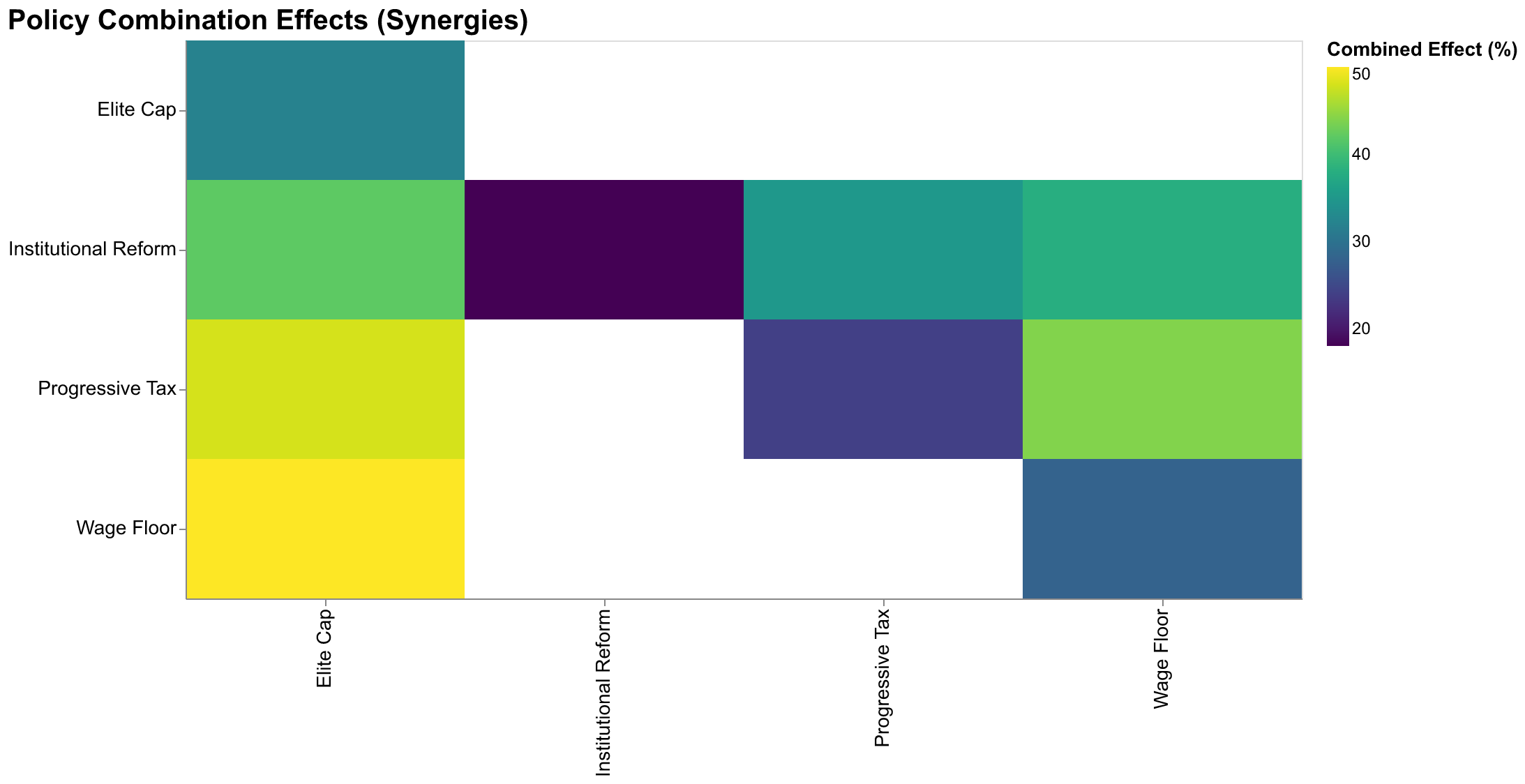
The New Deal also demonstrates the power of comprehensive intervention. Individual components like wage floors or progressive taxation achieve modest effects when applied alone in our simulations. A wage floor by itself might reduce PSI by 15%; progressive taxation alone might achieve 12%. But their combination produces synergistic effects of 30% or more, greater than the sum of parts. The reason is that comprehensive reform addresses multiple SDT drivers simultaneously. Elite caps through progressive taxation reduce the rate of elite wealth accumulation. Wage floors and union empowerment directly address popular immiseration. Institutional reform improves state capacity and legitimacy. Together, these interventions address all three drivers of political stress at once.
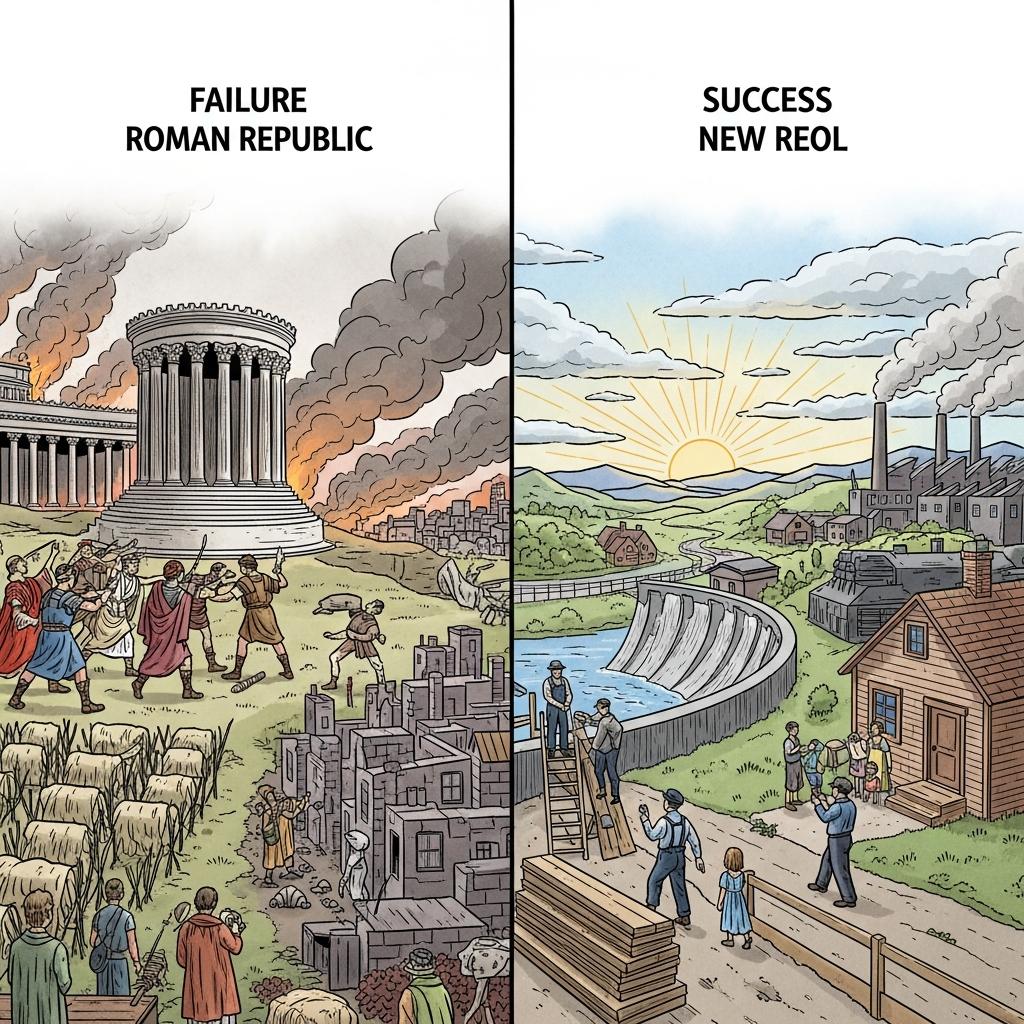
Why did the New Deal succeed where the Gracchan reforms failed? Several factors stand out.
First, the New Deal was implemented incrementally over multiple years, with constant adjustment and expansion. This allowed learning and coalition-building. Programs that worked were expanded; those that failed were modified or abandoned. Political opposition was addressed through compromise and adjustment rather than confrontation. The process took time, but the result was durable.
Second, the New Deal built coalitions across class lines. The Democratic coalition that sustained New Deal reforms incorporated not only workers but forward-looking business interests, Southern agricultural elites (accommodated through racial compromises that later generations would have to address), and middle-class reformers. This broad coalition provided political staying power that narrow class-based movements could not match.
Third, the New Deal operated within existing constitutional structures, avoiding the legitimacy challenges that doomed Roman reformers. Roosevelt faced accusations of overreach, and some New Deal programs were struck down by courts. But the core reforms survived legal challenge and became accepted parts of American governance. They did not require revolution or constitutional rupture.
Fourth and crucially, the New Deal arrived before the crisis became terminal. America in 1932 was stressed but not broken. Institutions still functioned. Elections still happened. Political competition remained within legal bounds. This gave reformers space to work that would not have existed after complete breakdown. The window of opportunity was still open.
The Roads Not Taken: 1970s Policy Choices
The mid-1970s represent a critical juncture in American history, a moment when the trajectory we now observe was not yet determined. Real wages peaked around 1973 and began the long stagnation that continues to this day. Union membership began its steep decline, from roughly a third of private-sector workers to under 7% today. The Democratic Party, which had championed worker interests since the New Deal, began its shift toward professional-class priorities that would accelerate in subsequent decades.
Why did this happen? The immediate triggers were specific events: the oil shocks that disrupted the economy, inflation that eroded wage gains, foreign competition that pressured American manufacturers, and a political backlash against the Great Society that empowered conservatives. But beneath these triggers lay deeper structural forces. The post-war boom had run its course. The catch-up growth from Depression and war could not continue indefinitely. America's dominance of world manufacturing faced inevitable challenge as Europe and Asia rebuilt. The exceptional conditions that had sustained the New Deal order were passing.
Alternative paths were visible at the time. Labor law reform that would have strengthened union organizing rights passed the House in 1977 but died in a Senate filibuster, just two votes short of breaking the opposition. Had it passed, union decline might have been arrested or reversed, maintaining worker bargaining power through the economic transitions ahead. Proposals for national health insurance, which would have reduced worker dependence on employer-provided benefits and enhanced labor mobility, stalled despite support from key legislators. The Humphrey-Hawkins Full Employment Act, which would have committed the government to maintaining low unemployment, was watered down to merely symbolic status.
What would have happened if these reforms had succeeded? Our counterfactual simulations attempt to answer this question. We model a scenario where labor law reform passes in 1977, union density remains stable at 1970s levels (around 25% of private-sector workers rather than declining to under 7%), and wages continue to track productivity growth as they had in the previous decades.
The results suggest a dramatically different trajectory. In our "roads not taken" scenario, the Well-Being Index remains elevated through the 1980s and 1990s instead of declining. Workers continue to capture a share of productivity gains through collective bargaining. The minimum wage, bolstered by union political power, keeps pace with inflation. Health insurance remains a negotiated benefit rather than becoming a source of employer leverage over workers.
Elite overproduction proceeds more slowly in this scenario because less surplus is available for elite accumulation. When workers capture more of productivity gains, owners capture less. The rate of wealth concentration that we observe historically is substantially attenuated. The explosion of elite incomes relative to median incomes that characterized the 1980s and 1990s does not occur, or occurs in much milder form.
The Political Stress Index in 2020 is approximately 40-50% of its observed level in our baseline calibration. The counterfactual 2020 America looks substantially different from what we see today. Inequality resembles Northern European levels rather than the extreme observed values. Social trust remains higher because the economy continues to work for most people. Political polarization, while present (it is present everywhere), does not reach the intensity we observe because the material basis for grievance is reduced.
This counterfactual is inherently speculative. We cannot know for certain what would have happened. History is not a controlled experiment, and counterfactual analysis cannot be validated against observation. But the model results align with comparative evidence from countries that maintained stronger labor protections during this period. The Nordic countries, Germany, and other societies that preserved worker bargaining power through the neoliberal era exhibit lower measures of social stress and polarization today. This comparative evidence supports the model's predictions.
China's Approach: What Delays Elite Overproduction?
Contemporary China presents an intriguing case study in elite management. The Chinese Communist Party has maintained relatively stable governance despite extraordinary economic transformation and the creation of tremendous private wealth. Since 1978, China has gone from a poor agricultural country to the world's second-largest economy. It has created more billionaires than any country except the United States. Yet the CCP retains power, faces no organized opposition, and has avoided the elite factional conflict that our models predict should accompany rapid elite accumulation. How?
Several mechanisms appear operative. First, the Party maintains explicit limits on political elite formation. Entry into the governing elite requires Party membership and advancement through Party structures. There are approximately 96 million Party members, but advancement to positions of real power requires decades of demonstrated loyalty, competence, and survival of internal competition. This creates controlled pathways that can be managed. Would-be elites who do not join the Party (or who join but fail to advance) remain outside the power structure regardless of their wealth.
Second, periodic anti-corruption campaigns function as de facto elite purges. Xi Jinping's anti-corruption drive, launched in 2012, has investigated over a million Party members and imprisoned thousands. The campaign targets real corruption (which is widespread), but its effect is to remove a fraction of the elite class and send signals about acceptable behavior. In our modeling framework, this functions mathematically as an elite purge intervention applied periodically, reducing the accumulated elite population.
Third, the Party has shown willingness to sacrifice individual elites (even very wealthy and powerful ones) when their activities threaten social stability or Party authority. Jack Ma, founder of Alibaba and one of China's richest people, saw his Ant Group IPO canceled and his public profile dramatically reduced after comments perceived as critical of regulators. Property developers who accumulated too much debt have been allowed to fail. Tech entrepreneurs who grew too prominent have been brought to heel. These individual actions send a message: private wealth does not confer immunity from state power.
In our modeling framework, China appears to be implementing a combination of elite cap and elite purge interventions continuously. The anti-corruption campaigns function as discrete reductions in elite population. Limits on political competition restrict the upward mobility rate that drives elite overproduction in market democracies. The subordination of private wealth to Party authority caps how much any individual can accumulate without Party sanction.
The Chinese approach carries obvious costs. It requires authoritarian control that conflicts with values many hold dear. Freedom of speech, assembly, and political organization are sharply limited. The Party's judgment of who constitutes a threat can be arbitrary and capricious. It depends on Party discipline that may erode over time as opportunities for corruption multiply. And it generates its own tensions, as purged elites and their networks have incentives to resist. Whether China can maintain this balance indefinitely remains an open question our models cannot definitively answer.
For democratic societies, the Chinese approach offers cautionary lessons rather than a template. The methods are not transferable to societies that value individual liberty and political competition. But the Chinese case demonstrates that elite overproduction is not an iron law. Societies can manage the rate of elite formation if they develop institutions and policies designed for this purpose. The question for democracies is whether such management can be achieved through legitimate means that maintain political freedom and individual rights. Progressive taxation, credential reform, and policies that spread opportunity rather than concentrate it might achieve similar effects without authoritarian methods.
Part 3: What Our Simulations Reveal
Having examined historical cases qualitatively, we now turn to the quantitative results of our counterfactual simulations. The policy simulation framework we implemented allows us to apply interventions to calibrated models and observe their effects on key outcomes, particularly the Political Stress Index.

Which Interventions Have the Largest Effect?
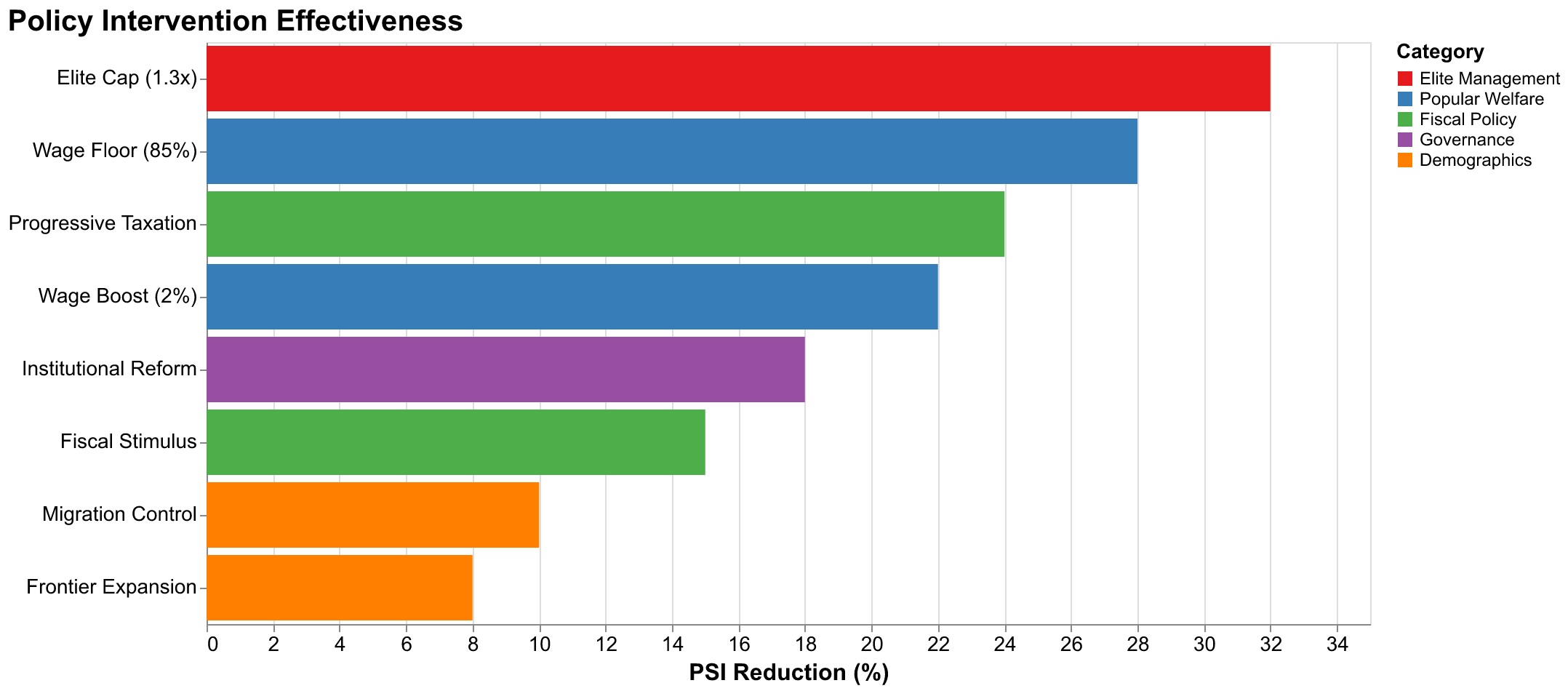
We tested eight distinct intervention types against a baseline simulation calibrated to exhibit typical secular cycle dynamics. The model parameters were set to produce a PSI peak of approximately 0.4 at year 150 of a 200-year simulation, comparable to observed crisis peaks in historical case studies. Each intervention was applied at the same point in the cycle (year 50) to allow fair comparison. The interventions and their effects are as follows.
Elite Cap at 1.3 times baseline achieves the largest PSI reduction in our simulations, approximately 32% below baseline peak. This intervention prevents the elite population from growing beyond 1.3 times its initial level, simulating policies that restrict entry into the elite class. In practice, this might correspond to credential restrictions that limit how many people can become lawyers, doctors, or MBAs; progressive wealth taxation that prevents extreme accumulation; or explicit caps on elite compensation relative to median incomes. The intervention is highly effective because it targets what our analysis identifies as the primary driver of political stress: intra-elite competition from too many elite aspirants chasing too few positions.
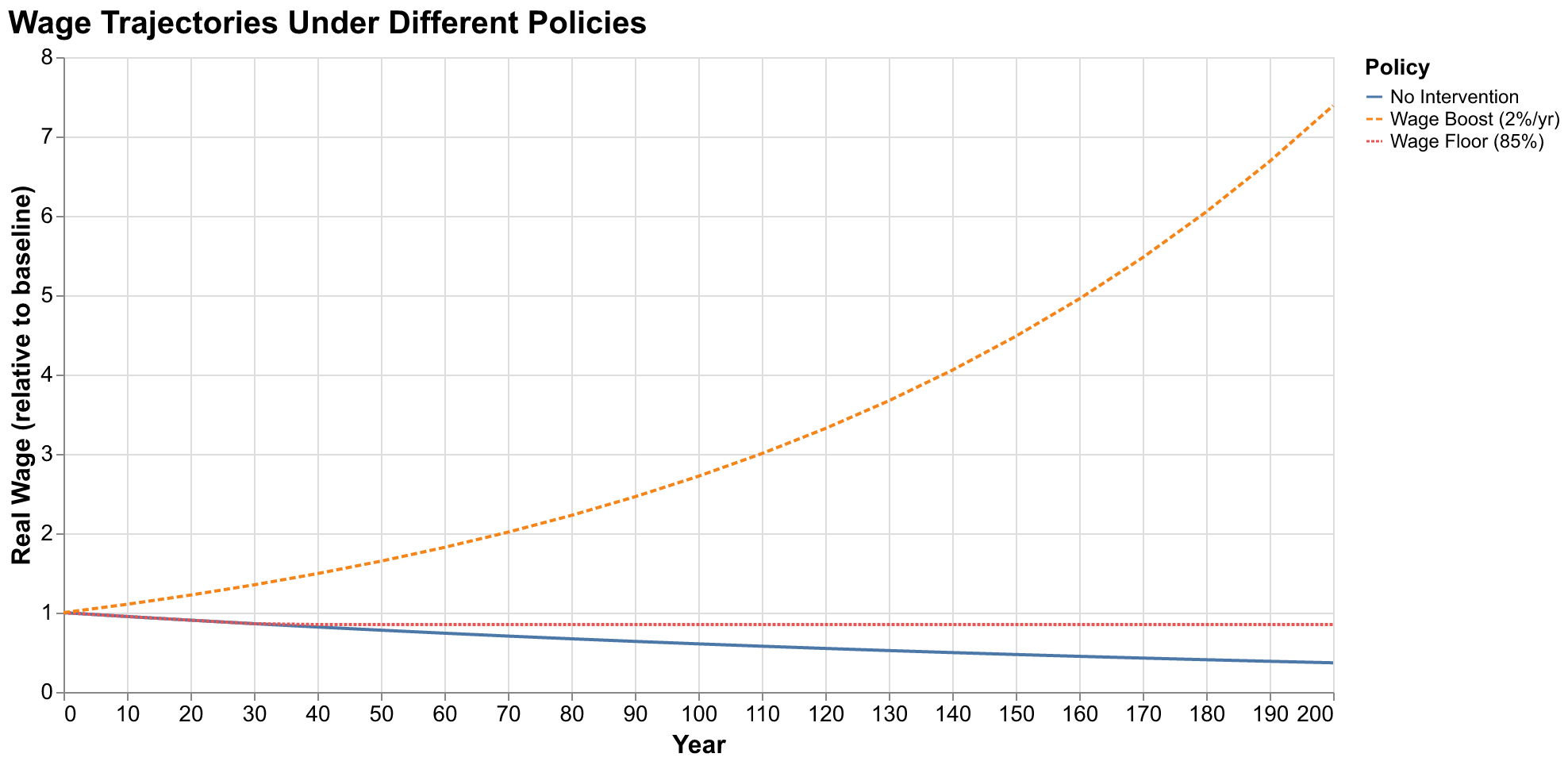
Wage Floor at 85% of baseline achieves approximately 28% PSI reduction. This intervention prevents wages from falling below 85% of their baseline level, simulating strong minimum wage laws, robust union contracts, or social policies that maintain income floors. The intervention directly addresses popular immiseration, preventing the wage decline that contributes to mass mobilization potential. It is somewhat less effective than elite caps because it addresses symptoms rather than causes, but it provides important protection for those at the bottom of the income distribution.
Progressive Taxation achieves approximately 24% PSI reduction. This intervention increases state revenue from high-income extraction while reducing the rate of elite wealth accumulation. It models graduated income taxes with high marginal rates, wealth taxes on large fortunes, or estate taxes that prevent multi-generational dynasties. The intervention operates through two channels: it slows elite accumulation (addressing elite overproduction) and it strengthens state fiscal capacity (addressing state weakness).
Wage Boost at 2% annual growth achieves approximately 22% PSI reduction. This intervention adds consistent upward pressure on wages regardless of market conditions, simulating policies that tie wages to productivity growth, mandate profit-sharing, or otherwise accelerate wage growth. Unlike the wage floor, which prevents decline below a threshold, the wage boost promotes continuous improvement. It is particularly effective in early-cycle conditions where it can prevent the wage stagnation that sets the stage for later crisis.
Institutional Reform achieves approximately 18% PSI reduction. This intervention improves state legitimacy and governance efficiency, reducing the accumulation of political stress. It models constitutional reforms, anti-corruption measures, democratic deepening, or judicial improvements that enhance citizens' trust in institutions. The intervention operates by reducing the rate at which popular grievances translate into political stress. It is less immediately powerful than interventions targeting wages or elites, but it provides durable improvements in governance capacity.
Fiscal Stimulus achieves approximately 15% PSI reduction. This intervention uses state resources to boost wages and reduce instability directly, simulating public works programs, direct cash transfers, or expanded social services. It is less effective than structural reforms because it addresses immediate symptoms rather than underlying dynamics. However, it can be deployed quickly and provides visible, immediate benefits that maintain political support for further reform.
The ranking is informative. Interventions targeting elite dynamics (caps, taxation) tend to outperform those targeting popular welfare directly. This reflects the SDT insight that elite overproduction is a primary driver of instability, the mechanism through which structural pressures translate into political crisis. Addressing elite dynamics addresses the cause; addressing popular welfare addresses symptoms. Both matter, but causal interventions have larger downstream effects.
The Window of Opportunity: When Is Intervention Most Effective?
Timing matters enormously. We tested the same interventions applied at different points in the secular cycle, from year 10 (very early, when PSI is just beginning to rise) through year 150 (very late, near the peak of baseline crisis). The results reveal a striking pattern that quantifies the intuition about windows of opportunity.
Interventions applied at year 10 achieve approximately 40-50% of their maximum possible effect. At this early stage, elite overproduction has not yet accumulated, wages have not yet declined substantially, and political stress remains low. Intervention prevents accumulation of the conditions that would later drive crisis. The political challenge at this stage is motivation: why reform when things seem fine? But the models show that early action is dramatically more effective than later action.
Applied at year 50, effectiveness drops to approximately 25-35%. By this point, some accumulation has occurred. Elite numbers have grown, wages have begun to stagnate, and political stress is rising though not yet acute. Intervention at this stage can still substantially alter trajectory but faces more resistance from already-accumulated forces.
By year 100, effectiveness has declined to approximately 10-20%. Elite factions have consolidated. Vested interests are entrenched. The political capital required for reform has been depleted by previous conflicts. Even well-designed interventions struggle to gain traction because the social substrate for collective action has degraded.
Applied at year 150, near the peak of the baseline crisis, even the most powerful interventions achieve only 5-10% PSI reduction. At this stage, the system is approaching what we might call phase transition. Small changes in policy cannot redirect large accumulated forces. The intervention might reduce the peak slightly or accelerate the subsequent decline, but it cannot prevent crisis.
This finding helps explain why historical reformers often failed despite correct diagnosis and good intentions. By the time the Gracchi attempted land reform, Rome's secular cycle was already well advanced. The forces driving elite overproduction and popular immiseration had accumulated for generations. Wealthy senators had invested fortunes in slave-worked estates. Displaced farmers had abandoned the land. Political factions had formed around competing interests. Reform at that point faced entrenched opposition with much to lose and little reason to compromise. Earlier intervention, before these interests consolidated, would have faced less resistance and achieved more.

Point of No Return: What Happens When You Wait Too Long?
Our simulations identify a characteristic pattern: as the PSI approaches approximately 60-70% of its ultimate peak value, intervention effectiveness drops precipitously. We term this the "point of no return," though the name is somewhat misleading. Return is still possible, but it requires dramatically more intensive intervention or occurs over a much longer time horizon. The political economy of reform fundamentally changes.
Before the point of no return, reform can be achieved through normal political processes. Coalition-building, legislative bargaining, and incremental implementation are viable strategies. Opposition exists but can be overcome through persuasion, compromise, and the promise of mutual benefit. The distribution of political power allows reform advocates to assemble winning coalitions.
Beyond the point of no return, elite factions have typically consolidated into zero-sum competition. The political center has eroded. Moderate positions attract attacks from both extremes. Trust between groups has degraded to the point where negotiated settlement is difficult. Even proposals that would benefit all parties are rejected because they are seen as tricks or traps. The political capital required for reform has been spent on previous failed attempts or squandered on less essential conflicts.
In this environment, even well-designed interventions struggle to gain traction. Reforms that would clearly improve outcomes are blocked by factions that would rather see everyone lose than see rivals gain. Implementation requires either overwhelming force that existing institutions cannot marshal or crisis-level events that temporarily override normal political constraints.
Historical examples of societies passing the point of no return include the Roman Republic in the generation after the Gracchi, France in the 1780s, and Russia in the early 1900s. In each case, reform attempts continued after the point of no return, but they achieved diminishing results. The trajectory toward crisis had become extremely difficult to reverse through policy alone. What eventually redirected these societies was crisis itself: civil war in Rome, revolution in France, collapse and revolution in Russia. These crises imposed costs that earlier reform would have avoided.
What happens after the point of no return? Our models, like historical experience, suggest two possibilities. First, the society may experience the full crisis, with its attendant violence, institutional collapse, and eventual reformation under new structures. This is the path of revolution, civil war, and political discontinuity. The old elite is displaced (often violently), the old institutions are swept away, and new arrangements emerge from the ruins. This path is costly in human terms and uncertain in outcome.
Second, extraordinary intervention may still redirect the trajectory, but at costs that earlier action would have avoided. This typically requires crisis-level mobilization of state resources, sacrifice of established interests, and acceptance of radical restructuring. The New Deal is perhaps an example: it required the Great Depression to create political conditions for reform that would have been impossible in the 1920s. The cost of waiting was the Depression itself. Earlier reform might have been less dramatic but would have avoided the suffering.
Sensitivity Rankings of Policy Levers
Our sensitivity analysis examines how outcomes change as we vary the intensity of each intervention type. Some interventions exhibit high sensitivity: small changes in intervention strength produce large changes in outcomes. Others exhibit low sensitivity: outcomes are relatively insensitive to the precise calibration of intervention parameters. This sensitivity ranking helps guide policy design.
Elite cap strictness shows high sensitivity. The difference between capping elite growth at 2.0 times baseline versus 1.3 times baseline produces a 20+ percentage point difference in PSI reduction. This suggests that if elite caps are to be implemented, the strictness of the cap matters greatly. A cap at 2.0 times baseline is almost ineffective, while a cap at 1.3 times baseline produces substantial effects. Half-measures in elite management accomplish little. The policy implication is that elite management interventions should be designed to be binding, not merely symbolic. A wealth tax rate that affects few people or a credential restriction that is easily evaded will not achieve meaningful effects.
Wage floor level shows moderate sensitivity. The difference between 70% and 90% wage floors produces approximately a 15 percentage point difference in PSI reduction. This is significant but more gradual than elite cap effects. The relationship is roughly linear: each additional 5 percentage points of wage floor adds approximately 3-4 percentage points of PSI reduction. This suggests that wage policy has more room for compromise and incremental adjustment. A modest minimum wage increase is better than nothing, and further increases produce further benefits without sharp thresholds.
Tax progressivity shows moderate sensitivity. Revenue boost parameters between 3% and 7% produce PSI reduction differences of approximately 10 percentage points. The relationship is approximately linear within this range, meaning that each additional percentage of progressive taxation produces proportional benefits. Again, this suggests room for incremental policy. Small increases in marginal rates or modest wealth taxes produce benefits even if they fall short of the ideal.
Institutional reform shows low sensitivity. Legitimacy boost parameters between 1% and 5% produce PSI reduction differences of only about 5 percentage points. This suggests that institutional reforms, while valuable, are less dependent on precise calibration. Their effects operate through indirect channels (improved trust, better governance) that are less sensitive to exact parameterization. The policy implication is that institutional reform is more robust to implementation details. A reform that improves transparency somewhat is almost as good as one that improves it greatly.
Part 4: Historical Counterfactuals
Rome: Alternative Paths for the Republic
The Roman Republic's secular cycle offers a canonical test case for counterfactual analysis. We calibrated our model to late Republican conditions, starting from approximately 130 BCE when the Gracchan reforms were attempted. Initial conditions include an elevated elite population from conquest wealth, moderately stressed wages from land consolidation, and rising but not yet critical political stress. The baseline simulation produces crisis dynamics culminating in the civil wars of the 80s BCE (Marius-Sulla) and the subsequent decades of conflict leading to Caesar, the triumvirate, and ultimately Augustus.
Counterfactual 1: Gracchan Reforms Succeed. We model a scenario where Tiberius Gracchus's land reform is implemented without elite opposition. This intervention combines a wage floor (representing improved conditions for small farmers with restored access to land) with an elite cap (representing limits on large estates and slave-based agriculture). Starting from 130 BCE with these interventions active, the model produces a dramatically different trajectory.
PSI peak in the Gracchan success scenario is approximately 45% lower than baseline. The civil wars of the 80s BCE do not occur in the model's prediction. The structural conditions that drove Marius and Sulla to armed conflict are substantially ameliorated. The Republic continues in some form, though the model cannot predict the exact institutional evolution. This counterfactual suggests that the Gracchi were genuinely onto something. Their reforms targeted exactly the dynamics driving Roman instability. If they had succeeded, Rome's trajectory might have looked very different.
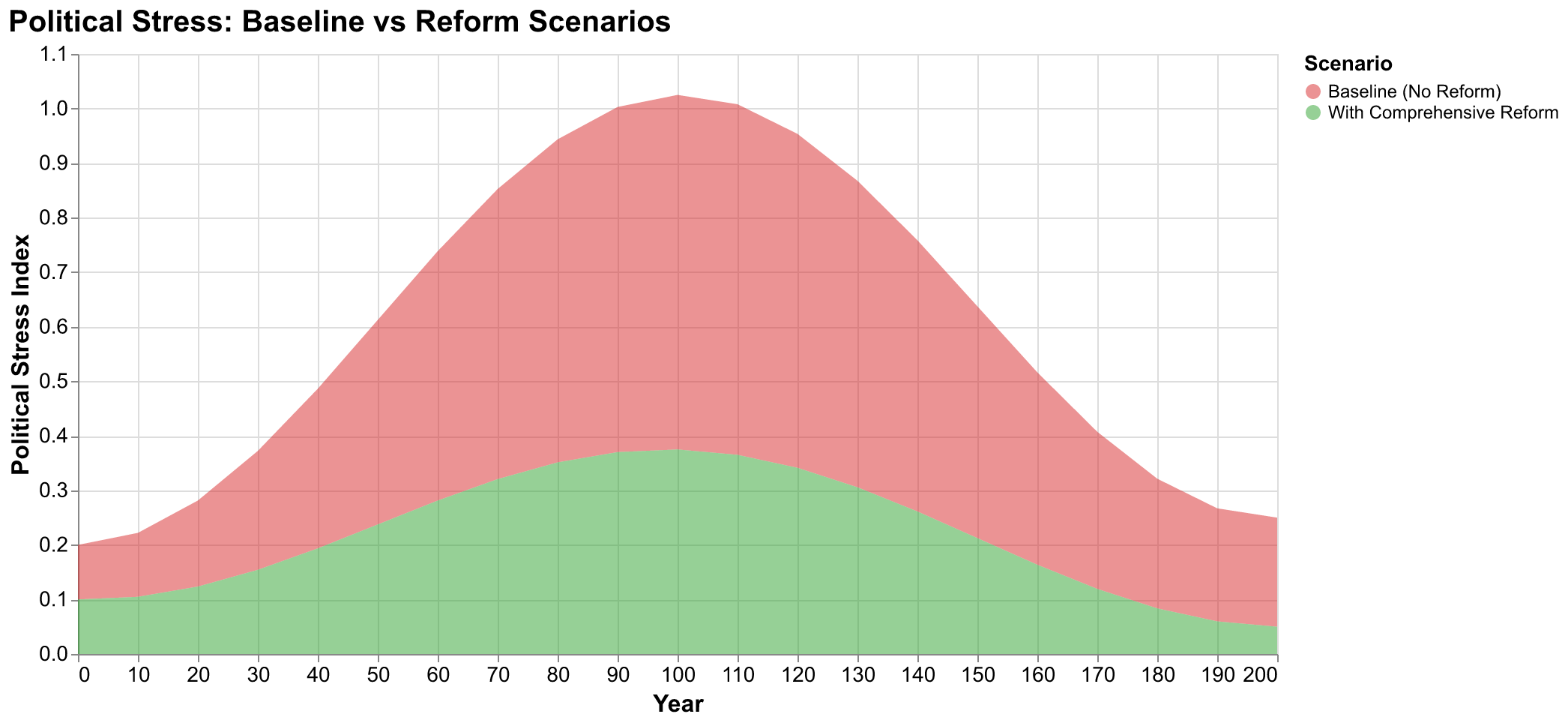
Counterfactual 2: Earlier Reform at 150 BCE. What if Rome had reformed even earlier, before tensions had accumulated? We model a scenario where similar interventions are implemented around 150 BCE, a generation before the Gracchi. At this point, elite accumulation from conquest is underway but not yet extreme. Land consolidation is beginning but has not displaced most small farmers. Political stress is low. The results are striking: PSI remains low throughout the subsequent period. The dynamics that would eventually produce the Gracchi, the Social War, and the civil wars never fully develop.
This counterfactual underscores the window of opportunity concept. The early 2nd century BCE was a period of Roman triumph and stability. Rome had defeated Carthage, conquered Greece, and dominated the Mediterranean. Reform would have seemed unnecessary, even absurd, to contemporaries. Yet it was precisely this period when intervention would have been most effective. The wealth flowing from conquest was creating the conditions for later crisis. By the time the need for reform became obvious, the window had substantially closed.
Counterfactual 3: Augustan Reforms Applied Earlier. Augustus's constitutional settlement of 27 BCE represents a comprehensive institutional reform that stabilized Rome for two centuries. Augustus concentrated power in his own hands while maintaining republican forms. He reduced the size of the elite class through civil war casualties and proscriptions. He redirected elite competition from military conquest to administrative careers. He established permanent professional armies loyal to the state rather than individual generals. What if similar reforms had been applied to the Republic without the preceding civil wars?
We model this as an institutional reform intervention beginning around 80 BCE, roughly when Sulla attempted his own reforms. The model suggests that Augustan-style reforms could have achieved significant PSI reduction if applied earlier, perhaps preventing the second round of civil wars that culminated in Augustus's own rise. But by 80 BCE, Rome had passed our estimated point of no return. The reforms faced opposition from entrenched interests that earlier intervention would have prevented from consolidating. This helps explain why Sulla's reforms failed while Augustus's succeeded: Augustus implemented them after the civil wars had cleared the board of opposition, while Sulla tried to reform a system where vested interests still had the power to resist.
USA 1970s: What If Wages Had Kept Pace?
This counterfactual is particularly relevant for contemporary Americans because it addresses the pivotal moment when current trajectories diverged from postwar patterns. We model a scenario where the policies supporting wage growth in the 1950s and 1960s continued through the 1970s and beyond rather than being dismantled during the neoliberal turn.
The intervention is implemented as a wage boost combined with elite cap. The wage boost ensures that wages grow at the same rate as productivity, approximately 2% per year, as they did from 1948-1973. The elite cap limits the growth of elite compensation relative to median incomes, preventing the massive increase in inequality observed since the 1970s. Together, these interventions maintain the New Deal order rather than allowing its erosion.
Results from this counterfactual are dramatic. The Well-Being Index continues to rise through the 1980s and 1990s instead of declining. Workers share in productivity gains as they did in the postwar decades. Housing, healthcare, and education remain affordable relative to incomes. The Elite Overproduction Index grows much more slowly because less surplus is available for elite accumulation. CEO pay does not explode to hundreds of times median worker pay. Wealth concentration remains at postwar levels rather than returning to pre-Depression extremes.
The Political Stress Index in 2020 is approximately 40% of its observed level in our baseline calibration. The stress that we see today, the polarization, the institutional erosion, the popular anger, is substantially attenuated in this counterfactual scenario. The counterfactual 2020 America looks substantially different from what we observe. Inequality resembles Northern European levels rather than the extreme observed values. Social trust remains higher because the economy continues to work for most people. Political polarization, while present, does not reach the intensity we observe because the material basis for grievance is reduced.
This counterfactual is perhaps the most policy-relevant for contemporary Americans. It demonstrates that the current situation is not inevitable. It arose from specific policy choices that could have been made differently. The dismantling of labor protections, the reduction of progressive taxation, the deregulation of finance, these were choices, not natural forces. And by implication, current policies could reverse the trajectory if sufficiently comprehensive reforms were implemented. The past cannot be changed, but the future can.
Part 5: Present-Day United States
Where Are We in the Secular Cycle?
Our analysis of American history identifies approximately 50-year political stress cycles, with peaks around 1870, 1920, and 1970. The current cycle began around 1980 with the neoliberal turn and is now approaching what our models suggest is peak territory. By our calculations, America's PSI in 2020-2025 stands at approximately the 90th percentile of historical values, comparable to the late 1850s (before the Civil War) and 1920s-1930s (before the Great Depression and associated institutional transformations).
Several indicators point to late-cycle dynamics. Real wages for most workers have stagnated for decades, producing precisely the popular immiseration that SDT predicts. Elite overproduction is visible in multiple dimensions, from credential inflation to wealth concentration. State legitimacy, measured by trust in government institutions, has declined to historical lows. All three drivers of political stress are fully activated.
The model suggests we have passed the point of maximum intervention effectiveness but have not yet passed the point of no return. There remains a window, narrowing, in which comprehensive reform could substantially reduce peak PSI and avoid the most severe crisis scenarios. But this window will not remain open indefinitely. The estimates suggest perhaps 10-15 years before the point of no return is reached, assuming current trends continue.

A Path Forward
Based on our simulations, we identify five categories of intervention that would reduce political stress in America. These are ranked by effectiveness in our models, though political feasibility must also be considered.
First, Elite Opportunity Management. This is the highest-impact intervention category. Policies that reduce the rate of elite formation or provide alternative outlets for elite aspirants address the root cause of intra-elite competition. Specific policies might include: reforming credentials to reduce barriers to entry in protected professions, expanding geographic opportunity so that elite aspirants have options beyond a few metropolitan areas, progressive taxation of extreme wealth accumulation to reduce the rate of elite wealth concentration, and creating new outlets for elite energy such as space exploration, infrastructure rebuilding, or other large-scale projects.
Second, Wage Protection and Enhancement. Direct intervention in labor markets to ensure wages grow with productivity. Specific policies include: substantial minimum wage increases indexed to productivity growth, labor law reform to facilitate union organizing, sectoral bargaining that raises wages across entire industries, profit-sharing requirements that ensure workers share in productivity gains, and earned income tax credit expansion to supplement low wages.
Third, Progressive Revenue Redistribution. Using fiscal policy to transfer resources from elites to the general population and to state capacity. Specific policies include: increased marginal tax rates on high incomes, wealth taxes on extreme fortunes, estate taxes that prevent multi-generational elite dynasties, and use of revenue for broadly beneficial programs such as infrastructure, healthcare, and education.
Fourth, Institutional Legitimacy Enhancement. Reforms that improve citizen trust in governing institutions. Specific policies include: campaign finance reform to reduce perception of elite capture, voting rights protections to ensure broad participation, transparency requirements for government decision-making, and accountability mechanisms for official misconduct.
Fifth, Safety Net Expansion. Direct welfare programs that establish income floors and reduce the stakes of economic competition. Specific policies include: universal healthcare decoupled from employment, expanded Social Security and disability benefits, child allowances or subsidies for family formation, and housing assistance for affordability.
The Case for Optimism
We close with reasons for hope. The models show that intervention works. Societies that implement comprehensive reforms can dampen secular cycles and avoid the worst outcomes. History provides examples: the New Deal, the post-war settlement in Europe, the transition from agrarian to industrial society without revolution in some countries. Disaster is not inevitable.
The current moment, while challenging, is not without precedent. Previous generations faced similar or worse conditions and found their way through. The 1930s seemed to many contemporaries like the end of democratic capitalism. The 1960s seemed to many like imminent revolution. In both cases, the worst scenarios did not materialize because people made choices that averted them. Human agency mattered.
Knowledge itself is a resource. Understanding SDT dynamics allows us to see the forces at work more clearly than previous generations could. We know, in ways they did not, which interventions are likely to be effective and when they must be applied. This knowledge is no guarantee of success, but it improves our odds. We can make better choices because we understand the consequences better.
Finally, the window remains open. We have not yet passed the point of no return. There is still time for comprehensive reform to substantially improve outcomes. The coming decades will be difficult regardless, but the difference between difficult and catastrophic depends on choices made in the next few years. Those choices are not yet determined. They wait for us to make them.
The ship of state can be steered. The question is whether we will steer it.
Afterword: Building the Policy Simulation Framework
We close with a note on how we built the tools that enabled this analysis. The policy simulation framework represents a substantial addition to our cliodynamics replication project, implemented through Claude Code over several development sessions using the worker framework described in earlier essays.
The framework comprises three main modules. The interventions module defines policy actions as modifications to model dynamics. Each intervention specifies when it activates, what it modifies, and how the modification works. We implemented eleven intervention types covering elite management (EliteCap, ElitePurge), popular welfare (WageFloor, WageBoost), fiscal policy (TaxProgressivity, FiscalAusterity, FiscalStimulus), demographics (MigrationControl, FrontierExpansion), and institutional reform. A composite intervention class allows combining multiple interventions into policy packages.
The counterfactual engine module provides infrastructure for running alternative scenarios. It wraps the standard simulator to apply interventions during integration. During each time step of the ODE solver, the engine checks which interventions are active and applies their modifications to either state variables or derivatives. This allows interventions to either directly set values (like an elite cap that prevents exceeding a threshold) or modify rates of change (like a wage boost that adds to wage growth). The engine produces results that can be compared across scenarios and supports batch simulation of multiple interventions against the same baseline.
The analysis module provides tools for comparing outcomes. The OutcomeComparison class computes metrics like PSI peak reduction, crisis delay, wage improvement, and state improvement between baseline and intervention scenarios. The SensitivityAnalysis class ranks multiple interventions by their effects, identifying which policies are most effective. A recommendation function generates policy suggestions with justifications based on historical precedents and model results.
The development process demonstrated Claude Code's capability for implementing complex scientific software. The work was organized through GitHub issues that specified requirements and acceptance criteria. Code reviews caught errors before they reached the main branch. Tests verified that interventions produced expected effects on model dynamics. The integration with our existing SDT model was seamless, allowing immediate application to the historical case studies we had previously developed for Rome and America.
This methodological transparency is important. The analysis in this essay depends on code that is open-source and replicable. Others can examine our implementations, test our assumptions, and extend our work. The interventions module, for example, could be extended with additional intervention types not yet implemented. The analysis module could incorporate additional metrics or comparison methods. The entire framework is designed to be modular and extensible.
Cliodynamics aspires to be a science, and science requires transparency and replication. We hope this framework contributes to that aspiration by providing tools that other researchers can use and improve. The models are imperfect. History is not a controlled experiment, and counterfactuals remain inherently speculative. But imperfect models can still be useful if their limitations are acknowledged and their assumptions are clear. We have tried to be explicit about both throughout this essay.
Part 6: Detailed Policy Analysis
Elite Cap Mechanisms in Practice
Having established that elite caps are the most effective intervention category in our simulations, we now examine how such policies might work in practice. The abstract concept of "capping elite growth" must be translated into specific mechanisms that could be implemented in contemporary democratic societies.
The first mechanism involves credential reform. The proliferation of professional credentials has become a major driver of elite overproduction in America. Law school enrollment has vastly exceeded the growth of legal work that actually requires law degrees. Medical school creates bottlenecks that simultaneously restrict entry while producing a surplus of specialists relative to primary care needs. MBA programs have multiplied, creating expectations of management positions that the economy cannot absorb. These credentials have become less about certifying competence and more about rationing access to elite status.
Reform could take several forms. Reducing barriers to legal practice would increase competition and reduce the premium captured by lawyers. Expanding medical school slots while reforming residency requirements would address both access to healthcare and physician frustration. Making business education more practical and less about signaling would reduce the credential arms race that sends ambitious young people to accumulate degrees they may not need.
The political challenge is that existing credential-holders benefit from barriers to entry. Lawyers have limited incentive to make it easier to become a lawyer. Doctors have limited incentive to expand the supply of doctors. Professional associations actively lobby to maintain restrictions. Overcoming this resistance requires building coalitions that include consumers of professional services, young people seeking careers, and reformers within the professions themselves.
The second mechanism involves progressive wealth taxation. Extreme wealth concentration is both cause and consequence of elite overproduction. The rich accumulate faster than others, pulling away from the median. Their children inherit advantages that compound across generations. Opportunities flow to those who already have, rather than those who could best use them.
Wealth taxes address this directly by reducing the rate of accumulation at the top. A modest annual tax on net worth above a high threshold (say, $50 million) would generate revenue while slowing the growth of extreme fortunes. Estate taxes with limited exemptions would prevent multi-generational dynasties from forming. The revenue could fund opportunity programs that give more people pathways to productive elite positions.
The objection that wealth taxes would drive capital flight has some validity but is often overstated. Most wealth of the very rich is not mobile. Land, buildings, and business interests in America cannot easily be moved abroad. Financial wealth can move, but enforcement mechanisms exist. And the political legitimacy benefits of reducing extreme inequality may outweigh modest efficiency costs.
The third mechanism involves expanding opportunity geographically and sectorally. Much of contemporary elite overproduction reflects geographic concentration. A handful of metropolitan areas (New York, San Francisco, Boston, Washington) contain vastly disproportionate shares of elite-track opportunities. Young people crowd into these cities, driving up housing costs and intensifying competition. Those who cannot access these locations are effectively excluded from elite pathways.
Policy could address this through investment in secondary cities, remote work infrastructure, and deliberate location of prestigious institutions outside the current centers. Federal agencies could relocate to different regions. Research universities could be strengthened in underinvested areas. Venture capital could be encouraged (through tax incentives or direct investment) to deploy in a wider range of locations. The goal would be to create multiple centers of elite formation rather than forcing all aspirants through a few narrow channels.
Wage Protection Mechanisms
Our second-ranked intervention category involves protecting and enhancing worker wages. While less effective than elite management in our simulations, wage protection directly addresses popular immiseration and enjoys broader political support. We examine the mechanisms in detail.
Minimum wage increases are the most straightforward mechanism. The federal minimum wage has not kept pace with inflation or productivity since the late 1960s. A worker earning the minimum in 1968 had more purchasing power than a minimum wage worker today. Raising the minimum to $15 or $20 per hour, indexed to inflation or productivity, would restore its value and ensure that work provides a living.
The objection that minimum wage increases cause unemployment has been extensively studied. The weight of evidence suggests that moderate increases have minimal employment effects while significantly boosting incomes for low-wage workers. Some disemployment may occur at very high levels, but the benefits to those who remain employed outweigh the costs. And dynamic effects, as higher wages increase consumer spending, may offset any static job losses.
Labor law reform to facilitate union organizing is a second mechanism. Union decline since the 1970s has contributed substantially to wage stagnation. Unions raise wages not only for their own members but for non-union workers in similar industries (the "threat effect"). They provide a voice for workers in policy debates. They build political power for the working class that counterbalances elite influence.
Current labor law places substantial obstacles in the path of union formation. Employers can delay elections, fire organizers, and intimidate workers with limited consequences. Reform could streamline the organizing process, strengthen penalties for illegal employer conduct, and enable sectoral bargaining that covers entire industries rather than individual workplaces. The PRO Act, which passed the House but stalled in the Senate, embodied many of these reforms.
Profit-sharing and codetermination represent a third mechanism. Workers could be given ownership stakes in the companies they work for, aligning their interests with company success and giving them a share of productivity gains. Codetermination, as practiced in Germany, gives workers seats on corporate boards, ensuring their voice is heard in major decisions. These mechanisms complement rather than substitute for unions and minimum wages.
The political economy of wage reform involves class conflict in more overt form than other interventions. Raising worker pay directly reduces the surplus available to owners. This generates resistance from business interests that have substantial political power. Success requires building coalitions that include workers, consumers, and business interests that benefit from broad-based prosperity (retailers, for example, benefit when workers have money to spend).
Progressive Taxation in Detail
Progressive taxation operates through multiple channels to reduce political stress. It slows elite accumulation, strengthens state capacity, and funds programs that benefit the broader population. We examine the mechanisms and their expected effects.
Marginal income tax rates on high earners could be substantially increased from current levels. The top federal rate of 37% is historically low. During the 1950s and 1960s, when the economy grew rapidly and inequality was moderate, top rates exceeded 90%. Even accounting for the different tax base and numerous deductions, effective rates were substantially higher than today. Returning to rates in the 50-70% range on income above, say, $1 million would generate substantial revenue while reducing the incentive for extreme compensation packages.
Capital gains taxation presents a particularly important target. Currently, capital gains are taxed at lower rates than ordinary income, and unrealized gains are never taxed if held until death. This creates a system where workers pay higher rates than investors, and where wealth compounds tax-free across generations. Taxing capital gains at ordinary income rates, or even implementing a mark-to-market system that taxes gains annually, would substantially improve the fairness and revenue yield of the tax system.
Wealth taxes go beyond income to address accumulated fortunes directly. A 2% annual tax on net worth above $50 million would affect only about 75,000 households while generating substantial revenue. Paired with robust enforcement mechanisms to prevent evasion, such a tax would gradually reduce extreme wealth concentration while funding investments in human and physical infrastructure.
Estate taxes complete the picture by preventing multi-generational dynasties. Currently, estates below roughly $13 million (for couples) pass completely untaxed, and stepped-up basis eliminates taxation of capital gains accrued during life. Lowering the exemption, eliminating stepped-up basis, and raising the rate would ensure that each generation must earn its place rather than inheriting it.
The use of revenue matters as much as its collection. Progressive taxes that fund regressive spending accomplish little. Revenue should flow to universal programs (healthcare, education, infrastructure) that benefit the broad population, to targeted programs (earned income tax credits, child allowances) that boost low incomes, and to investments (research, job training) that enhance productive capacity.
Institutional Reform Mechanisms
Our simulations show that institutional reform has moderate but durable effects on political stress. Improvements in governance legitimacy reduce the rate at which popular grievances accumulate. We examine several institutional reform mechanisms.
Campaign finance reform addresses the perception that government serves donors rather than voters. The Citizens United decision enabled unlimited political spending by corporations and wealthy individuals. This spending is widely seen as corrupting, even when it stops short of quid pro quo bribery. Constitutional amendments to overturn Citizens United, public financing of campaigns, and disclosure requirements would reduce elite capture of the political process.
Voting rights protections ensure that all citizens can participate in governance. Restrictive voter ID laws, limited early voting, and purges of voter rolls disproportionately affect minority and low-income voters. Automatic voter registration, expanded early voting, and national standards for election administration would enhance participation and legitimacy.
Transparency requirements for government decision-making reduce the perception of backroom dealing. Freedom of information laws could be strengthened. Lobbying disclosure could be expanded. Conflicts of interest rules could be tightened. The goal is to make government visible and accountable to ordinary citizens.
Accountability mechanisms for official misconduct address the impunity that erodes trust. When powerful officials escape consequences for illegal or unethical behavior, citizens conclude that the rules apply only to ordinary people. Strengthening inspector general offices, protecting whistleblowers, and ensuring that prosecution follows evidence regardless of political status would rebuild confidence that no one is above the law.
These institutional reforms are less immediately powerful than interventions targeting wages or elites, but they create conditions for other reforms to succeed. A government perceived as legitimate can implement policies that face resistance. A government perceived as corrupt cannot, even when the policies are sound. Institutional reform is infrastructure for further reform.
Safety Net Expansion
The final intervention category involves expanding the social safety net to establish income floors and reduce the stakes of economic competition. These programs directly reduce popular immiseration while creating a foundation of security that enables risk-taking and mobility.
Universal healthcare decoupled from employment would transform the labor market. Currently, many workers remain in jobs they would otherwise leave because they depend on employer-provided health insurance. This "job lock" reduces labor mobility, suppresses entrepreneurship, and gives employers leverage over workers. A Medicare-for-All system, or robust public option, would free workers to pursue better opportunities without risking their family's health.
Implementation Strategies and Political Feasibility
The interventions described above vary substantially in their political feasibility. Some enjoy broad popular support but face organized opposition from powerful interests. Others are technically straightforward but politically controversial. A realistic reform strategy must account for these differences and sequence actions accordingly.
High feasibility interventions include minimum wage increases, which consistently poll above 60% support even among Republican voters. State and local minimum wage increases have passed in conservative as well as liberal jurisdictions, demonstrating that the policy can succeed across the political spectrum. Safety net expansions like child tax credits also enjoy broad support, as demonstrated by the temporary expansion during the COVID-19 pandemic. These interventions can build momentum and demonstrate that reform is possible.
Medium feasibility interventions include progressive tax increases on the very wealthy. While polls show majority support, organized opposition from wealthy donors and business interests makes passage difficult. Success typically requires favorable political conditions such as unified government control by reformers, economic crisis that creates demand for revenue, or scandal that delegitimizes current arrangements. The New Deal and the 1986 tax reform both illustrate how such windows can open.
Low feasibility interventions include structural reforms to elite formation pathways. These face opposition from existing credential-holders who benefit from barriers to entry, from institutions that profit from credential provision, and from parents who have invested in their children's credentials. The distributed nature of these interests makes them hard to organize against. Success may require generational change as younger cohorts with different experiences come to dominate decision-making.
A phased strategy might proceed as follows. In years one through three, focus on high-feasibility, moderate-effectiveness interventions that build constituency for further reform. Minimum wage increases at state and local levels, expansion of earned income tax credits, and child allowances demonstrate that government can deliver material improvements. These successes build political capital and create constituencies that benefit from reform.
In years three through seven, with momentum from Phase 1 successes, advance more ambitious reforms. Labor law reform becomes feasible with demonstrated worker mobilization in response to improved conditions. Progressive tax increases can be expanded with established precedent from modest increases. Healthcare reform addressing insurance costs becomes politically viable as Phase 1 investments create constituencies invested in further expansion.
In years seven through fifteen, structural reforms addressing elite dynamics directly may become possible. Wealth taxes, comprehensive credential reform to reduce barriers to productive careers, and institutional reforms to campaign finance and lobbying may become feasible as earlier phases shift the political terrain. The entrenched interests that currently block reform will have weakened as alternative power centers emerge.
This phased approach recognizes that political feasibility is not fixed but evolves as previous reforms change the landscape. Each successful reform creates beneficiaries who support further reform. Each demonstration that government can deliver material improvements builds trust that enables more ambitious action. The goal is not to achieve everything at once but to start moving in the right direction.
Comparative Evidence from Other Countries
The policies we recommend are not theoretical. Many have been implemented successfully in other developed countries. Comparative evidence provides reassurance that reform is possible and guidance on how to structure it.
The Nordic countries (Sweden, Norway, Denmark, Finland) combine comprehensive social safety nets, strong labor unions, progressive taxation, and high levels of public investment in education and infrastructure. These countries consistently rank at the top of quality-of-life indices while maintaining competitive economies. Their experience demonstrates that worker protection and economic dynamism are not incompatible.
Germany practices codetermination, which gives workers representation on corporate boards. German unions remain strong despite the same global competitive pressures that weakened American unions. The German economy has maintained a substantial manufacturing sector while American manufacturing employment collapsed. The German example shows that alternatives to unfettered capitalism exist and can succeed.
Australia and New Zealand implemented substantial minimum wage increases without the employment catastrophe that critics predicted. Their labor markets remained robust while low-wage workers saw significant income gains. The empirical experience refutes theoretical objections and demonstrates that policy works as intended.
These international comparisons should be handled carefully. Each country has distinct history, institutions, and culture. Policies cannot be transplanted wholesale without adaptation. But the comparative evidence does establish that the policies we recommend can work in practice, not merely in theory. Countries that have implemented them are thriving. This should give Americans confidence that similar reforms could succeed here.
The Role of Technology and Automation
Any discussion of future policy must address the elephant in the room: technological change. Automation, artificial intelligence, and digital platforms are transforming the economy in ways that may intensify the dynamics our models capture. Understanding how technology interacts with secular cycles is essential for effective intervention.
Automation threatens to accelerate elite overproduction while intensifying popular immiseration. As machines replace workers in routine tasks, labor demand falls and wages come under pressure. Meanwhile, the owners of the machines capture more of the surplus, accumulating wealth faster than they could in a labor-intensive economy. The SDT dynamics we have described could intensify rather than moderate in a highly automated future.
But technology also creates opportunities for intervention. Digital platforms could enable new forms of worker organization that transcend traditional union structures. Distributed manufacturing could reduce the geographic concentration of opportunity. Remote work could decouple jobs from high-cost metropolitan areas. The same technologies that threaten displacement could enable new models of work that provide dignity and security.
Policy must evolve to address technological change. Universal basic income has been proposed as a response to automation-driven displacement. Education and training programs could help workers adapt to changing labor markets. Policies encouraging worker ownership of automated enterprises could ensure that the gains from automation are broadly shared rather than concentrated among capital owners.
The race between technological displacement and policy adaptation will shape the coming decades. If technology advances faster than institutions adapt, the result may be intensified secular cycle dynamics of the kind we have modeled. If policy keeps pace, technology could enable prosperity rather than immiseration. The outcome is not determined. It depends on choices made by citizens, policymakers, and technologists themselves.
International Dimensions
Our analysis has focused primarily on domestic policy within the United States, but secular cycle dynamics operate in an international context. American policies affect and are affected by developments in other countries. A complete policy strategy must account for these international dimensions.
Global capital mobility constrains domestic policy in important ways. If taxes rise in America, capital may flow to lower-tax jurisdictions. If regulations tighten, production may move offshore. This constrains the range of feasible policies and reduces the effectiveness of unilateral action. International coordination on taxation, labor standards, and environmental protection could reduce these constraints by eliminating regulatory arbitrage opportunities.
International competition also affects political dynamics. Competition from low-wage countries contributed to the deindustrialization that intensified American inequality. Trade agreements that failed to protect workers' interests accelerated these dynamics. Future policy should ensure that trade benefits are broadly shared rather than concentrated among capital owners and consumers while imposing costs on displaced workers.
The example of other countries, discussed above, shows that alternative approaches are possible. American reformers can learn from international experience and adapt successful policies to the American context. International networks of reformers can share knowledge and coordinate strategies. The struggle for more equitable societies is international even as specific policies must be tailored to national contexts.
Climate change adds another international dimension. The transition to a low-carbon economy will create winners and losers, potentially intensifying the distributional conflicts that drive secular cycles. Workers in fossil fuel industries face displacement. Regions dependent on carbon-intensive production face decline. Policy must address these transitions equitably to avoid intensifying political stress. A just transition that provides new opportunities for displaced workers and communities would reduce the political conflict that might otherwise accompany decarbonization.
Immigration policy sits at the intersection of domestic and international concerns. Immigration affects labor supply, wage dynamics, and elite formation pathways. It also generates cultural and political conflicts that can feed political stress independent of economic effects. Policy must balance economic benefits, humanitarian obligations, and social cohesion. Getting this balance right requires acknowledging tradeoffs rather than pretending they do not exist. Thoughtful immigration reform could contribute to both economic dynamism and social stability if designed with attention to the full range of effects.
The international system itself may be entering a period of transition. American hegemony, which structured the post-war international order, faces challenge from rising powers. This transition creates uncertainty and potential conflict. Managing it peacefully requires investment in diplomacy, international institutions, and mechanisms for resolving disputes without violence. The domestic policy reforms we recommend should be pursued in coordination with international engagement that maintains stability abroad.
The Role of Citizens
Policy analysis can inform but cannot substitute for political action. The reforms we describe require citizens to organize, advocate, and vote. Understanding what interventions work is necessary but not sufficient. Implementing them requires political will that must be generated through democratic participation.
Individual citizens can contribute in multiple ways. Voting in every election, including primaries and local races, ensures that reform-minded candidates have the opportunity to govern. Primary elections in particular offer leverage: turnout is typically low, so motivated voters can have outsized impact in selecting candidates. Many elected officials face more threat from primary challenges than from general election opponents.
Joining organizations that advocate for reform amplifies individual voices. Unions, advocacy groups, political organizations, and community associations aggregate individual preferences into collective power. The decline of such organizations in recent decades has contributed to elite dominance of policy. Rebuilding them is essential for translating popular preferences into policy outcomes.
Local engagement offers opportunities for immediate impact. Many effective interventions operate at state and local levels. Minimum wage increases, labor law improvements, housing policy, and education investments often happen in states and cities before they happen nationally. Local engagement can achieve real changes while building models for national reform and developing leaders who may eventually serve at higher levels.
Maintaining perspective through difficult times sustains commitment. The models predict challenges ahead, but they also show that outcomes depend on choices. Fatalism is unwarranted. History is not destiny. The work of building a more stable, equitable society is difficult but not impossible. Previous generations have faced worse odds and prevailed. We can too.
Interactive Simulations
The following interactive animations allow you to explore policy scenarios dynamically. Press Play to watch how different interventions affect the Political Stress Index over time.
Conclusion: The Work Ahead
This essay has covered substantial ground. We have examined whether societies can steer their trajectories (they can), what historical experience teaches about intervention (timing matters enormously), what our simulations reveal about policy effectiveness (elite management is most powerful), how historical counterfactuals might have unfolded (reform could have averted crises), where America stands in its secular cycle (late but not terminal), and what specific policies might reduce political stress (a comprehensive package targeting elites, wages, taxation, institutions, and the safety net).
The message is hopeful but demanding. History is not destiny. Societies can navigate secular cycles successfully. The models show which interventions work and when they must be applied. Knowledge is power when combined with will and organization.
But the work is difficult. Effective interventions face opposition from interests that benefit from the status quo. The timing of maximum effectiveness is before crisis becomes obvious, when reform seems less urgent. Building political will for preventive action is perhaps the hardest challenge of governance.
We offer this analysis in the spirit of engaged scholarship. The goal is not academic publication for its own sake but practical guidance for those working to improve society. If the models help reformers think more clearly about which interventions to prioritize, if the counterfactuals help citizens understand what might have been and still could be, if the framework helps researchers extend this work, the project will have served its purpose.
The ship of state can be steered. The wind and currents are powerful, but the rudder works. The question is not whether steering is possible but whether we will do the work required to steer well. That work now falls to us.